1,216 people
viewed recently

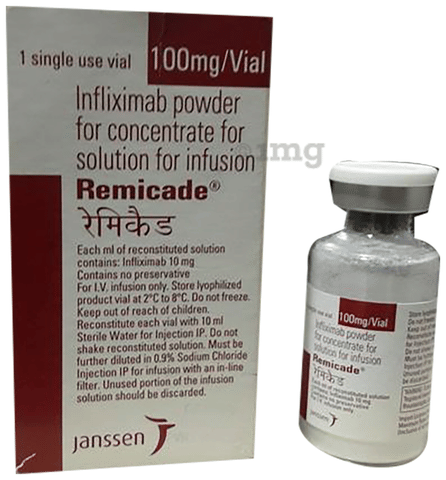
Remicade Injection
Infliximab (100mg)
 Genuine
Authenticity Assured
 Prescription
required
 Cold stored
Stored between 2-8°C
Remicade Injection is used for the treatment of various inflammatory conditions of the joints (rheumatoid arthritis, psoriatic arthritis, ankylosing spondylitis), skin (psoriasis), and bowel (ulcerative colitis, Crohn’s disease). It reduces inflammation in these conditions by blocking TNF alpha.
Written By Dr. Lipika Khurana, PGDHHM, BDS,
Reviewed By Dr. Sachin Gupta, MD Pharmacology, MBBS,
Last updated on 06 Oct 2026 | 01:03 AM (IST)
Written By Dr. Lipika Khurana, PGDHHM, BDS,
Reviewed By Dr. Sachin Gupta, MD Pharmacology, MBBS,
Last updated on 06 Oct 2026 | 01:03 AM (IST)
₹5884
/ month (3 months)
with EMI on select credit cards
All EMI Plans
Price without EMI
₹17310
MRP ₹19236
10% off
(Inclusive of applicable taxes)
1 Powder for Injection


Payment, Returns & Expiry

Online payment only
To meet compliance, this product is available with online payment. Thanks for your patience!

We don’t take this product back
Products such as this are non-returnable to make sure that the next person doesn’t get a used item

Product expires after Jan, 2028
Expiry date may vary by batch. All batches have a 3-month shelf life from the date of dispatch.
Price Info
MRP may vary by batch. Any additional charges, including packaging, handling, shipping or delivery charges, will be clearly disclosed before purchase.
Save more with additional offers

Get upto Rs.150 Cashback on minimum transaction of Rs.599/- with Mobikwik UPI (@ikwik).
Get upto Rs.150 Cashback on minimum transaction of Rs.599/- with Mobikwik UPI (@ikwik).


Get up to ₹75 cashback on a minimum order value (MOV) of ₹499 and above, valid once per customer.
Get up to ₹75 cashback on a minimum order value (MOV) of ₹499 and above, valid once per customer.
Get up to ₹75 cashback on a minimum order value (MOV) of ₹499 and above, valid once per customer.
Get up to ₹75 cashback on a minimum order value (MOV) of ₹499 and above, valid once per customer.
Get upto Rs.150 Cashback on minimum transaction of Rs.599/- with Mobikwik UPI (@ikwik).
Get upto Rs.150 Cashback on minimum transaction of Rs.599/- with Mobikwik UPI (@ikwik).
Get up to ₹75 cashback on a minimum order value (MOV) of ₹499 and above, valid once per customer.
Get up to ₹75 cashback on a minimum order value (MOV) of ₹499 and above, valid once per customer.
Get up to ₹75 cashback on a minimum order value (MOV) of ₹499 and above, valid once per customer.
Get up to ₹75 cashback on a minimum order value (MOV) of ₹499 and above, valid once per customer.

Assured cashback up to ₹300*. T&C Apply*
Assured cashback up to ₹300*. T&C Apply*
General Information
Contains
Infliximab (100mg)
Marketer
Janssen Pharmaceuticals
Storage
Store in a refrigerator (2 - 8°C). Do not freeze.
The content is shown in English



All substitutes for Remicade Injection
For information purposes only. Consult a doctor before taking any medicine.
Safety advice

Alcohol
CONSULT YOUR DOCTOR
It is not known whether it is safe to consume alcohol with Remicade Injection. Please consult your doctor.

Pregnancy
CONSULT YOUR DOCTOR
Remicade Injection is not recommended during pregnancy as there is positive evidence of fetal risk based on animal studies. However, it may still be prescribed by a doctor in situations where the benefits outweigh the risks.

Breast feeding
CAUTION
Remicade Injection should be used with caution during breastfeeding. Breastfeeding should be held until the treatment of the mother is completed and the drug is eliminated from the body.

Driving
CONSULT YOUR DOCTOR
It is not known whether Remicade Injection alters the ability to drive. Do not drive if you experience any symptoms that affect your ability to concentrate and react. Please consult your doctor.
Kidney
CONSULT YOUR DOCTOR
There is limited data available on the use of Remicade Injection in patients with kidney disease. Please consult your doctor.
Liver
CAUTION
Remicade Injection should be used with caution in patients with liver disease. Dose adjustment may be needed.

Related lab tests
References
- Furst DE, Ulrich RW, Varkey-Altamirano C. Nonsteroidal Anti-Inflammatory Drugs, Disease Modifying Antirheumatic Drugs, Nonopioids Analgesics, & Drugs Used in Gout. In: Katzung BG, Masters SB, Trevor AJ, editors. Basic and Clinical Pharmacology. 11th ed. New Delhi, India: Tata McGraw Hill Education Private Limited; 2009. pp. 633-34.
- Wallace JL, Sharkey KA. Pharmacotherapy of Inflammatory Bowel Disease. In: Brunton LL, Chabner BA, Knollmann BC, editors. Goodman & Gilman’s: The Pharmacological Basis of Therapeutics. 12th ed. New York, New York: McGraw-Hill Medical; 2011. p. 1359.
- Briggs GG, Freeman RK, editors. A Reference Guide to Fetal and Neonatal Risk: Drugs in Pregnancy and Lactation. 10th ed. Philadelphia, PA: Wolters Kluwer Health; 2015. pp. 712-13.
- Infliximab. Hoddesdon, Hertfordshire: Merck Sharp & Dohme Limited; 1999 [18 Oct. 2018]. [Accessed 23 Jan. 2019] (online) Available from:

Related products
Products related to Remicade Injection





100% genuine products

Safe & secure payments

No contact delivery
Fully sanitized facilities

Want to know more
We provide you with authentic, trustworthy and relevant information
Have issue with the content
Why we need a prescription?