







Glucarb 50 Tablet
Acarbose (50mg)
 Genuine
Authenticity Assured
 Prescription
required
Glucarb 50 Tablet is used to treat people with type 2 diabetes mellitus. It helps lower blood sugar levels after meals. It belongs to a group of medicines known as alpha-glucosidase inhibitors. This medicine is usually prescribed in combination with other diabetes medications.
Written By Dr. Lipika Khurana, PGDHHM, BDS,
Reviewed By Dr. Sachin Gupta, MD Pharmacology, MBBS,
Last updated on 05 Oct 2026 | 01:01 AM (IST)
Written By Dr. Lipika Khurana, PGDHHM, BDS,
Reviewed By Dr. Sachin Gupta, MD Pharmacology, MBBS,
Last updated on 05 Oct 2026 | 01:01 AM (IST)
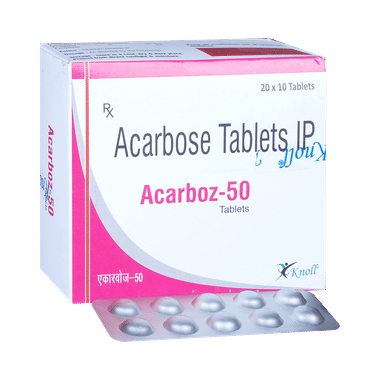
Available alternative from Top Brand
Sold out

Glucarb 50 Tablet
strip of 10 tablets
₹62.2

Same composition
Acarboz 50mg Tablet
strip of 10 tablets
by Knoll Pharmaceuticals Ltd
Get in 60 mins

₹84.6
₹7.19 per tablet
₹71.9
order for
₹1200
Save more with additional offers

Get upto Rs.150 Cashback on minimum transaction of Rs.599/- with Mobikwik UPI (@ikwik).
Get upto Rs.150 Cashback on minimum transaction of Rs.599/- with Mobikwik UPI (@ikwik).


Get up to ₹75 cashback on a minimum order value (MOV) of ₹499 and above, valid once per customer.
Get up to ₹75 cashback on a minimum order value (MOV) of ₹499 and above, valid once per customer.
Get up to ₹75 cashback on a minimum order value (MOV) of ₹499 and above, valid once per customer.
Get up to ₹75 cashback on a minimum order value (MOV) of ₹499 and above, valid once per customer.
Get upto Rs.150 Cashback on minimum transaction of Rs.599/- with Mobikwik UPI (@ikwik).
Get upto Rs.150 Cashback on minimum transaction of Rs.599/- with Mobikwik UPI (@ikwik).
Get up to ₹75 cashback on a minimum order value (MOV) of ₹499 and above, valid once per customer.
Get up to ₹75 cashback on a minimum order value (MOV) of ₹499 and above, valid once per customer.
Get up to ₹75 cashback on a minimum order value (MOV) of ₹499 and above, valid once per customer.
Get up to ₹75 cashback on a minimum order value (MOV) of ₹499 and above, valid once per customer.
Flat Rs.150 on a Min Transaction of Rs.1000.
Flat Rs.150 on a Min Transaction of Rs.1000.

Assured cashback up to ₹300*. T&C Apply*
Assured cashback up to ₹300*. T&C Apply*
General Information

The content is shown in English




All substitutes for Glucarb 50 Tablet
For information purposes only. Consult a doctor before taking any medicine.
Acarboz 50mg Tablet
by Knoll Pharmaceuticals Ltd
₹8.46/tablet
36% costlier
Glucobay 50 Tablet
by Bayer Zydus Pharma Pvt Ltd
₹15.9/tablet
156% costlier
Recarb 50 Tablet
by Bal Pharma Ltd
₹12.1/tablet
95% costlier
Acartex 50 Tablet
by Zeelab Pharmacy Pvt Ltd
₹6/tablet
4% cheaper
Acarva 50 Tablet
by Mi-Dose Pharma Pvt. Ltd.
₹13.8/tablet
122% costlier
Safety advice

Alcohol
CONSULT YOUR DOCTOR
It is not known whether it is safe to consume alcohol with Glucarb 50 Tablet. Please consult your doctor.

Pregnancy
SAFE IF PRESCRIBED
Glucarb 50 Tablet is generally considered safe to use during pregnancy. Animal studies do not indicate harmful effects. However, there are limited human studies.

Breast feeding
CONSULT YOUR DOCTOR
Information regarding the use of Glucarb 50 Tablet during breastfeeding is not available. Please consult your doctor.

Driving
CAUTION
Glucarb 50 Tablet may affect your driving ability if your blood sugar becomes too low or too high. Monitor your blood glucose and avoid driving if affected.
Kidney
CAUTION
Glucarb 50 Tablet should be used with caution in patients with severe kidney disease. Dose adjustment may be needed.
Liver
CAUTION
Glucarb 50 Tablet should be used with caution in patients with liver disease. Dose adjustment may be needed.
Use of Glucarb 50 Tablet is not recommended in patients with severe liver disease.
Use of Glucarb 50 Tablet is not recommended in patients with severe liver disease.

References
- Powers AC, D’Alessio D. Endocrine Pancreas and Pharmacotherapy of Diabetes Mellitus and Hypoglycemia. In: Brunton LL, Chabner BA, Knollmann BC, editors. Goodman & Gilman’s: The Pharmacological Basis of Therapeutics. New York, New York: McGraw-Hill Medical; 2011. p. 1264.
- Nolte MS. Pancreatic hormones and antidiabetic drugs. In: Katzung BG, Masters SB, Trevor AJ, editors. Basic and Clinical Pharmacology. 11th ed. New Delhi, India: Tata McGraw Hill Education Private Limited; 2009. pp. 743-44.
- Briggs GG, Freeman RK, editors. A Reference Guide to Fetal and Neonatal Risk: Drugs in Pregnancy and Lactation. 10th ed. Philadelphia, PA: Wolters Kluwer Health; 2015. pp. 6-7.
- Drugs and Lactation Database (LactMed) [Internet]. Bethesda (MD): National Library of Medicine (US); 2006. Acarbose. [Updated 2018 Oct 31]. [Accessed 18 Feb. 2020] (online) Available from:

- Acarbose [Product Monograph]. Ottawa, ON: Marcan Pharmaceuticals Inc.; 2019. [Accessed 20 Sept. 2021] (online) Available from:
- Acarbose [EMC Label]. Kenton, UK: Glenmark Pharmaceuticals Europe Limited; 2018. [Accessed 20 Sep. 2021]. (online) Available from:
- DailyMed. Acarbose [Drug Label Information]. [Accessed 20 Sept. 2021] (online) Available from:
- Acarbose. Wayne, NJ: Bayer HealthCare Pharmaceuticals Inc.; 2017. [Accessed 12 Jan. 2026] (online). Available from:
Related products
Products related to Glucarb 50 Tablet





100% genuine products

Safe & secure payments

No contact delivery

Fully sanitized facilities

Want to know more
We provide you with authentic, trustworthy and relevant information
Have issue with the content
Why we need a prescription?

