








Dibose 0.3 Tablet
Voglibose (0.3mg)
 Genuine
Authenticity Assured
 Prescription
required
Dibose 0.3 Tablet is a medicine used to treat type 2 diabetes mellitus. It helps control the high blood sugar levels in your body after each meal. It is used when other similar medicines along with a restricted diet, are unable to control abnormally high blood sugar levels.
Written By Dr. Syeda Aafia, MBA, BDS,
Reviewed By Dr. Rajeev Sharma, MBA, MBBS,
Last updated on 03 Sep 2026 | 01:02 AM (IST)
Written By Dr. Syeda Aafia, MBA, BDS,
Reviewed By Dr. Rajeev Sharma, MBA, MBBS,
Last updated on 03 Sep 2026 | 01:02 AM (IST)
Available alternative from Top Brand
Sold out
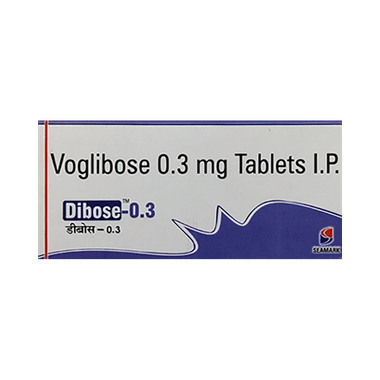
Dibose 0.3 Tablet
strip of 10 tablets
₹58.1

Same composition
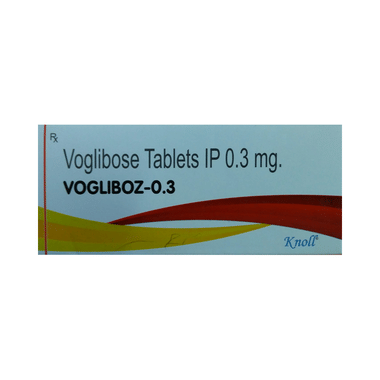
Vogliboz 0.3 Tablet
strip of 10 tablets
by Knoll Pharmaceuticals Ltd
Get in 60 mins

₹66.8
₹5.68 per tablet
₹56.8
order for
₹1200
Save more with additional offers

Get up to ₹75 cashback on a minimum order value (MOV) of ₹499 and above, valid once per customer.
Get up to ₹75 cashback on a minimum order value (MOV) of ₹499 and above, valid once per customer.

Get up to ₹75 cashback on a minimum order value (MOV) of ₹499 and above, valid once per customer.
Get up to ₹75 cashback on a minimum order value (MOV) of ₹499 and above, valid once per customer.
Flat Rs.150 on a Min Transaction of Rs.1000.
Flat Rs.150 on a Min Transaction of Rs.1000.
Get up to ₹75 cashback on a minimum order value (MOV) of ₹499 and above, valid once per customer.
Get up to ₹75 cashback on a minimum order value (MOV) of ₹499 and above, valid once per customer.
Get up to ₹75 cashback on a minimum order value (MOV) of ₹499 and above, valid once per customer.
Get up to ₹75 cashback on a minimum order value (MOV) of ₹499 and above, valid once per customer.
Flat Rs.150 on a Min Transaction of Rs.1000.
Flat Rs.150 on a Min Transaction of Rs.1000.

Assured cashback up to ₹300*. T&C Apply*
Assured cashback up to ₹300*. T&C Apply*
General Information

The content is shown in English


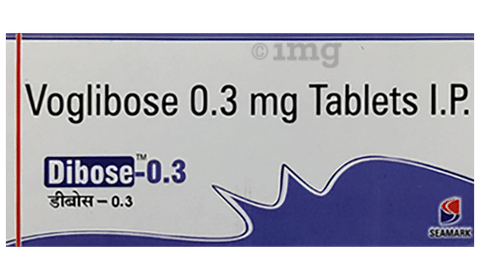

All substitutes for Dibose 0.3 Tablet
For information purposes only. Consult a doctor before taking any medicine.
Vogliboz 0.3 Tablet
by Knoll Pharmaceuticals Ltd
₹6.68/tablet
15% costlier
Volix 0.3mg Tablet
by Sun Pharmaceutical Industries Ltd
₹17.4/tablet
199% costlier
PPG 0.3 Tablet
by Abbott
₹12.1/tablet
108% costlier
Vobose 0.3 Tablet
by USV Private Limited
₹14/tablet
141% costlier
Voglimac 0.3 Tablet
by Macleods Pharmaceuticals Pvt Ltd
₹12.8/tablet
120% costlier
Safety advice

Alcohol
CONSULT YOUR DOCTOR
It is not known whether it is safe to consume alcohol with Dibose 0.3 Tablet. Please consult your doctor.

Pregnancy
CONSULT YOUR DOCTOR
The safety of Dibose 0.3 Tablet during pregnancy has not been established. There are no adequate and well-controlled studies in pregnant women, and animal data on reproductive toxicity are insufficient. Your doctor will weigh the benefits and any potential risks before prescribing.

Breast feeding
CONSULT YOUR DOCTOR
Information regarding the use of Dibose 0.3 Tablet during breastfeeding is not available. Please consult your doctor.

Driving
UNSAFE
Dibose 0.3 Tablet may decrease alertness, affect your vision, or make you feel sleepy and dizzy. Do not drive if these symptoms occur.
Kidney
CAUTION
Dibose 0.3 Tablet should be used with caution in patients with kidney disease. Dose adjustment may be needed.
Liver
CAUTION
Dibose 0.3 Tablet should be used with caution in patients with severe liver disease. Dose adjustment may be needed.

References
- Pattanaik SR, Shah P, Baker A, et al. Implications of Postprandial Hyperglycaemia and Role of Voglibose in Type 2 Diabetes Mellitus. Journal of Clinical and Diagnostic Research. 2018;12(4):OE08-OE12. [Accessed 21 Sept. 2021] (online) Available from:

- Dabhi AS, Bhatt NR, Shah MJ. Voglibose: An alpha glucosidase inhibitor. J Clin Diagn Res. 2013;7(12):3023-3027. [Accessed 21 Sept. 2021] (online) Available from:
- Dabhi AS, Bhatt NR, Shah MJ. Voglibose: An Alpha Glucosidase Inhibitor. J Clin Diagn Res. 2013;7(12):3023-7. [Accessed 12 Mar. 2019] (online) Available from:
- Voglibose [Package Insert]. Mumbai, Maharashtra: Alkem Laboratories Ltd. [Accessed 10 Nov. 2025] (online). Available from:
Related products
Products related to Dibose 0.3 Tablet





100% genuine products

Safe & secure payments

No contact delivery
Fully sanitized facilities

Want to know more
We provide you with authentic, trustworthy and relevant information
Have issue with the content
Why we need a prescription?

