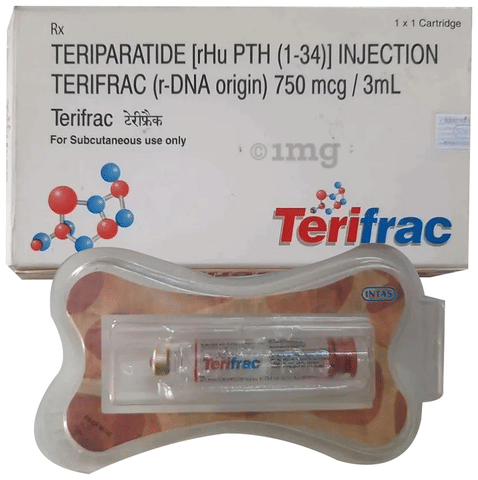
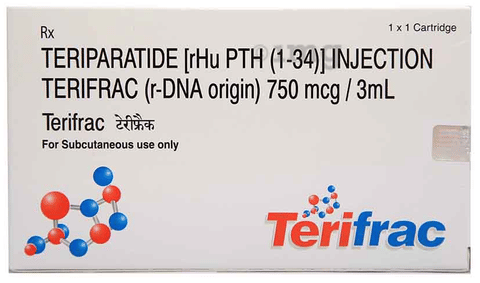
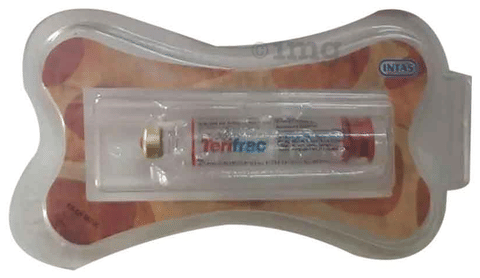


Terifrac Injection
Teriparatide (750mcg)
 Genuine
Authenticity Assured
 Prescription
required
 Cold stored
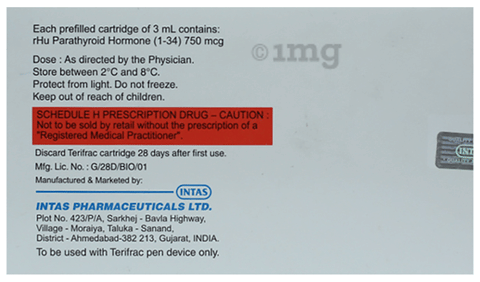
Stored between 2-8°C
Terifrac Injection is a man-made version of the parathyroid hormone used to treat men and postmenopausal women who have severe osteoporosis with a high risk of fractures. It works by stimulating new bone formation, which improves bone density and decreases the risk of spinal fractures.
Written By Dr. Swati Mishra, BDS,
Reviewed By Dr. Mekhala Chandra, MD, MBBS,
Last updated on 14 Sep 2026 | 01:03 AM (IST)
Written By Dr. Swati Mishra, BDS,
Reviewed By Dr. Mekhala Chandra, MD, MBBS,
Last updated on 14 Sep 2026 | 01:03 AM (IST)
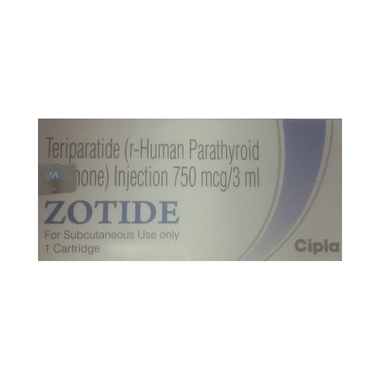
Available in pack size of 3 injections
Sold out
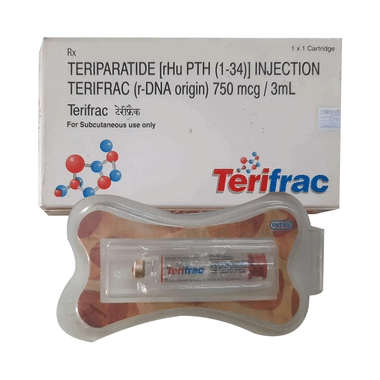
Terifrac Injection
cartridge of 1 Injection
₹5105

Different pack-size
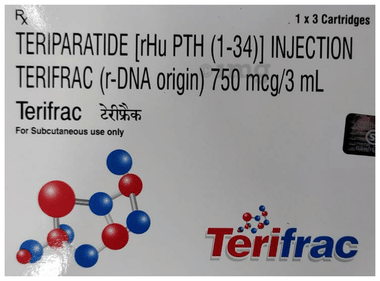
Terifrac Injection (3ml Each)
box of 3 injections
by Intas Pharmaceuticals Ltd
Get by Wed, 16 Sep
₹13308
₹4436.0 per unit
Save more with additional offers

10% cashback up to 200 on Min Transaction of Rs.1000, for first time users of Airtel Payments Bank.
10% cashback up to 200 on Min Transaction of Rs.1000, for first time users of Airtel Payments Bank.


Get up to ₹75 cashback on a minimum order value (MOV) of ₹499 and above, valid once per customer.
Get up to ₹75 cashback on a minimum order value (MOV) of ₹499 and above, valid once per customer.
Get up to ₹75 cashback on a minimum order value (MOV) of ₹499 and above, valid once per customer.
Get up to ₹75 cashback on a minimum order value (MOV) of ₹499 and above, valid once per customer.
10% cashback up to 200 on Min Transaction of Rs.1000, for first time users of Airtel Payments Bank.
10% cashback up to 200 on Min Transaction of Rs.1000, for first time users of Airtel Payments Bank.
Get up to ₹75 cashback on a minimum order value (MOV) of ₹499 and above, valid once per customer.
Get up to ₹75 cashback on a minimum order value (MOV) of ₹499 and above, valid once per customer.
Get up to ₹75 cashback on a minimum order value (MOV) of ₹499 and above, valid once per customer.
Get up to ₹75 cashback on a minimum order value (MOV) of ₹499 and above, valid once per customer.

Assured cashback up to ₹300*. T&C Apply*
Assured cashback up to ₹300*. T&C Apply*
General Information
Contains
Teriparatide (750mcg)
Marketer
Intas Pharmaceuticals Ltd
Storage
Store in a refrigerator (2 - 8°C). Do not freeze.
The content is shown in English



All substitutes for Terifrac Injection
For information purposes only. Consult a doctor before taking any medicine.
Tricium PTH Injection
by Corona Remedies Pvt Ltd
₹6176/injection
9% costlier
Zotide Injection
by Cipla Ltd
₹10088.55/injection
78% costlier
Bonmax PTH 750mcg Injection
by Zydus Cadila
₹7211.2/injection
27% costlier
Bonspark Injection
by Integrace Pvt Ltd
₹7031.25/injection
24% costlier
Rockbon PTH Injection
by Abbott
₹5814.38/injection
3% costlier
Safety advice

Alcohol
CONSULT YOUR DOCTOR
It is not known whether it is safe to consume alcohol with Terifrac Injection. Please consult your doctor.

Pregnancy
CONSULT YOUR DOCTOR
Terifrac Injection is not recommended during pregnancy as there is positive evidence of fetal risk based on animal studies. However, it may still be prescribed by a doctor in situations where the benefits outweigh the risks.

Breast feeding
CAUTION
Terifrac Injection should be used with caution during breastfeeding. Breastfeeding should be held until the treatment of the mother is completed and the drug is eliminated from the body.

Driving
UNSAFE
Terifrac Injection may decrease alertness, affect your vision, or make you feel sleepy and dizzy. Do not drive if these symptoms occur.

Kidney
CAUTION
Terifrac Injection should be used with caution in patients with severe kidney disease. Dose adjustment may be needed.
Use of Terifrac Injection is not recommended in patients with severe kidney disease.
Use of Terifrac Injection is not recommended in patients with severe kidney disease.

Liver
CONSULT YOUR DOCTOR
There is limited data available on the use of Terifrac Injection in patients with liver disease.

Related lab tests
References
- Bikle DD. Agents That Affects Bone Mineral Homoestasis. In: Katzung BG, Masters SB, Trevor AJ, editors. Basic and Clinical Pharmacology. 11th ed. New Delhi, India: Tata McGraw Hill Education Private Limited; 2009. p. 766.
- Friedman PA. Agents Affecting Mineral Ion Homeostasis and Bone Turnover. In: Brunton LL, Chabner BA, Knollmann BC, editors. Goodman & Gilman’s: The Pharmacological Basis of Therapeutics. 12th ed. New York, New York: McGraw-Hill Medical; 2011. p. 1300
- Teriparatide. Indianapolis, Indiana: Lilly France; 2008. [Accessed 02 Apr. 2019] (online) Available from:

- Central Drugs Standard Control Organisation (CDSCO). [Accessed 02 Apr. 2019] (online) Available from:
- Teriparatide injection [Prescribing Information]. Indianapolis, IN: Lilly USA, LLC; 2024. [Accessed 01 Apr. 2025] (online) Available from:
Related products
Products related to Terifrac Injection




Related ayurvedic ingredients


100% genuine products

Safe & secure payments

No contact delivery

Fully sanitized facilities

Want to know more
We provide you with authentic, trustworthy and relevant information
Have issue with the content
Why we need a prescription?