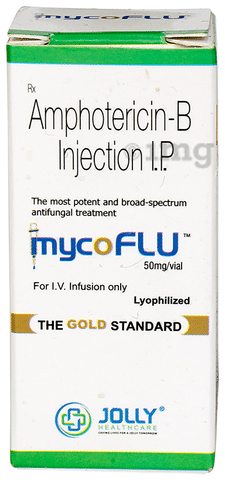
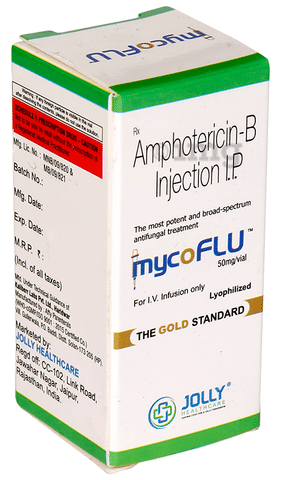


Mycoflu Injection
Amphotericin B (50mg)
 Genuine
Authenticity Assured
 Prescription
required
 NPPA Regulated
Show Details
 Cold stored
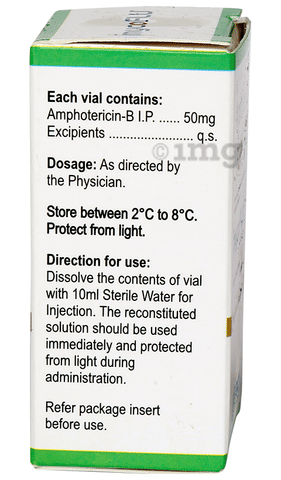
Stored between 2-8°C
Mycoflu Injection is a medicine used to treat severe fungal infections that affect the blood, lungs, brain, or other internal organs. It is also used for a parasitic disease called visceral leishmaniasis (kala azar). It works by killing the fungus or parasite that causes the infection.
Written By Dr. Swati Mishra, BDS,
Reviewed By Dr. Rajeev Sharma, MBA, MBBS,
Last updated on 22 Oct 2026 | 01:03 AM (IST)
Written By Dr. Swati Mishra, BDS,
Reviewed By Dr. Rajeev Sharma, MBA, MBBS,
Last updated on 22 Oct 2026 | 01:03 AM (IST)
Save more with additional offers

Get upto Rs.150 Cashback on minimum transaction of Rs.599/- with Mobikwik UPI (@ikwik).
Get upto Rs.150 Cashback on minimum transaction of Rs.599/- with Mobikwik UPI (@ikwik).


Get up to ₹75 cashback on a minimum order value (MOV) of ₹499 and above, valid once per customer.
Get up to ₹75 cashback on a minimum order value (MOV) of ₹499 and above, valid once per customer.
Get up to ₹75 cashback on a minimum order value (MOV) of ₹499 and above, valid once per customer.
Get up to ₹75 cashback on a minimum order value (MOV) of ₹499 and above, valid once per customer.
Get upto Rs.150 Cashback on minimum transaction of Rs.599/- with Mobikwik UPI (@ikwik).
Get upto Rs.150 Cashback on minimum transaction of Rs.599/- with Mobikwik UPI (@ikwik).
Get up to ₹75 cashback on a minimum order value (MOV) of ₹499 and above, valid once per customer.
Get up to ₹75 cashback on a minimum order value (MOV) of ₹499 and above, valid once per customer.
Get up to ₹75 cashback on a minimum order value (MOV) of ₹499 and above, valid once per customer.
Get up to ₹75 cashback on a minimum order value (MOV) of ₹499 and above, valid once per customer.

Assured cashback up to ₹300*. T&C Apply*
Assured cashback up to ₹300*. T&C Apply*
General Information
Contains
Amphotericin B (50mg)
Marketer
Jolly Healthcare
Storage
Store in a refrigerator (2 - 8°C). Do not freeze.
The content is shown in English



All substitutes for Mycoflu Injection
For information purposes only. Consult a doctor before taking any medicine.
Amphotret 50mg Injection
by Bharat Serums & Vaccines Ltd
₹238.76/injection
27% cheaper
Amfocare 50mg Injection
by Criticare Laboratories Pvt Ltd
₹407.63/injection
25% costlier
amphoDEX 50mg Injection
by Samarth Life Sciences Pvt Ltd
₹238.75/injection
27% cheaper
Affytericin-B Injection
by Affy Pharma Pvt Ltd
₹324/injection
1% cheaper
Fungitericin Injection
by Lifecare Innovations Pvt Ltd
₹281/injection
14% cheaper
Safety advice

Alcohol
CONSULT YOUR DOCTOR
It is not known whether it is safe to consume alcohol with Mycoflu Injection. Please consult your doctor.

Pregnancy
CONSULT YOUR DOCTOR
The safety of Mycoflu Injection during pregnancy has not been established. There are no adequate and well-controlled studies in pregnant women, and animal data on reproductive toxicity are insufficient. Your doctor will weigh the benefits and any potential risks before prescribing.

Breast feeding
CONSULT YOUR DOCTOR
Mycoflu Injection may be unsafe to use during breastfeeding. Limited human data suggests that the drug may pass into the breastmilk and harm the baby. It should be used only if the expected benefit outweighs the potential risk. Please consult your doctor.

Driving
CAUTION
Mycoflu Injection may cause dizziness or weakness due to changes in blood pressure. Do not drive if these symptoms occur.

Kidney
CONSULT YOUR DOCTOR
There is limited data available on the use of Mycoflu Injection in patients with kidney disease. Please consult your doctor.

Liver
SAFE IF PRESCRIBED
Mycoflu Injection is probably safe to use in patients with liver disease. Limited data suggest dose adjustment may not be needed.
Related lab tests
References
- Central Drugs Standard Control Organisation (CDSCO). [Accessed 29 Mar. 2019] (online) Available from:

- Phillips MA, Stanley SL Jr. Chemotherapy of Protozoal Infections: Amebiasis, Giardiasis, Trichomoniasis, Trypanosomiasis, Leishmaniasis, and Other Protozoal Infections. In: Brunton LL, Chabner BA, Knollmann BC, editors. Goodman & Gilman’s: The Pharmacological Basis of Therapeutics. 12th ed. New York, New York: McGraw-Hill Medical; 2011. p. 1424.
- Bennett JE. Antifungal Agents. In: Brunton LL, Chabner BA, Knollmann BC, editors. Goodman & Gilman’s: The Pharmacological Basis of Therapeutics. New York, New York: McGraw-Hill Medical; 2011. pp. 1571-75.
- Sheppard D, Lampiris HW. Antifungal Agents. In: Katzung BG, Masters SB, Trevor AJ, editors. Basic and Clinical Pharmacology. 11th ed. New Delhi, India: Tata McGraw Hill Education Private Limited; 2009. pp. 836-38.
- Amphotericin B [Drug Label]. San Dimas, California: Gilead Sciences, Inc.; 2000. [Accessed 20 Sept. 2025] (online) Available from:
- Amphotericin B [Prescribing Information]. Big Flats, NY: XGen Pharmaceuticals DJB, Inc.; 2022. [Accessed 20 Sept. 2025] (online) Available from:
Related products
Products related to Mycoflu Injection





100% genuine products

Safe & secure payments

No contact delivery

Fully sanitized facilities

Want to know more
We provide you with authentic, trustworthy and relevant information
Have issue with the content
Why we need a prescription?