







Ramact 5mg Tablet
Ramipril (5mg)


Ramact 5mg Tablet is widely used to treat high blood pressure and heart failure and may even be prescribed after a heart attack. It also lowers the chances of having a heart attack or stroke.
Written By Dr. Sakshi Jain, MS, BDS,
Reviewed By Dr. Sachin Gupta, MD Pharmacology, MBBS,
Last updated on 12 Sep 2026 | 01:04 AM (IST)
Written By Dr. Sakshi Jain, MS, BDS,
Reviewed By Dr. Sachin Gupta, MD Pharmacology, MBBS,
Last updated on 12 Sep 2026 | 01:04 AM (IST)
30% cheaper alternative available
Sold out

Ramact 5mg Tablet
strip of 10 tablets
₹72.6

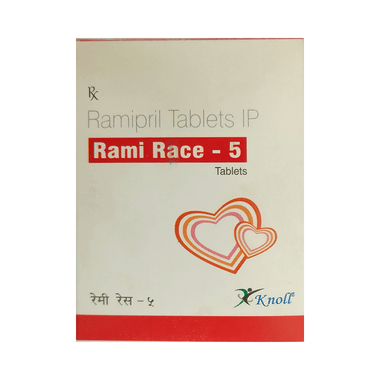
Same composition
Rami Race 5 Tablet
strip of 10 tablets
by Knoll Pharmaceuticals Ltd
Get in 30 mins

₹50.5
₹4.29 per tablet
₹42.9
order for
₹1200
Save more with additional offers

10% cashback up to 200 on Min Transaction of Rs.1000, for first time users of Airtel Payments Bank.
10% cashback up to 200 on Min Transaction of Rs.1000, for first time users of Airtel Payments Bank.


Get up to ₹75 cashback on a minimum order value (MOV) of ₹499 and above, valid once per customer.
Get up to ₹75 cashback on a minimum order value (MOV) of ₹499 and above, valid once per customer.
Get up to ₹75 cashback on a minimum order value (MOV) of ₹499 and above, valid once per customer.
Get up to ₹75 cashback on a minimum order value (MOV) of ₹499 and above, valid once per customer.
10% cashback up to 200 on Min Transaction of Rs.1000, for first time users of Airtel Payments Bank.
10% cashback up to 200 on Min Transaction of Rs.1000, for first time users of Airtel Payments Bank.
Get up to ₹75 cashback on a minimum order value (MOV) of ₹499 and above, valid once per customer.
Get up to ₹75 cashback on a minimum order value (MOV) of ₹499 and above, valid once per customer.
Get up to ₹75 cashback on a minimum order value (MOV) of ₹499 and above, valid once per customer.
Get up to ₹75 cashback on a minimum order value (MOV) of ₹499 and above, valid once per customer.

Assured cashback up to ₹300*. T&C Apply*
Assured cashback up to ₹300*. T&C Apply*
General Information

The content is shown in English




All substitutes for Ramact 5mg Tablet
For information purposes only. Consult a doctor before taking any medicine.
Rami Race 5 Tablet
by Knoll Pharmaceuticals Ltd
₹5.05/tablet
30% cheaper
Macpril 5 Tablet
by Macleods Pharmaceuticals Pvt Ltd
₹7.92/tablet
9% costlier
Ramipres 5 Tablet
by Cipla Ltd
₹7.74/tablet
7% costlier
Ziram 5 Tablet
by FDC Ltd
₹5.49/tablet
24% cheaper
RAMIstar 5 Tablet
by Lupin Ltd
₹7.93/tablet
9% costlier
Safety advice

Alcohol
CONSULT YOUR DOCTOR
It is not known whether it is safe to consume alcohol with Ramact 5mg Tablet. Please consult your doctor.

Pregnancy
UNSAFE
Ramact 5mg Tablet is highly unsafe during pregnancy. It can cause serious harm to the unborn baby, including birth defects and pregnancy loss. Do not use this medicine if you are pregnant or planning to become pregnant.

Breast feeding
CONSULT YOUR DOCTOR
Ramact 5mg Tablet may be unsafe to use during breastfeeding. Limited human data suggests that the drug may pass into the breastmilk and harm the baby. It should be used only if the expected benefit outweighs the potential risk. Please consult your doctor.

Driving
CAUTION
Ramact 5mg Tablet may cause dizziness or weakness due to changes in blood pressure. Do not drive if these symptoms occur.

Kidney
CAUTION
Ramact 5mg Tablet should be used with caution in patients with kidney disease. Dose adjustment may be needed.
Regular monitoring of blood pressure is recommended for dose adjustment.
Regular monitoring of blood pressure is recommended for dose adjustment.

Liver
CAUTION
Ramact 5mg Tablet should be used with caution in patients with liver disease. Dose adjustment may be needed.
Inform your doctor if you develop any signs and symptoms of jaundice while taking this medicine.
Inform your doctor if you develop any signs and symptoms of jaundice while taking this medicine.

Related lab tests
References
- Hilal-Dandan R. Renin and Angiotensin. In: Brunton LL, Chabner BA, Knollmann BC, editors. Goodman & Gilman’s: The Pharmacological Basis of Therapeutics. 12th ed. New York, New York: McGraw-Hill Medical; 2011. p. 733.
- Pfeffer MA, Opie LH. Inhibitors of the Renin-Angiotensin-Aldosterone System. In: Opie LH, Gersh BJ, editors. Drugs for the Heart. 8th ed. Philadelphia, Pennsylvania: Elsevier Saunders; 2013. pp. 143-44.
- Briggs GG, Freeman RK, editors. A Reference Guide to Fetal and Neonatal Risk: Drugs in Pregnancy and Lactation. 10th ed. Philadelphia, PA: Wolters Kluwer Health; 2015. pp. 1195-96.
- Ramipril. New York, New York: Pfizer, Inc.; 1991 [revised Sep. 2013]. [Accessed 19 Mar. 2019] (online) Available from:

- Ramipril. South Ruislip, UK: Aurobindo Pharma - Milpharm Ltd.; 2011 [revised 19 Mar. 2018]. [Accessed 19 Jun. 2019] (online) Available from:
- National Health Service. Ramipril; 2018. [Accessed 19 Jun. 2019] (online) Available from:
- Central Drugs Standard Control Organisation (CDSCO). [Accessed 19 Mar. 2019] (online) Available from:
- CiplaMed. Ramipril [Prescribing Information]. [Accessed 25 Jul. 2023] (online) Available from:
- Ramipril. East Windsor, NJ: Aurobindo Pharma USA, Inc.; 2025. [Accessed 28 Jan. 2026] (online). Available from:
Related products
Products related to Ramact 5mg Tablet





100% genuine products

Safe & secure payments

No contact delivery

Fully sanitized facilities

Want to know more
We provide you with authentic, trustworthy and relevant information
Have issue with the content
Why we need a prescription?

