







Parytine 10mg Tablet
Paroxetine (10mg)
 Genuine
Authenticity Assured
 Prescription
required
Parytine 10mg Tablet is a type of antidepressant belonging to the selective serotonin reuptake inhibitor (SSRI) group of medicines. It is used to treat major depression and anxiety-related conditions like obsessive-compulsive disorder and panic disorder.
Written By Dr. Swati Mishra, BDS,
Reviewed By Dr. Rajeev Sharma, MBA, MBBS,
Last updated on 06 Oct 2026 | 01:02 AM (IST)
Written By Dr. Swati Mishra, BDS,
Reviewed By Dr. Rajeev Sharma, MBA, MBBS,
Last updated on 06 Oct 2026 | 01:02 AM (IST)
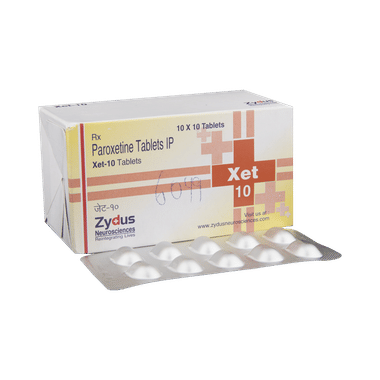
Available alternative from Zydus Cadila
Sold out

Parytine 10mg Tablet
strip of 10 tablets
₹82

Same composition
Xet 10 Tablet
strip of 10 tablets
by Zydus Cadila
Get by 6pm, Tomorrow
₹205
₹17.4 per tablet
₹174
order for
₹1200
Save more with additional offers

Get upto Rs.150 Cashback on minimum transaction of Rs.599/- with Mobikwik UPI (@ikwik).
Get upto Rs.150 Cashback on minimum transaction of Rs.599/- with Mobikwik UPI (@ikwik).


Get up to ₹75 cashback on a minimum order value (MOV) of ₹499 and above, valid once per customer.
Get up to ₹75 cashback on a minimum order value (MOV) of ₹499 and above, valid once per customer.
Get up to ₹75 cashback on a minimum order value (MOV) of ₹499 and above, valid once per customer.
Get up to ₹75 cashback on a minimum order value (MOV) of ₹499 and above, valid once per customer.
Get upto Rs.150 Cashback on minimum transaction of Rs.599/- with Mobikwik UPI (@ikwik).
Get upto Rs.150 Cashback on minimum transaction of Rs.599/- with Mobikwik UPI (@ikwik).
Get up to ₹75 cashback on a minimum order value (MOV) of ₹499 and above, valid once per customer.
Get up to ₹75 cashback on a minimum order value (MOV) of ₹499 and above, valid once per customer.
Get up to ₹75 cashback on a minimum order value (MOV) of ₹499 and above, valid once per customer.
Get up to ₹75 cashback on a minimum order value (MOV) of ₹499 and above, valid once per customer.

Assured cashback up to ₹300*. T&C Apply*
Assured cashback up to ₹300*. T&C Apply*
General Information

The content is shown in English




All substitutes for Parytine 10mg Tablet
For information purposes only. Consult a doctor before taking any medicine.
Pexep 10 Tablet
by Intas Pharmaceuticals Ltd
₹21.5/tablet
162% costlier
Xet 10 Tablet
by Zydus Cadila
₹20.5/tablet
150% costlier
Pari 10 Tablet
by Ipca Laboratories Ltd
₹19.6/tablet
139% costlier
Pexep 10 Tablet
by Intas Pharmaceuticals Ltd
₹23.67/tablet
189% costlier
Praxo 10mg Tablet
by KC Laboratories
₹7.08/tablet
14% cheaper
Safety advice

Alcohol
CONSULT YOUR DOCTOR
It is not known whether it is safe to consume alcohol with Parytine 10mg Tablet. Please consult your doctor.

Pregnancy
CONSULT YOUR DOCTOR
Parytine 10mg Tablet is not recommended during pregnancy as there is positive evidence of fetal risk based on animal studies. However, it may still be prescribed by a doctor in situations where the benefits outweigh the risks.

Breast feeding
CONSULT YOUR DOCTOR
Parytine 10mg Tablet may be unsafe to use during breastfeeding. Limited human data suggests that the drug may pass into the breastmilk and harm the baby. It should be used only if the expected benefit outweighs the potential risk. Please consult your doctor.

Driving
UNSAFE
Parytine 10mg Tablet may decrease alertness, affect your vision, or make you feel sleepy and dizzy. Do not drive if these symptoms occur.
Kidney
CAUTION
Parytine 10mg Tablet should be used with caution in patients with kidney disease. Dose adjustment may be needed.

Liver
CAUTION
Parytine 10mg Tablet should be used with caution in patients with liver disease. Dose adjustment may be needed.

References
- Stahl SM, editor. Paroxetine. In: Stahl's Essential Psychopharmacology: Prescriber's Guide. 5th ed. New York, New York: Cambridge University Press; 2014. pp. 513-19.
- Briggs GG, Freeman RK, editors. A Reference Guide to Fetal and Neonatal Risk: Drugs in Pregnancy and Lactation. 10th ed. Philadelphia, PA: Wolters Kluwer Health; 2015. pp. 1060-69.
- Paroxetine [EMC Label]. South Ruislip, Middlesex: Aurobindo Pharma - Milpharm Ltd.; 2025. [Accessed 25 Mar. 2019] (online) Available from:

- Central Drugs Standard Control Organisation (CDSCO). [Accessed 25 Mar. 2019] (online) Available from:
- Paroxetine [Product Monograph]. Mississauga, Ontario: GlaxoSmithKline Inc.; 2023. [Accessed 12 Dec. 2025] (online) Available from:
- Paroxetine hydrochloride [Product Monograph]. East Windsor, NJ: Aurobindo Pharma Ltd.; 2025. [Accessed 11 Nov. 2025] (online). Available from:
Related products
Products related to Parytine 10mg Tablet


Related ayurvedic ingredients

100% genuine products

Safe & secure payments

No contact delivery

Fully sanitized facilities

Want to know more
We provide you with authentic, trustworthy and relevant information
Have issue with the content
Why we need a prescription?

