






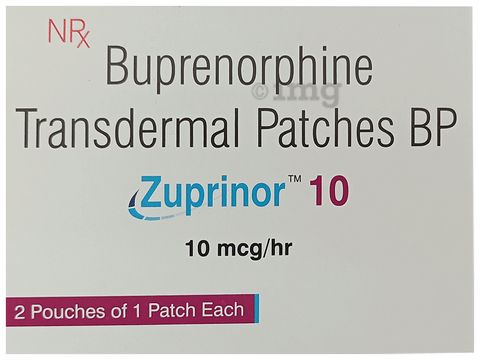
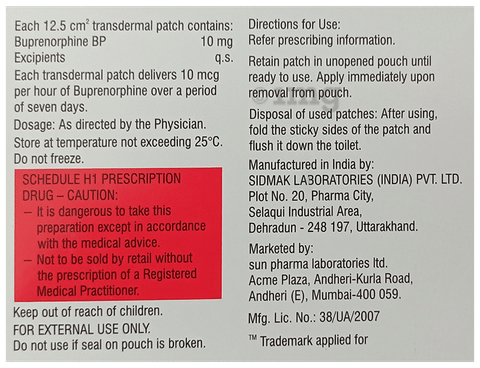
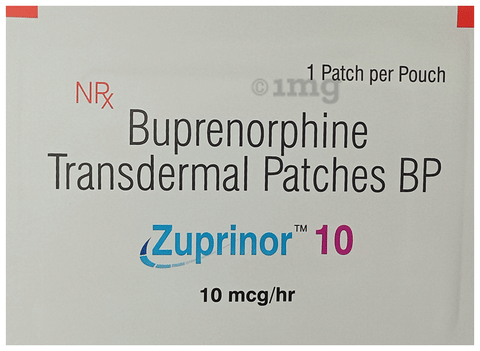


Zuprinor 10 Transdermal Patch
Buprenorphine (10mcg)
 Genuine
Authenticity Assured
 Prescription
required
Zuprinor 10 Transdermal Patch is used to treat moderate to severe pain and drug dependence/addiction to opioids. It helps prevent withdrawal symptoms that may be caused due to withdrawal of other opioids.
Written By Dr. Syeda Aafia, MBA, BDS,
Reviewed By Dr. Rajeev Sharma, MBA, MBBS,
Last updated on 22 Oct 2026 | 01:01 AM (IST)
Written By Dr. Syeda Aafia, MBA, BDS,
Reviewed By Dr. Rajeev Sharma, MBA, MBBS,
Last updated on 22 Oct 2026 | 01:01 AM (IST)

Save more with additional offers

Get upto Rs.150 Cashback on minimum transaction of Rs.599/- with Mobikwik UPI (@ikwik).
Get upto Rs.150 Cashback on minimum transaction of Rs.599/- with Mobikwik UPI (@ikwik).


Get up to ₹75 cashback on a minimum order value (MOV) of ₹499 and above, valid once per customer.
Get up to ₹75 cashback on a minimum order value (MOV) of ₹499 and above, valid once per customer.
Get up to ₹75 cashback on a minimum order value (MOV) of ₹499 and above, valid once per customer.
Get up to ₹75 cashback on a minimum order value (MOV) of ₹499 and above, valid once per customer.
Get upto Rs.150 Cashback on minimum transaction of Rs.599/- with Mobikwik UPI (@ikwik).
Get upto Rs.150 Cashback on minimum transaction of Rs.599/- with Mobikwik UPI (@ikwik).
Get up to ₹75 cashback on a minimum order value (MOV) of ₹499 and above, valid once per customer.
Get up to ₹75 cashback on a minimum order value (MOV) of ₹499 and above, valid once per customer.
Get up to ₹75 cashback on a minimum order value (MOV) of ₹499 and above, valid once per customer.
Get up to ₹75 cashback on a minimum order value (MOV) of ₹499 and above, valid once per customer.

Assured cashback up to ₹300*. T&C Apply*
Assured cashback up to ₹300*. T&C Apply*
General Information

The content is shown in English



Safety advice

Alcohol
No interaction found/established

Pregnancy
CONSULT YOUR DOCTOR
Zuprinor 10 Transdermal Patch is not recommended during pregnancy as there is positive evidence of fetal risk based on animal studies. However, it may still be prescribed by a doctor in situations where the benefits outweigh the risks.

Breast feeding
CAUTION
Zuprinor 10 Transdermal Patch should be used with caution during breastfeeding. Breastfeeding should be held until the treatment of the mother is completed and the drug is eliminated from the body.

Driving
No interaction found/established
Kidney
CONSULT YOUR DOCTOR
There is limited data available on the use of Zuprinor 10 Transdermal Patch in patients with kidney disease. Please consult your doctor.

Liver
CAUTION
Zuprinor 10 Transdermal Patch should be used with caution in patients with liver disease. Dose adjustment may be needed.
Consider the use of an alternate analgesic that may permit more flexibility with the dosing in patients with severe hepatic impairment.
Consider the use of an alternate analgesic that may permit more flexibility with the dosing in patients with severe hepatic impairment.
Related lab tests
References
- Schumacher MA, Basbaum AI, Way WL. Opioids Analgesics & Antagonists. In: Katzung BG, Masters SB, Trevor AJ, editors. Basic and Clinical Pharmacology. 11th ed. New Delhi, India: Tata McGraw Hill Education Private Limited; 2009. pp. 546-47.
- Yaksh TL, WallaceIn MS. Opioids, Analgesia, and Pain Management. In: Brunton LL, Chabner BA, Knollmann BC, editors. Goodman & Gilman’s: The Pharmacological Basis of Therapeutics. 12th ed. New York, New York: McGraw-Hill Medical; 2011. p. 510.
- Briggs GG, Freeman RK, editors. A Reference Guide to Fetal and Neonatal Risk: Drugs in Pregnancy and Lactation. 10th ed. Philadelphia, PA: Wolters Kluwer Health; 2015. p. 165-67.
- Central Drugs Standard Control Organisation (CDSCO). [Accessed 02 Apr. 2019] (online) Available from:

Related products
Products related to Zuprinor 10 Transdermal Patch



100% genuine products

Safe & secure payments

No contact delivery
Fully sanitized facilities

Want to know more
We provide you with authentic, trustworthy and relevant information
Have issue with the content
Why we need a prescription?

