






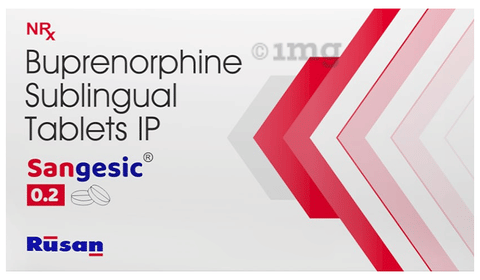

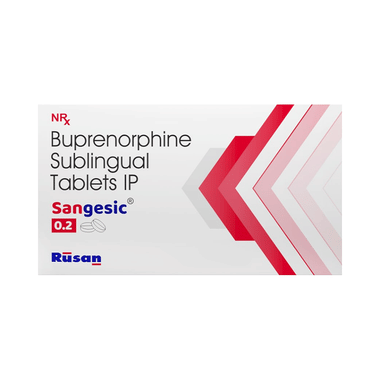
Sangesic 0.2 Sublingual tablet
Buprenorphine (0.2mg)
 Genuine
Authenticity Assured
 Prescription
required
Sangesic 0.2 Sublingual tablet is a medicine used to treat opioid dependence. It helps reduce cravings and withdrawal symptoms associated with opioid addiction without producing the intense "high" of stronger opioids. It helps to stabilize the person during treatment and supports long-term recovery from opioid dependence.
Written By Dr. Swati Mishra, BDS,
Reviewed By Dr. Rajeev Sharma, MBA, MBBS,
Last updated on 24 Sep 2026 | 01:01 AM (IST)
Written By Dr. Swati Mishra, BDS,
Reviewed By Dr. Rajeev Sharma, MBA, MBBS,
Last updated on 24 Sep 2026 | 01:01 AM (IST)
Save more with additional offers
10% cashback up to 200 on Min Transaction of Rs.1000, for first time users of Airtel Payments Bank.
10% cashback up to 200 on Min Transaction of Rs.1000, for first time users of Airtel Payments Bank.


Get up to ₹75 cashback on a minimum order value (MOV) of ₹499 and above, valid once per customer.
Get up to ₹75 cashback on a minimum order value (MOV) of ₹499 and above, valid once per customer.
Get up to ₹75 cashback on a minimum order value (MOV) of ₹499 and above, valid once per customer.
Get up to ₹75 cashback on a minimum order value (MOV) of ₹499 and above, valid once per customer.
10% cashback up to 200 on Min Transaction of Rs.1000, for first time users of Airtel Payments Bank.
10% cashback up to 200 on Min Transaction of Rs.1000, for first time users of Airtel Payments Bank.
Get up to ₹75 cashback on a minimum order value (MOV) of ₹499 and above, valid once per customer.
Get up to ₹75 cashback on a minimum order value (MOV) of ₹499 and above, valid once per customer.
Get up to ₹75 cashback on a minimum order value (MOV) of ₹499 and above, valid once per customer.
Get up to ₹75 cashback on a minimum order value (MOV) of ₹499 and above, valid once per customer.

Assured cashback up to ₹300*. T&C Apply*
Assured cashback up to ₹300*. T&C Apply*
General Information

The content is shown in English



Safety advice

Alcohol
CONSULT YOUR DOCTOR
It is not known whether it is safe to consume alcohol with Sangesic 0.2 Sublingual tablet. Please consult your doctor.

Pregnancy
CONSULT YOUR DOCTOR
Information regarding the use of Sangesic 0.2 Sublingual tablet during pregnancy is not available. Please consult your doctor.

Breast feeding
SAFE IF PRESCRIBED
Sangesic 0.2 Sublingual tablet may be safe to use during breastfeeding. Animal studies have shown low or no adverse effects to the developing baby; however, there are limited human studies.

Driving
UNSAFE
Sangesic 0.2 Sublingual tablet may decrease alertness, affect your vision, or make you feel sleepy and dizzy. Do not drive if these symptoms occur.
Sangesic 0.2 Sublingual tablet can cause drowsiness, so avoid driving or operating heavy machinery until you know how the medicine affects you.
Sangesic 0.2 Sublingual tablet can cause drowsiness, so avoid driving or operating heavy machinery until you know how the medicine affects you.
Kidney
CAUTION
Sangesic 0.2 Sublingual tablet should be used with caution in patients with kidney disease. Dose adjustment may be needed.
Liver
CAUTION
Sangesic 0.2 Sublingual tablet should be used with caution in patients with liver disease. Dose adjustment may be needed.
Related lab tests
References
- Buprenorphine sublingual tablets [Prescribing Information]. North Chesterfield, VA: Indivior Inc.; 2018. [Accessed 20 Sep. 2024] (online) Available from:

- Buprenorphine hydrochloride sublingual tablets [Prescribing Information]. Morgantown, WV: Mylan Pharmaceuticals Inc.; 2017. [Accessed 20 Sep. 2024] (online) Available from:
- Buprenorphine hydrochloride sublingual tablets [Prescribing Information]. Columbus, Ohio: Roxane Laboratories, Inc.; 2015. [Accessed 20 Sep. 2024] (online) Available from:
Related products
Products related to Sangesic 0.2 Sublingual tablet



100% genuine products
Safe & secure payments

No contact delivery
Fully sanitized facilities

Want to know more
We provide you with authentic, trustworthy and relevant information
Have issue with the content
Why we need a prescription?

