







Polytose Injection
Polymyxin B (500000units)
 Genuine
Authenticity Assured
 Prescription
required
Polytose Injection is an antibiotic that fights bacteria. It is used to treat severe bacterial infections of the body. It works by killing and stopping the growth of bacteria that cause these problems. It is commonly used to treat critically ill patients admitted to the hospital.
Written By Dr. Sakshi Jain, MS, BDS,
Reviewed By Dr. Sachin Gupta, MD Pharmacology, MBBS,
Last updated on 11 Oct 2026 | 01:01 AM (IST)
Written By Dr. Sakshi Jain, MS, BDS,
Reviewed By Dr. Sachin Gupta, MD Pharmacology, MBBS,
Last updated on 11 Oct 2026 | 01:01 AM (IST)
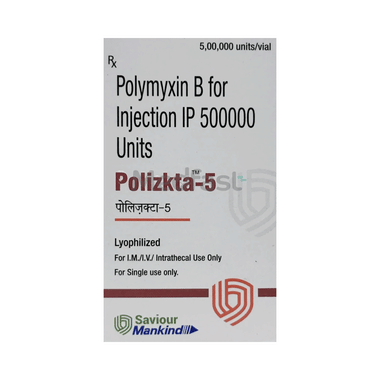
Available alternative from Mankind
Sold out

Polytose Injection
vial of 1 Injection
₹1960

Same composition
Polizkta 5 Injection
vial of 1 Injection
by Mankind Pharma Ltd
Get by Tomorrow
₹3843
₹3267.0 per unit
₹3267
order for
₹1200
Save more with additional offers

Get upto Rs.150 Cashback on minimum transaction of Rs.599/- with Mobikwik UPI (@ikwik).
Get upto Rs.150 Cashback on minimum transaction of Rs.599/- with Mobikwik UPI (@ikwik).


Get up to ₹75 cashback on a minimum order value (MOV) of ₹499 and above, valid once per customer.
Get up to ₹75 cashback on a minimum order value (MOV) of ₹499 and above, valid once per customer.
Get up to ₹75 cashback on a minimum order value (MOV) of ₹499 and above, valid once per customer.
Get up to ₹75 cashback on a minimum order value (MOV) of ₹499 and above, valid once per customer.
Get upto Rs.150 Cashback on minimum transaction of Rs.599/- with Mobikwik UPI (@ikwik).
Get upto Rs.150 Cashback on minimum transaction of Rs.599/- with Mobikwik UPI (@ikwik).
Get up to ₹75 cashback on a minimum order value (MOV) of ₹499 and above, valid once per customer.
Get up to ₹75 cashback on a minimum order value (MOV) of ₹499 and above, valid once per customer.
Get up to ₹75 cashback on a minimum order value (MOV) of ₹499 and above, valid once per customer.
Get up to ₹75 cashback on a minimum order value (MOV) of ₹499 and above, valid once per customer.

Assured cashback up to ₹300*. T&C Apply*
Assured cashback up to ₹300*. T&C Apply*
General Information

The content is shown in English




All substitutes for Polytose Injection
For information purposes only. Consult a doctor before taking any medicine.
Polizkta 5 Injection
by Mankind Pharma Ltd
₹4412.7/injection
96% costlier
Polyzan Injection
by Suzan Pharma
₹3649/injection
62% costlier
Hipoly-B Injection
by Intas Pharmaceuticals Ltd
₹656.25/injection
71% cheaper
Gerpoly-B Injection
by Zydus Cadila
₹2892.66/injection
29% costlier
SU-Pol Injection
by Suzan Pharma
₹1299/injection
42% cheaper
Safety advice

Alcohol
CONSULT YOUR DOCTOR
It is not known whether it is safe to consume alcohol with Polytose Injection. Please consult your doctor.

Pregnancy
CONSULT YOUR DOCTOR
The safety of Polytose Injection during pregnancy has not been established. There are no adequate and well-controlled studies in pregnant women, and animal data on reproductive toxicity are insufficient. Your doctor will weigh the benefits and any potential risks before prescribing.

Breast feeding
CONSULT YOUR DOCTOR
Information regarding the use of Polytose Injection during breastfeeding is not available. Please consult your doctor.

Driving
CONSULT YOUR DOCTOR
It is not known whether Polytose Injection alters the ability to drive. Do not drive if you experience any symptoms that affect your ability to concentrate and react. Please consult your doctor.

Kidney
CAUTION
Polytose Injection should be used with caution in patients with kidney disease. Dose adjustment may be needed.

Liver
CONSULT YOUR DOCTOR
There is limited data available on the use of Polytose Injection in patients with liver disease.
Related lab tests
References
- MacDougall C, Chambers HF. Protein Synthesis Inhibitors and Miscellaneous Antibacterial Agents. In: Brunton LL, Chabner BA, Knollmann BC, editors. Goodman & Gilman’s: The Pharmacological Basis of Therapeutics. 12th ed. New York, New York: McGraw-Hill Medical; 2011. pp. 1538-39.
- Chambers HF, Deck DH. Miscellaneous Antimicrobial Agents; Disingectants, Antiseptics, & Sterilants. In: Katzung BG, Masters SB, Trevor AJ, editors. Basic and Clinical Pharmacology. 11th ed. New Delhi, India: Tata McGraw Hill Education Private Limited; 2009. p. 878.
- Briggs GG, Freeman RK, editors. A Reference Guide to Fetal and Neonatal Risk: Drugs in Pregnancy and Lactation. 10th ed. Philadelphia, PA: Wolters Kluwer Health; 2015. p. 1133.
- Polymyxin B. Bedford, Ohio: Ben Venue Laboratories, Inc.; 2011. [Accessed 28 Mar. 2019] (online) Available from:

Related products
Products related to Polytose Injection




100% genuine products

Safe & secure payments

No contact delivery

Fully sanitized facilities

Want to know more
We provide you with authentic, trustworthy and relevant information
Have issue with the content
Why we need a prescription?

