







Cefoder 100mg/5ml Syrup
Written By Dr. Anuj Saini, MMST, MBBS
Reviewed By Dr. Rajeev Sharma, MBA, MBBS
Last updated on 12 Nov 2025 | 12:40 AM (IST)
Cefoder 100mg/5ml Syrup is an antibiotic medicine. It is commonly given to children for the treatment of a wide range of bacterial infections targeting the ears, eyes, nose, throat, lungs, skin, gastrointestinal tract, and urinary tract. It is also effective in treating typhoid fever in children and adolescents.
 Genuine
Authenticity Assured
 Prescription
required
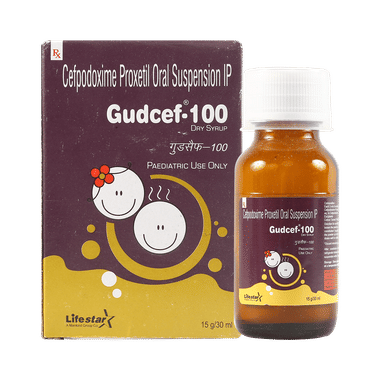
Available alternative from Mankind
Sold out

Cefoder 100mg/5ml Syrup
bottle of 30 ml Syrup
₹37.5

Same composition
Gudcef 100mg/5ml Syrup
bottle of 30 ml Syrup
by Mankind Pharma Ltd
Get by Tomorrow
₹161
₹4.57 per ml
₹137
order for
₹1200

Save more with additional offers

10% cashback up to 200 on Min Transaction of Rs.1000, for first time users of Airtel Payments Bank.
10% cashback up to 200 on Min Transaction of Rs.1000, for first time users of Airtel Payments Bank.


Get cashback up to ₹500
Get upto Rs.500 Cashback on minimum transaction of Rs.999/- with Mobikwik Wallet.

Assured cashback up to ₹300*
Assured cashback up to ₹300*
Save more with additional offers
10% cashback up to 200 on Min Transaction of Rs.1000, for first time users of Airtel Payments Bank.
10% cashback up to 200 on Min Transaction of Rs.1000, for first time users of Airtel Payments Bank.
Get cashback up to ₹500
Get upto Rs.500 Cashback on minimum transaction of Rs.999/- with Mobikwik Wallet.
Assured cashback up to ₹300*
Assured cashback up to ₹300*
Get upto Rs.150 Cashback
Get upto Rs.150 Cashback
General Information

The content is shown in English




All substitutes for Cefoder 100mg/5ml Syrup
For information purposes only. Consult a doctor before taking any medicine.
Gudcef 100mg/5ml Syrup
by Mankind Pharma Ltd
₹175.3/syrup
327% costlier
Doxcef 100mg/5ml Syrup
by Lupin Ltd
₹233.1/syrup
468% costlier
Spectratil 100mg/5ml Syrup
by Apex Laboratories Pvt Ltd
₹117.19/syrup
186% costlier
Polares 100mg/5ml Syrup
by Zuventus Healthcare Ltd
₹215.55/syrup
425% costlier
Foloup DS Syrup
by Ipca Laboratories Ltd
₹167.34/syrup
308% costlier
Safety advice

Kidney
CAUTION
Cefoder 100mg/5ml Syrup should be used with caution in patients with severe kidney disease. Dose adjustment may be needed.
Usually, Cefoder 100mg/5ml Syrup is considered safe to use in children with mild to moderate kidney disease. Dose modifications may be required in children with severe kidney disease.
Usually, Cefoder 100mg/5ml Syrup is considered safe to use in children with mild to moderate kidney disease. Dose modifications may be required in children with severe kidney disease.

Liver
CAUTION
Cefoder 100mg/5ml Syrup should be used with caution in patients with liver disease. Dose adjustment may be needed.
Related lab tests
References
- Royal College of Paediatrics and Child Health. Medicines for Children - information for parents and carers. [Accessed 26 Dec. 2020] (online) Available from:

- Ma TK, Chow KM, Choy AS, et al. Clinical manifestation of macrolide antibiotic toxicity in CKD and dialysis patients. Clin Kidney J. 2014;7(6):507-512. [Accessed 31 Dec. 2020] (online) Available from:
- Pegues DA, Miller Harrison SI. Salmonellosis. In: Jameson JL, Fauci AS, Kasper DL, et al. (Editors). Harrison's Principles of Internal Medicine. New York, New York: McGraw-Hill Medical; 2018. p. 1177.
- Cefpodoxime Proxetil. Vadodara, Gujarat: Bharat Parentral Ltd.; [Accessed 04 Nov. 2025] (online). Available from:
Related products
Products related to Cefoder 100mg/5ml Syrup



100% genuine products

Safe & secure payments

No contact delivery

Fully sanitized facilities

Want to know more
We provide you with authentic, trustworthy and relevant information
Have issue with the content
Why we need a prescription?

Provide right medicines
Prescriptions are complex documents. We proof read and recheck at various steps to provide you the right medication in the correct form and dose

In accordance with the law
Most medicines cannot be sold without a valid prescription, as per the Drugs and Cosmetics Act, 1940 and Rules, 1945
