






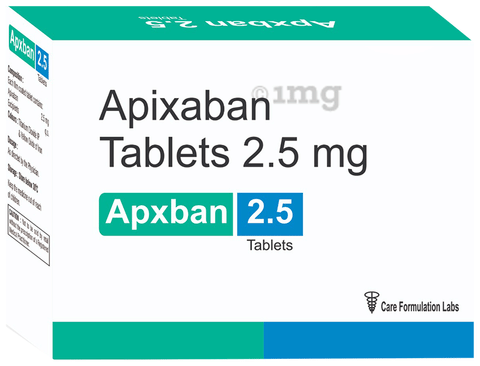
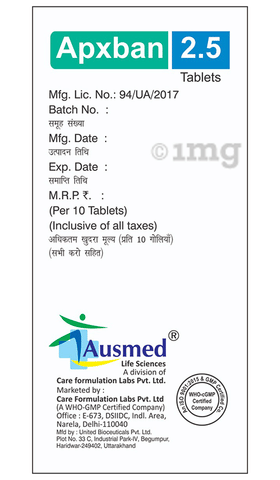

Apxaban 2.5 Tablet
Apixaban (2.5mg)
 Genuine
Authenticity Assured
 Prescription
required
Apxaban 2.5 Tablet is a medicine known as an anticoagulant or blood thinner. It helps prevent and treat blood clots. It prevents and treats clot formation in the veins of your legs, lungs, brain, and heart. It is used to reduce the risk of stroke and heart attack.
Written By Dr. Swati Mishra, BDS,
Reviewed By Dr. Sachin Gupta, MD Pharmacology, MBBS,
Last updated on 14 Jul 2026 | 01:08 AM (IST)
Written By Dr. Swati Mishra, BDS,
Reviewed By Dr. Sachin Gupta, MD Pharmacology, MBBS,
Last updated on 14 Jul 2026 | 01:08 AM (IST)
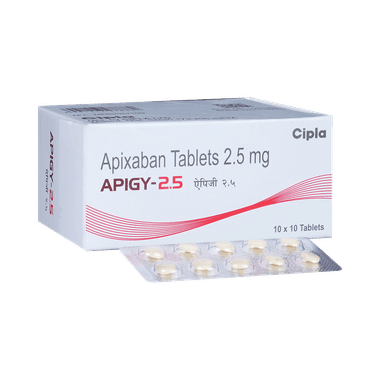
48% cheaper alternative available from Cipla
Sold out

Apxaban 2.5 Tablet
strip of 10 tablets
₹294

Same composition
Apigy 2.5 Tablet
strip of 10 tablets
by Cipla Ltd
Get in 60 mins

₹153
₹13.0 per tablet
₹130
order for
₹1200
Save more with additional offers
10% cashback up to 200 on Min Transaction of Rs.1000, for first time users of Airtel Payments Bank.
10% cashback up to 200 on Min Transaction of Rs.1000, for first time users of Airtel Payments Bank.

Get upto Rs.500 Cashback on minimum transaction of Rs.999/- with Mobikwik Wallet.
Get upto Rs.500 Cashback on minimum transaction of Rs.999/- with Mobikwik Wallet.
Get upto Rs.150 Cashback on minimum transaction of Rs.599/- with Mobikwik UPI.
Get upto Rs.150 Cashback on minimum transaction of Rs.599/- with Mobikwik UPI.
10% cashback up to 200 on Min Transaction of Rs.1000, for first time users of Airtel Payments Bank.
10% cashback up to 200 on Min Transaction of Rs.1000, for first time users of Airtel Payments Bank.
Get upto Rs.500 Cashback on minimum transaction of Rs.999/- with Mobikwik Wallet.
Get upto Rs.500 Cashback on minimum transaction of Rs.999/- with Mobikwik Wallet.
Get upto Rs.150 Cashback on minimum transaction of Rs.599/- with Mobikwik UPI.
Get upto Rs.150 Cashback on minimum transaction of Rs.599/- with Mobikwik UPI.

Flat ₹30 cashback. T&C Apply*
Flat ₹30 cashback. T&C Apply*
General Information

The content is shown in English



All substitutes for Apxaban 2.5 Tablet
For information purposes only. Consult a doctor before taking any medicine.
Apigy 2.5 Tablet
by Cipla Ltd
₹15.3/tablet
48% cheaper
Cadiquis 2.5mg Tablet
by Cadila Pharmaceuticals Ltd
₹5.06/tablet
83% cheaper
Apigat 2.5 Tablet
by Natco Pharma Ltd
₹20.27/tablet
31% cheaper
Apixator 2.5 Tablet
by Torrent Pharmaceuticals Ltd
₹13.4/tablet
54% cheaper
Elixaban 2.5 Tablet
by Sun Pharmaceutical Industries Ltd
₹12.2/tablet
59% cheaper
Safety advice
Alcohol
CONSULT YOUR DOCTOR
It is not known whether it is safe to consume alcohol with Apxaban 2.5 Tablet. Please consult your doctor.

Pregnancy
CONSULT YOUR DOCTOR
The safety of Apxaban 2.5 Tablet during pregnancy has not been established. There are no adequate and well-controlled studies in pregnant women, and animal data on reproductive toxicity are insufficient. Your doctor will weigh the benefits and any potential risks before prescribing.

Breast feeding
CONSULT YOUR DOCTOR
Information regarding the use of Apxaban 2.5 Tablet during breastfeeding is not available. Please consult your doctor.

Driving
SAFE
Apxaban 2.5 Tablet does not usually affect your ability to drive.
Kidney
CAUTION
Apxaban 2.5 Tablet should be used with caution in patients with kidney disease. Dose adjustment may be needed.
Liver
CAUTION
Apxaban 2.5 Tablet should be used with caution in patients with severe liver disease. Dose adjustment may be needed.
However, Apxaban 2.5 Tablet dose adjustment may not be needed in patients with mild liver disease.
However, Apxaban 2.5 Tablet dose adjustment may not be needed in patients with mild liver disease.
References
- Fox KA, White HD, Gersh BJ, et al. Antithrombotic Agents: Platelet Inhibitors, Acute Anticoagulants, Fibrinolytics, and Chronic Anticoagulants. In: Opie LH, Gersh BJ, editors. Drugs for the Heart. 8th ed. Philadelphia, Pennsylvania: Elsevier Saunders; 2013. pp. 366-67.
- Apixaba [Prescribing Information]n. Princeton, New Jersey: Bristol-Myers Squibb Company; 2012. [Accessed 24 Jan. 2019] (online) Available from:

- Drugs and Lactation Database (LactMed) [Internet]. Bethesda (MD): National Library of Medicine (US); 2006. Apixaban. [Updated 2018 Dec 3]. [Accessed 19 Feb. 2020] (online) Available from:
- Apixaban [Prescribing Information]. Verna, Goa, Indoco Remedies Ltd.; 2021. [Accessed 09 Jun, 2023] (online) Available from:
- Northwestern Memorial Hospital: Apixaban [Patient Education]. [Accessed 09 Jun, 2023] (online) Available from:
- Apixaban [Prescribing Information]. Mumbai, Maharashtra: M/s. Pfizer Limited; 2025.

100% genuine products
Safe & secure payments
No contact delivery
Fully sanitized facilities
Want to know more
We provide you with authentic, trustworthy and relevant information
Have issue with the content
Why we need a prescription?

