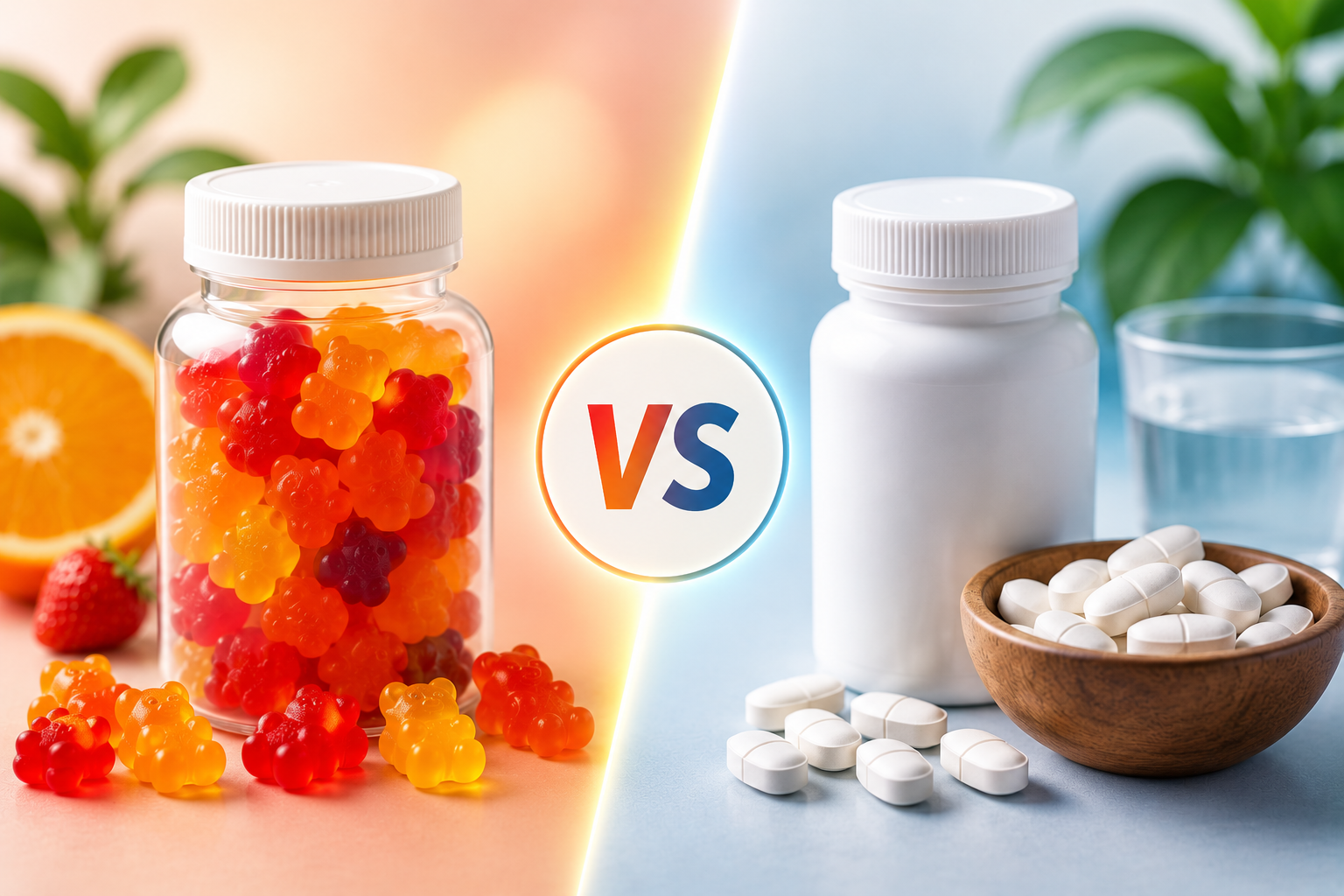
If you’ve ever stood in front of a supplement shelf wondering whether to pick a bottle of colorful gummy vitamins or the more traditional tablets, you’re not alone.
Gummies look more appealing. They taste better, are easier to chew, and you don’t have to deal with that familiar “big pill stuck in my throat” feeling. But there’s a bigger question behind the convenience: are gummy vitamins actually as effective as tablets?
The short answer is they can be. But it depends on the nutrient, the dose, the product, and how consistently you take it.
Research comparing the two forms is still limited, but some studies have found that certain gummy formulations can be absorbed as well as, or even better than, tablets. That doesn’t mean every gummy is better. The label still matters.
What Are Gummy Vitamins?

Gummy vitamins are dietary supplements made in a chewable form. They usually contain vitamins and minerals along with ingredients such as pectin or gelatin, sweeteners, flavours and colouring agents.
They’re designed to make supplement-taking easier. This can be useful if you dislike swallowing tablets or often forget to take them because you simply don’t enjoy the experience.
Tablets, on the other hand, are compressed forms of vitamins and minerals. They generally contain fewer ingredients needed for taste and texture, so manufacturers can sometimes fit higher amounts of certain nutrients into a smaller serving.
The real difference isn’t simply “gummy versus tablet.” It’s what’s inside each product and how your body absorbs it.
What Does Research Say About Gummy Vitamins?

One of the more useful studies looked specifically at vitamin D3 gummies compared with vitamin D3 tablets.
Researchers first conducted a small crossover study and then a larger study involving 31 healthy adults. Participants took vitamin D3 in either gummy or tablet form, and researchers measured vitamin D3 levels in their blood over time [1].
The results were interesting. In the larger study, vitamin D3 gummies produced higher blood concentrations and greater overall exposure to vitamin D3 than the tablets used in the study. The researchers concluded that the gummy formulation had greater bioavailability, meaning more of the vitamin appeared in the bloodstream.
That sounds like a clear win for gummies, right?
Not quite.
The study tested a specific vitamin D formulation, a specific dose and specific products. You can’t automatically apply those results to every vitamin or mineral sold as a gummy.
Vitamin C gummies, iron gummies, multivitamin gummies and vitamin D gummies can all behave differently in the body.
Research comparing gummy multivitamins with tablets is also much more limited. A 2023 systematic review examined studies on gummy vitamins and multivitamin tablets and highlighted the need to assess chemical composition, dissolution and bioequivalence rather than assuming one dosage form is always superior.
So, What Does the Research Really Tell Us?
It tells us that gummies can be effective. In some cases, they may even offer good or better absorption. But there isn’t enough evidence to say that gummies are universally more effective than tablets.
The nutrient matters more than the shape of the supplement.
Why Might Gummies Work Well?
One major advantage of gummies is that it has nothing to do with absorption.
It’s consistency.
Think about it. If your doctor recommends a supplement but you hate swallowing tablets, you might skip it several times a week. A gummy that you actually remember to take could be more useful for you in the long run.
A supplement only works when you take the right amount consistently.
Gummies can also be easier for people who have difficulty swallowing pills. Children and adults who struggle with tablets may find chewable supplements more comfortable.
Some people also report that gummies feel gentler on the stomach. However, this can depend on the ingredients and the individual, so don’t assume every gummy will suit you.
Are Gummies Always Better Absorbed?
No.
This is one of the biggest misconceptions surrounding gummy vitamins.
There isn’t a universal rule saying that gummies dissolve faster or that your body absorbs all gummy vitamins better than tablets.
The absorption of a nutrient depends on several factors, including the nutrient itself, its chemical form, the dose, the other ingredients in the product and what you eat with it.
For example, vitamin D is fat-soluble, so taking it with a meal containing some fat can support absorption. The formulation also matters.
The vitamin D gummy study is a good example of why you shouldn’t judge all supplements by their dosage form alone. The gummies performed better in that study, but that doesn’t mean a gummy iron supplement will behave in exactly the same way.
Gummies can also have lower amounts of certain nutrients
Here’s Where Tablets Can Have an Advantage
Gummies need to taste good and maintain a pleasant texture. That can make it harder for manufacturers to pack large amounts of certain vitamins and minerals into a small gummy.
Some gummy products also contain fewer nutrients than you might expect from a traditional multivitamin.
This is why you should look at the Supplement Facts or nutrition label rather than choosing a product simply because it looks appealing.
For example, NIH’s Dietary Supplement Label Database contains gummy products with different combinations and amounts of vitamins and minerals. Some also contain added sugar, while others use sugar substitutes.
So, two products may both say “multivitamin gummies” on the front but provide very different nutrient amounts.
The Sugar Problem with Gummy Vitamins
Gummy vitamins may taste like sweets, but they’re still supplements.
Many contain added sugar. Some gummy products listed in the NIH database contain several grams of sugar per serving. One example provides 4 grams of added sugar in two gummies, while another calcium and vitamin D gummy provides 5 grams per serving.
That may not sound like much, but remember that you’re taking a supplement, not eating dessert.
Frequent exposure to sugar can also increase the risk of tooth decay. Sugars are used by bacteria in the mouth to produce acids that attack tooth enamel.
Some gummies use sugar alcohols instead. These can reduce added sugar, but ingredients such as sorbitol may cause bloating or loose stools in some people.
If you take gummies every day, check the ingredient list as carefully as you check the vitamin content.
What About Gummies for Zinc, Iron and Other Minerals?
This is where you need to be a little more careful.
Minerals such as zinc and iron are needed in specific amounts, and taking too much can cause problems.
For example, zinc is important for immune function, wound healing and other processes in the body. But more isn’t automatically better. Excessive zinc intake can interfere with copper absorption and may cause side effects.
If you’re considering a zinc supplement, don’t choose a gummy simply because it tastes better. First ask yourself whether you actually need extra zinc.
You can also learn more about the signs and dietary sources of zinc in this guide on zinc deficiency, its symptoms, causes and food sources.
A Healthy Diet Should Still Come First
Vitamins and minerals are best obtained through a balanced diet whenever possible.
That doesn’t mean supplements are useless. They can be helpful when your diet doesn’t provide enough of a nutrient or when your doctor recommends supplementation.
For example, if you’re trying to support your overall nutrition during seasonal changes, your everyday meals matter far more than whether your vitamin comes in a gummy or tablet.
Simple foods such as fruits, vegetables, pulses, nuts, seeds and dairy can provide a range of nutrients. You can also explore these Indian foods that may help ease seasonal allergies for some easy food ideas.
Gummy or Tablet: Which Should You Choose?
There isn’t one winner for everyone.
Choose gummies if you have trouble swallowing tablets, prefer a chewable supplement and can find a product that provides the nutrients and doses you actually need.
Choose tablets if you need a higher dose of a particular nutrient, want to avoid added sugar, or find a suitable tablet formulation that meets your needs.
Most importantly, don’t choose a supplement based only on taste, packaging or marketing claims.
- Read the label.
- Check the dose.
- Look at the ingredients.
And if you’re taking a supplement to treat a deficiency, follow the dose recommended by your doctor rather than guessing.
- The bottom line
- So, are gummy vitamins as effective as tablets?
- They can be.
Research on vitamin D has shown that a specific gummy formulation was absorbed at least as well as, and in that study better than, the tablet formulation tested. But evidence isn’t strong enough to say that all gummies are superior to all tablets.
For most people, the better supplement is the one that provides the right nutrient in the right dose and that you can take consistently.
If gummies help you stick to your supplement routine, that’s a genuine advantage.
Just don’t let the fruity flavour fool you into treating them like candy.
FAQs
Are gummy vitamins better than tablets?
Not necessarily. Some studies suggest certain gummy formulations can have good or even higher absorption than tablets, but results vary by nutrient and product. There isn’t enough evidence to say gummies are always better.
Do gummy vitamins absorb faster?
Not always. Absorption depends on the nutrient, formulation, dose and other ingredients. A vitamin D study found greater bioavailability with the gummy formulation tested, but this shouldn’t be assumed for every vitamin.
Are gummy vitamins less effective than tablets?
No. Gummies can provide vitamins and minerals effectively when they contain the right nutrient and dose. Their effectiveness depends more on the formulation and your ability to take them consistently than on the fact that they’re gummies.
Do gummy vitamins contain sugar?
Many do, although not all. Some products contain added sugar, while others use sugar substitutes. Check the nutrition and ingredient labels before buying.
Can gummy vitamins cause cavities?
They can contribute to tooth decay if they contain sugar and are consumed frequently. Sugar exposure allows oral bacteria to produce acids that can damage tooth enamel.
Can I take gummy vitamins every day?
Some gummy vitamins are designed for daily use, but you should follow the serving size on the label. Don’t take more simply because they taste like sweets. Certain vitamins and minerals can cause problems when taken in excessive amounts.
Are gummy vitamins good for children?
Some are specifically formulated for children, but dosage matters. Keep gummy vitamins out of children’s reach because they can look and taste like candy. Always follow the age-specific serving instructions on the product.
Should I take a gummy or tablet for vitamin D?
Either form may work. A controlled study in healthy adults found higher vitamin D3 blood levels and greater bioavailability with the gummy formulation tested compared with the tablet formulation. However, individual products can differ.
Are gummy vitamins good for treating a deficiency?
They can be used in some cases, but the right dose matters. If you have a confirmed deficiency, it’s better to follow a healthcare professional’s recommendation rather than choosing a supplement based on its form or flavour.
What should I check before buying gummy vitamins?
Check the amount of each nutrient, serving size, added sugar, sweeteners, allergens and other ingredients. Also check whether the product provides the nutrient you actually need. Supplements can differ from products used in research, so don’t assume every product will produce the same results.
References
1. Wagner, C. L., Shary, J. R., Nietert, P. J., Wahlquist, A. E., Ebeling, M. D., & Hollis, B. W. (2019). Bioequivalence Studies of Vitamin D Gummies and Tablets in Healthy Adults: Results of a Cross-Over Study. Nutrients, 11(5), 1023. https://doi.org/10.3390/nu11051023
(The article is written by Mantasha, Sr. Executive, Clinical Health & Content, and reviewed by Monalisa Deka, Deputy Manager, Clinical Health & Content, Medical Affairs.)
Recommended Reads:
Eat to Ease Pain: 5 Anti–Inflammatory Foods to Reduce Joint Pain
Joint Pain In Winter: Essential Steps To Follow Before The Cold Sets In