







Trumef 100mg/5ml Suspension
Mefenamic Acid (100mg/5ml)


Trumef 100mg/5ml Suspension is a nonsteroidal anti-inflammatory drug (NSAID). It helps relieve pain and inflammation (redness and swelling) in children. It works by blocking the action of a chemical messenger that is known to cause fever, pain, and inflammation.
Written By Dr. Lipika Khurana, PGDHHM, BDS,
Reviewed By Dr. Rajeev Sharma, MBA, MBBS,
Last updated on 29 Sep 2026 | 01:00 AM (IST)
Written By Dr. Lipika Khurana, PGDHHM, BDS,
Reviewed By Dr. Rajeev Sharma, MBA, MBBS,
Last updated on 29 Sep 2026 | 01:00 AM (IST)
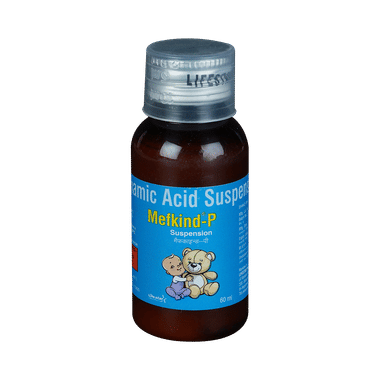
Available alternative from Mankind
Sold out

Trumef 100mg/5ml Suspension
bottle of 60 ml Suspension
₹23.3

Same composition
Mefkind-P Suspension
bottle of 60 ml Suspension
by Mankind Pharma Ltd
Get by 10pm
₹35.8
₹0.51 per ml
₹30.4
order for
₹1200
Save more with additional offers
10% cashback up to 200 on Min Transaction of Rs.1000, for first time users of Airtel Payments Bank.
10% cashback up to 200 on Min Transaction of Rs.1000, for first time users of Airtel Payments Bank.


Get up to ₹75 cashback on a minimum order value (MOV) of ₹499 and above, valid once per customer.
Get up to ₹75 cashback on a minimum order value (MOV) of ₹499 and above, valid once per customer.
Get up to ₹75 cashback on a minimum order value (MOV) of ₹499 and above, valid once per customer.
Get up to ₹75 cashback on a minimum order value (MOV) of ₹499 and above, valid once per customer.
10% cashback up to 200 on Min Transaction of Rs.1000, for first time users of Airtel Payments Bank.
10% cashback up to 200 on Min Transaction of Rs.1000, for first time users of Airtel Payments Bank.
Get up to ₹75 cashback on a minimum order value (MOV) of ₹499 and above, valid once per customer.
Get up to ₹75 cashback on a minimum order value (MOV) of ₹499 and above, valid once per customer.
Get up to ₹75 cashback on a minimum order value (MOV) of ₹499 and above, valid once per customer.
Get up to ₹75 cashback on a minimum order value (MOV) of ₹499 and above, valid once per customer.

Assured cashback up to ₹300*. T&C Apply*
Assured cashback up to ₹300*. T&C Apply*
General Information

The content is shown in English




All substitutes for Trumef 100mg/5ml Suspension
For information purposes only. Consult a doctor before taking any medicine.
Safety advice
Kidney
UNSAFE
Trumef 100mg/5ml Suspension is unsafe to use in patients with kidney disease and should be avoided.

Liver
CAUTION
Trumef 100mg/5ml Suspension should be used with caution in patients with severe liver disease. Dose adjustment may be needed.
References
- Grosser T, Smyth E, FitzGerald GA. Anti-Inflammatory, Antipyretic, and Analgesic Agents; Pharmacotherapy of Gout. In: Brunton LL, Chabner BA, Knollmann BC, editors. Goodman & Gilman’s: The Pharmacological Basis of Therapeutics. 12th ed. New York, New York: McGraw-Hill Medical; 2011. p. 989.
- Mefenamic Acid [FDA Label]. Atlanta, GA: Sciele Pharma, Inc.; 2018. [Accessed 06 Jan. 2021] (online) Available from:

- Mefenamic Acid [Product information]. Sandton, South Africa: Pfizer Laboratories (Pty) Ltd.; 2024. [Accessed 02 Jul. 2025] (online) Available from:
Related products
Products related to Trumef 100mg/5ml Suspension






100% genuine products

Safe & secure payments

No contact delivery

Fully sanitized facilities

Want to know more
We provide you with authentic, trustworthy and relevant information
Have issue with the content
Why we need a prescription?

