






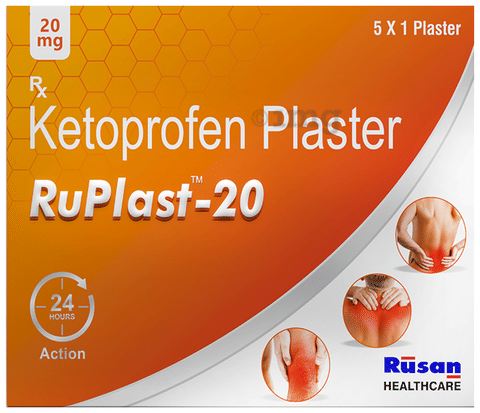
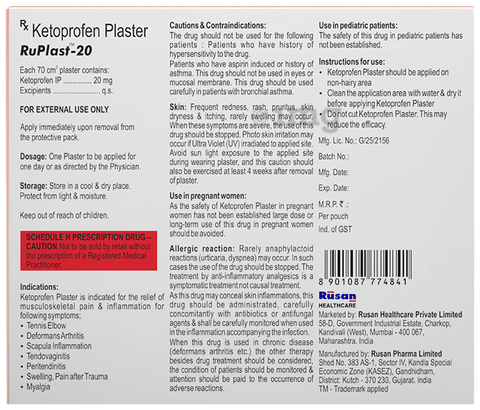


Ruplast 20 Plaster
Ketoprofen (20mg)
 Genuine
Authenticity Assured
 Prescription
required
Ruplast 20 Plaster is a pain-relieving medicine. It is used to treat pain, swelling, stiffness, and joint pain in conditions like rheumatoid arthritis, osteoarthritis, and acute musculoskeletal injuries. It works by blocking the release of certain chemical messengers that cause fever, pain, and inflammation.
Written By Dr. Nikita Saini, MBA, MDS,
Reviewed By Dr. Dheeraj Kumar Sharma, PhD, M.Pharm,
Last updated on 15 Oct 2026 | 01:04 AM (IST)
Written By Dr. Nikita Saini, MBA, MDS,
Reviewed By Dr. Dheeraj Kumar Sharma, PhD, M.Pharm,
Last updated on 15 Oct 2026 | 01:04 AM (IST)
Save more with additional offers

Get upto Rs.150 Cashback on minimum transaction of Rs.599/- with Mobikwik UPI (@ikwik).
Get upto Rs.150 Cashback on minimum transaction of Rs.599/- with Mobikwik UPI (@ikwik).


Get up to ₹75 cashback on a minimum order value (MOV) of ₹499 and above, valid once per customer.
Get up to ₹75 cashback on a minimum order value (MOV) of ₹499 and above, valid once per customer.
Get up to ₹75 cashback on a minimum order value (MOV) of ₹499 and above, valid once per customer.
Get up to ₹75 cashback on a minimum order value (MOV) of ₹499 and above, valid once per customer.
Get upto Rs.150 Cashback on minimum transaction of Rs.599/- with Mobikwik UPI (@ikwik).
Get upto Rs.150 Cashback on minimum transaction of Rs.599/- with Mobikwik UPI (@ikwik).
Get up to ₹75 cashback on a minimum order value (MOV) of ₹499 and above, valid once per customer.
Get up to ₹75 cashback on a minimum order value (MOV) of ₹499 and above, valid once per customer.
Get up to ₹75 cashback on a minimum order value (MOV) of ₹499 and above, valid once per customer.
Get up to ₹75 cashback on a minimum order value (MOV) of ₹499 and above, valid once per customer.

Assured cashback up to ₹300*. T&C Apply*
Assured cashback up to ₹300*. T&C Apply*
General Information

The content is shown in English



Safety advice

Alcohol
No interaction found/established

Pregnancy
CONSULT YOUR DOCTOR
Information regarding the use of Ruplast 20 Plaster during pregnancy is not available. Please consult your doctor.

Breast feeding
CONSULT YOUR DOCTOR
Information regarding the use of Ruplast 20 Plaster during breastfeeding is not available. Please consult your doctor.

Driving
No interaction found/established

Kidney
CAUTION
Ruplast 20 Plaster should be used with caution in patients with kidney disease. Dose adjustment may be needed.

Liver
CAUTION
Ruplast 20 Plaster should be used with caution in patients with liver disease. Dose adjustment may be needed.
Related products
Products related to Ruplast 20 Plaster






100% genuine products

Safe & secure payments

No contact delivery

Fully sanitized facilities

Want to know more
We provide you with authentic, trustworthy and relevant information
Have issue with the content
Why we need a prescription?

