
“My vitamin D is low” has almost become a default assumption these days. Everyone seems to say it, and a lot of people just start popping a pill without ever actually checking their levels first. But guessing your dose without knowing where you stand can do more harm than good.
That’s exactly why your safe vitamin D dosage isn’t a one-size-fits-all number. So let’s look at the basics: how much you need, how much is too much, and where to get it.
Vitamin D helps your body absorb calcium, the main building block for strong bones [1]. It also plays a role in muscle function and your immune system. But your needs change based on your age, health, and how much sun you get, so there isn’t a single number that works for everyone.
How Much Vitamin D Do You Actually Need? Your Safe Vitamin D Dosage By Age
Here’s where the confusion usually starts. The Recommended Dietary Allowance (RDA) for vitamin D is
| Age group | RDA per day |
| Infants, children, and teens | 10–15 mcg (400–600 IU) |
| Adults (19-70 years) | 15 mcg (600 IU) |
| Adults 71 and older | 20 mcg (800 IU) a day |
| Pregnant and breastfeeding women | 15 mcg (600 IU) |
A quick caveat
- This RDA assumes you’re getting very little sun exposure, since sunlight is a major natural source of vitamin D for many people [2].
- If you spend plenty of time outdoors, your actual dietary need might be lower.
- RDA numbers are a general guide, not a personal prescription; your ideal safe vitamin D dosage depends on your blood levels, lifestyle, and any health conditions your doctor already knows about.
What Happens If You Don’t Get Enough?
Not getting enough vitamin D comes with its own problems. Since vitamin D helps you absorb calcium, low levels over time can weaken your bones [2]
Common signs of deficiency
- Bone pain
- Muscle weakness
- Fatigue
- Softening of bones (osteomalacia) in adults, or rickets in children [3]
However, many people with mild deficiencies don’t feel anything obvious at all. That’s actually one of the trickiest parts; you often can’t tell just by how you feel.
How To Check Your Levels
A simple blood test, called the 25-hydroxy vitamin D test, is the most reliable way to know where you stand [2]. For example, someone who spends most of their day indoors, works night shifts, or consistently covers up outdoors might not realize they’re running low until a routine check-up flags it. That’s exactly why guessing based on symptoms alone isn’t a great strategy.
Tolerable Upper Intake Level (UL): The Ceiling For A Safe Vitamin D Dosage
- Ranges from 25 to 100 mcg (1,000 to 4,000 IU) a day, depending on your age [2].
- Going consistently above this, especially through high-dose supplements, is where things start getting risky
- Vitamin D toxicity almost always occurs from taking too many supplements, not from spending time in the sun [2].
- Your skin actually limits how much vitamin D it produces from sunlight, so sunbathing all day won’t push you into dangerous territory
Signs Of Taking Too Much
- Nausea and vomiting
- Poor appetite
- Constipation
- Weakness
- Unexpected weight loss
- In more serious cases, too-high blood calcium, which may lead to confusion, kidney problems, or an irregular heartbeat [2]
So more definitely isn’t always better here.
Staying within a safe vitamin D dosage is what gets you the benefits without the risk.
Sources Of Vitamin D

Sunlight is generally the easiest way to raise your blood vitamin D levels since your skin makes it from cholesterol when exposed to UV rays [2]. But if you don’t get much natural sun, whether due to climate, indoor lifestyles, or skin covering, food and supplements need to fill the gap.
Sunlight
- Your body naturally produces vitamin D3 when skin is exposed to UVB rays [2]
- Cloud cover, pollution, sunscreen, and skin exposure all affect how much your body makes
- You can’t overdose on vitamin D from sun alone, since your skin limits production [2]
Foods Rich In Vitamin D
Very few foods are naturally great sources, but a handful stand out.
- Cod liver oil
- Swordfish
- Salmon
- Canned tuna
- Beef liver
- Egg yolks
Many packaged foods, like fortified milk, are also topped up with added vitamin D.
Supplements
- Fill the gap for people who don’t get enough from food or sun
- Come in two forms, D2 and D3
- Should be discussed with a doctor first, especially if you’re on other medications
D2 vs. D3: Does the Form Actually Matter?Vitamin D supplements vary in quality. D2 (ergocalciferol) comes from plants and fungi, while D3 (cholecalciferol) is the same form your skin makes in the sun. Both raise your blood levels, but D3 tends to raise it higher and keep it up for longer, which is why it’s usually the preferred pick on supplement shelves [1]. |
A Quick Word On Supplement Interactions
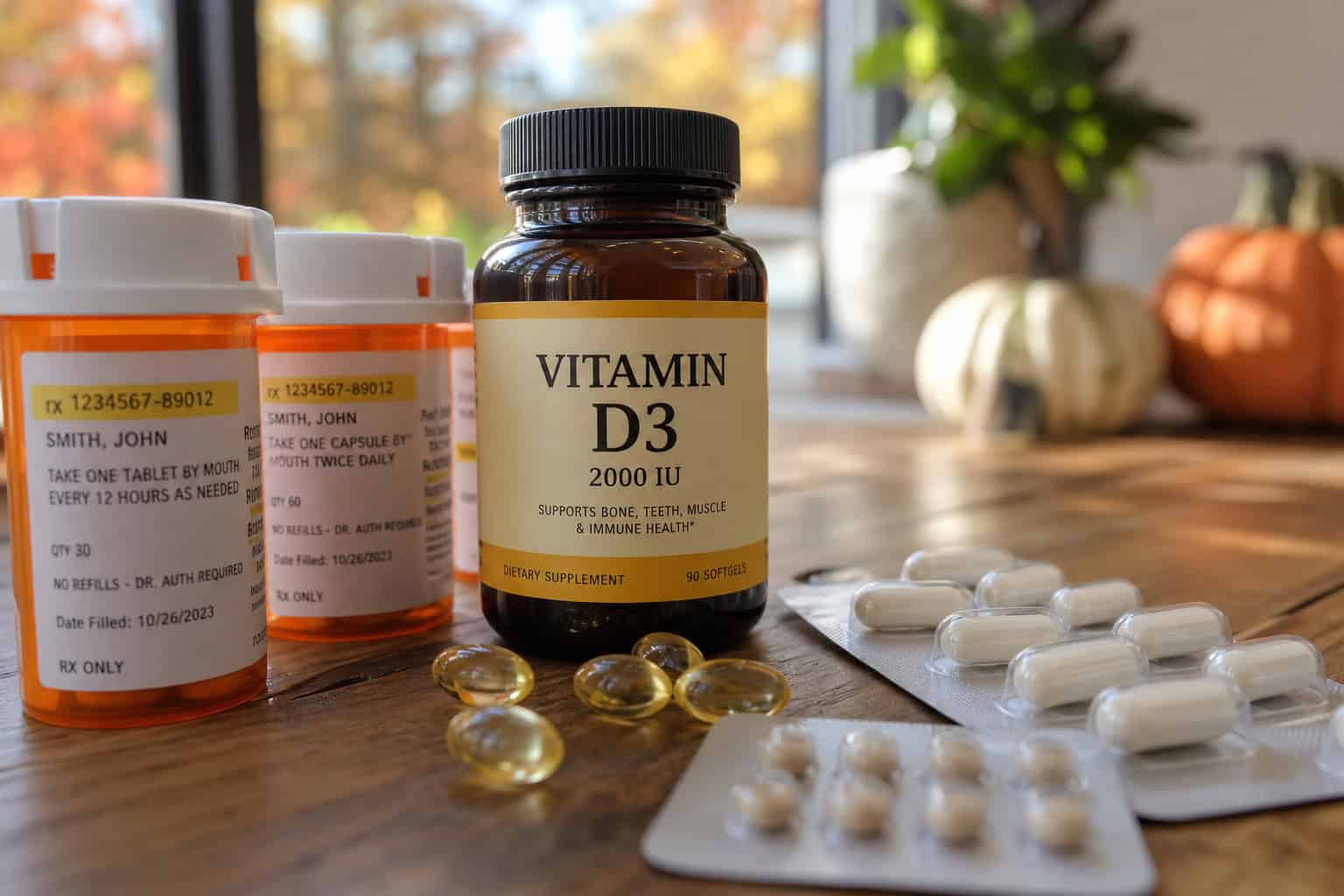
Vitamin D can interact with certain medicines [1]:
- Statins: High-dose vitamin D might make cholesterol-lowering statins less effective
- Steroids: Medicines like prednisone can lower your vitamin D levels
- Thiazide diuretics: Could push your blood calcium too high if combined with vitamin D supplements [2].
That’s another reason a quick chat with your doctor or pharmacist before starting supplements is genuinely worth the five minutes.
Who Might Need A Higher Vitamin D Intake?
Some people need more than the standard dose to stay in a healthy range [2,3]:
- Older adults, since skin becomes less efficient at making vitamin D with age
- People with limited sun exposure, whether due to lifestyle, clothing, or climate
- People with darker skin, which naturally reduces vitamin D production from sunlight
- Anyone with a condition that affects fat absorption, like celiac disease or Crohn’s disease, since vitamin D needs fat to be absorbed properly.
Note: If you fall into one of these groups, your safe vitamin D dosage may need to be adjusted by your doctor, rather than guessed.
The Bottom Line
Getting your safe vitamin D dosage right isn’t about guessing or following whatever a supplement bottle says. For most healthy adults, staying within 600 to 800 IU a day through food, sun, and supplements covers your needs, while going too far past the upper limit of 4,000 IU a day, especially long-term, can cause real harm. If you’re unsure where you stand, a simple blood test and a conversation with your doctor will tell you far more than guesswork ever could.
FAQs
Can I take vitamin D every day safely?
Yes, daily vitamin D within the recommended range is considered safe for most people. Problems usually only show up with very high, sustained doses well above the upper limit.
What’s the best time to take vitamin D, morning or night?
There’s no strict rule here since vitamin D is fat-soluble, so taking it with a meal that has some fat helps your body absorb it better, whatever time of day works for you.
Can too much sun give me vitamin D toxicity?
No, your skin naturally limits how much vitamin D it produces from sunlight. Vitamin D toxicity almost always comes from overdoing supplements, not sun exposure.
How do I know if I’m vitamin D deficient?
The only reliable way is a blood test called the 25-hydroxy vitamin D test. Symptoms like fatigue or bone pain can be too vague to self-diagnose.
Does vitamin D help with immunity?
Vitamin D plays a role in normal immune function, and low levels have been linked to a higher chance of respiratory infections in some studies. However, it’s not a guaranteed fix, so it works best alongside overall healthy habits.
Can I take vitamin D and calcium together?
Yes, they’re often taken together since vitamin D helps your body absorb calcium. That said, combining high-dose supplements of both should be discussed with a doctor, since it may raise certain risks.
Is vitamin D deficiency common in India?
Vitamin D deficiency is fairly common even in sunny regions, often due to limited direct sun exposure, indoor lifestyles, and skin covering. If you suspect low levels, a simple blood test can confirm it.
What’s better, vitamin D2 or D3?
Both forms raise your blood vitamin D levels, but D3 tends to raise it higher and keep it up for longer than D2. For this reason, D3 is generally the preferred choice if you’re taking a supplement.
How do I take vitamin D correctly?
Start by discussing your specific needs with a doctor, who can advise whether you need supplements and how much. If you do take a supplement, follow the dosing instructions on the package and pair it with a meal containing some fat for better absorption.
References:
1. Vitamin D – Consumer. National Institutes of Health (NIH), Office of Dietary Supplements (ODS). Available online at https://ods.od.nih.gov/factsheets/VitaminD-Consumer/
2. Vitamin D – Health Professional Fact Sheet. National Institutes of Health (NIH), Office of Dietary Supplements (ODS). Available online at https://ods.od.nih.gov/factsheets/VitaminD-HealthProfessional/
3. Bone Health & Osteoporosis Foundation. Calcium and vitamin D requirements, recommended foods & supplements [Internet]. Arlington (VA): Bone Health & Osteoporosis Foundation; 2023 [cited 2026 Aug 24]. Available online at https://www.bonehealthandosteoporosis.org/patients/treatment/calciumvitamin-d/
(The article is written by Nancy Dixit, Associate Manager, Clinical Health & Content, Medical Affairs, and reviewed by Monalisa Deka, Deputy Manager, Clinical Health & Content, Medical Affairs.)
Recommended Reads:
Simple Habits to Boost Vitamin D and Lower Cortisol Levels Naturally
Mushrooms And Vitamin D: Best Varieties For Vitamin D And How To Eat More Of Them