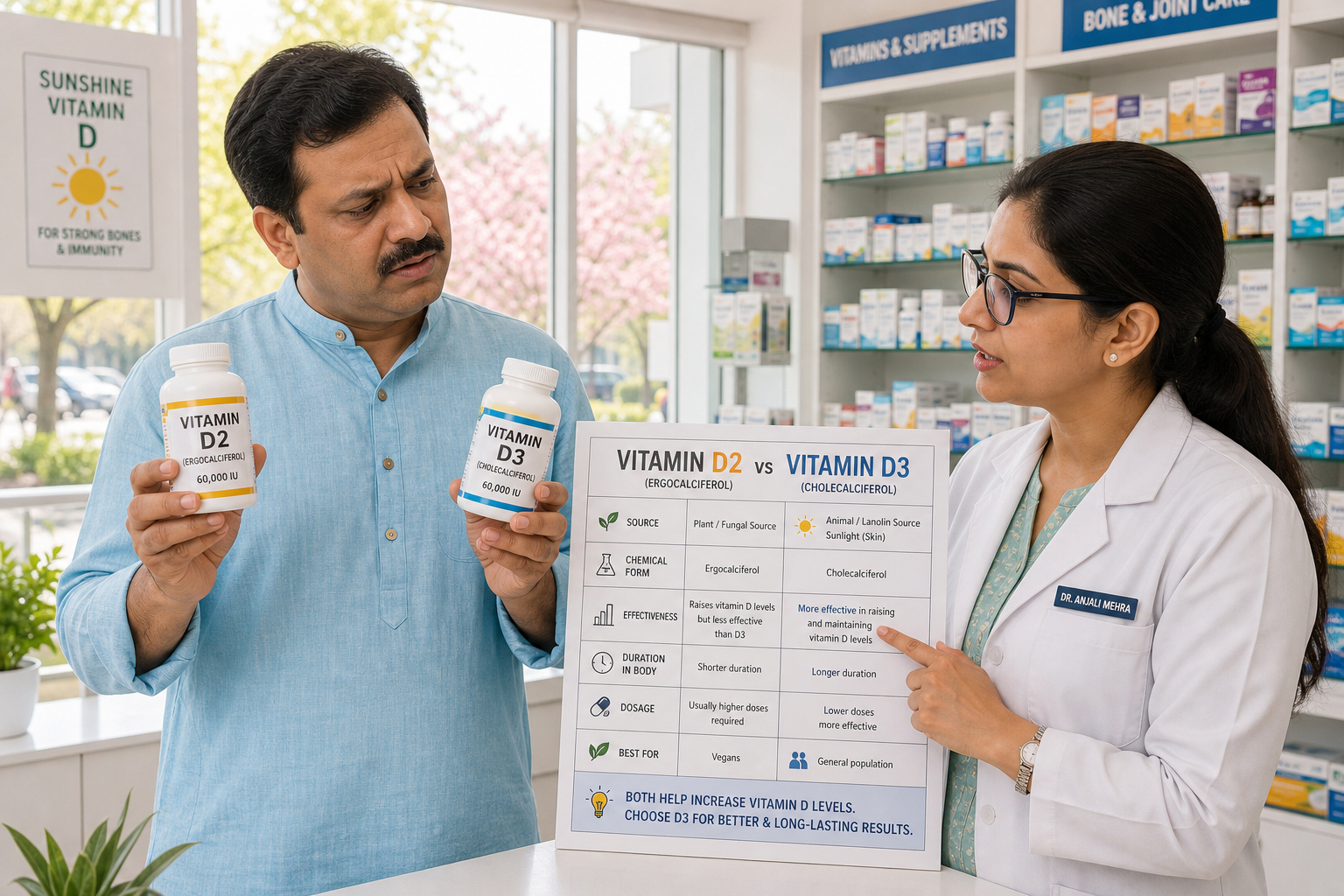
Walk into any pharmacy, and you’ll find vitamin D bottles labelled two different ways: D2 and D3. They sound almost identical. But they’re not the same, and picking the wrong one could mean your supplement isn’t doing much for you. So, vitamin D2 vs D3 – does it really matter which one you take?
Short answer: yes, it does. Let’s break down what the research shows, so you can choose the one that works best for your body.
What Is Vitamin D, and Why Does the Form Matter?
Vitamin D isn’t really a single vitamin – it’s a family of two related compounds:
1. Vitamin D2 (ergocalciferol)
Comes from plants and fungi
2. Vitamin D3 (cholecalciferol)
It comes from animal sources, and it’s also the form your own skin makes when sunlight hits it [1]
However, once either form enters your body, it needs two conversion steps before it can actually work:
- Liver turns it into 25-hydroxyvitamin D
- Kidneys convert that into the active hormone your cells actually use [2]
Both D2 and D3 follow this pathway, but they don’t travel through it equally well, as we’ll see below.
Did You Know? Vitamin D Helps Calcium Do Its JobVitamin D is a fat-soluble vitamin that promotes the absorption of calcium. Vitamin D and calcium work as a team, but mostly in one direction. Once vitamin D is converted into its active form, it helps your gut absorb calcium more efficiently [2]. So, vitamin D helps your body use calcium, but you don’t necessarily need to take both supplements together [2]. |
Vitamin D2 vs D3: What’s Actually Different?
Here’s a quick side-by-side, and then we’ll get into the detail:
| Vitamin D2 | Vitamin D3 | |
| Also called | Ergocalciferol | Cholecalciferol |
| Common sources | Plants, fungi, and fortified foods | Sunlight, animal products, and fortified foods |
| Effectiveness | Slightly less potent | Slightly more potent |
| Supplements | Often used in high-dose prescriptions, and for people following a strict vegan diet | Often found in over-the-counter supplements; may also be prescribed |
At the chemical level, D2 and D3 look almost the same, with one small difference in their side chain structure [1]. That tiny difference matters because the following are true:
- This changes how well each form binds to the protein that carries vitamin D through your blood [1]
- It affects how quickly your body breaks each form down [1]
- D3 tends to stick around in your bloodstream longer than D2 does, giving your body more time to convert it into its active, usable form.
Which One Absorbs Better? Vitamin D Absorption, According to Research
Here’s where the real difference shows up. Studies comparing the two forms consistently point the same way:
- D3 raises your blood vitamin D levels more than D2 does, especially when taken as one large dose rather than small daily ones [3]
- Out of 14 studies comparing the two forms, most found D2 fell short of D3 at raising total vitamin D in the blood [4]
- The gap between D2 and D3 shows up most clearly with high, occasional doses – with small daily doses, the difference is smaller [5]
- For correcting an actual vitamin D deficiency, D3 is now considered the more effective and reliable option [2]
So while D3 is usually the better choice, how much better it is depends on your dose and how often you take it.
Food Sources: Where You Actually Get D2 and D3

Even better, you don’t have to rely on supplements alone. Both forms show up naturally in food, just from very different places.
If there’s one thing most people already know about vitamin D, it’s that sunlight helps your body make it – that’s why it’s often called the “sunshine vitamin”. But what sunlight actually does is support the synthesis of D3 specifically. Vitamin D2 isn’t created by sunlight at all.
Vitamin D2 Sources
- Mushrooms exposed to UV light
- Fortified plant-based milks, cereals, juices
Vitamin D3 sources
- Fatty fish, such as salmon, mackerel, and sardines
- Animal products like egg yolks and liver
- Fortified dairy products, like cow’s milk and yogurt
- Your own skin, after sun exposure
Plus, many fortified products – like milk, cereal, and plant-based milk alternatives – use either D2 or D3, so it’s worth checking the label if you’re specifically trying to boost one form.
Vitamin D2 vs D3: Which Should You Take as a Supplement?
So, does this mean you should always reach for D3? For most people, yes:
Vitamin D3 Supplements
D3 is generally the better pick if you’re correcting a deficiency or just maintaining healthy levels, since it’s more effective at raising your blood levels [2], [3]
Vitamin D2 Supplements for Vegans
D2 still matters for strict vegans since it’s plant-derived, while D3 supplements are usually made from animal sources like lanolin (from sheep’s wool) or fish oil.
Some newer D3 supplements are made from lichen instead, making them vegan-friendly too, so it’s worth checking the label if that’s a priority for you.
Browse a range of vitamin D supplements on Tata 1mg. Shop Vitamin D.
How Much Vitamin D Do You Actually Need?

Even better, there are clear numbers to work with here:
Vitamin D Dosage for Healthy Adults
400 to 800 IU a day to maintain normal levels. Adults over 65 are often advised to aim for 800 to 1,000 IU daily [2].
Vitamin D Dosage for Deficiency
If you’re actually deficient, doctors often recommend a higher short-term dose – sometimes 6,000 IU daily or a large weekly dose – before dropping down to a regular maintenance amount once your levels normalize [2].
That said, the dosage really should be guided by an actual blood test and your doctor’s advice, not guesswork.
Quick safety note: If you have kidney disease, a history of kidney stones, or take diuretics, steroids, or heart medicines, talk to your doctor before taking high-dose vitamin D. Your dose may need to be adjusted based on your health and medications.
Who’s Most at Risk of Low Vitamin D?
Additionally, some groups are far more likely to run low, regardless of which form they take:
- People who get very little sun exposure
- Older adults, since skin becomes less efficient at making D3 with age [2]
- People with darker skin tones, since more melanin reduces how much D3 the skin produces from sunlight [2]
- Anyone with a condition affecting fat absorption, since vitamin D is fat-soluble
- People who consistently use sunscreen or cover most of their skin outdoors
In contrast, vitamin D deficiency isn’t rare – it’s estimated to affect close to a billion people worldwide, cutting across both developed and developing countries [2].
D2 or D3? Here’s What to Look For
So, does the form really matter? Yes, D3 raises your blood levels more reliably than D2, especially at higher, less frequent doses, and it’s now the preferred option for correcting a deficiency. That said, D2 still has a real place for people following a strict vegan diet, since it’s plant-derived.
Whichever one you pick, check the label for the actual compound name, look for third-party testing marks, and match the dose to what your doctor recommends. Your specific needs – diet, sun exposure, and current levels – matter more than the label on the bottle.
Disclaimer: This article is for general health awareness only and isn’t a substitute for professional medical advice. Vitamin D needs vary by individual, so please consult a doctor or get a blood test before starting, changing, or stopping any supplement.
FAQs
Is vitamin D3 always better than vitamin D2?
For most people, yes – D3 raises blood vitamin D levels more effectively [3], [4]. But D2 still works, and it’s the only option for people avoiding animal-derived supplements entirely.
Can I take vitamin D2 and D3 together?
There’s no strong reason to combine them. Most guidelines focus on picking one form and taking a consistent, appropriate dose rather than mixing both.
How long does it take for vitamin D3 to raise your levels?
It varies by dose and your starting level, but noticeable changes in blood levels typically show up within a few weeks of consistent supplementation.
Does sunlight give you D2 or D3?
Sunlight only produces D3. Your skin can’t make vitamin D2 at all – that form comes exclusively from plants, fungi, or fortified foods [1].
Is vitamin D2 vegan?
Yes. Vitamin D2 comes from plant and fungal sources, making it naturally vegan. Most D3 supplements aren’t vegan unless specifically labeled as lichen-derived.
What happens if you take too much vitamin D?
Vitamin D is fat-soluble, so excess amounts can build up in your body. Very high blood levels can lead to toxicity, so daily amounts above 4,000 IU generally aren’t recommended without medical supervision [2].
Do I need a prescription for vitamin D3?
In most cases, no – standard-dose D3 is available over the counter. Higher prescription-strength doses are sometimes used for correcting significant deficiencies under medical supervision.
Can vitamin D deficiency cause fatigue?
Yes, ongoing low vitamin D levels are linked to muscle weakness and fatigue, along with bone pain in more severe, prolonged cases [2].
What are the symptoms of vitamin D deficiency?
Most people with low vitamin D have no symptoms at all. When symptoms do show up, they usually include bone pain, joint or muscle aches, muscle weakness, and fatigue [2].
What can vitamin D deficiency lead to if left untreated?
Long-term deficiency can weaken bones, raising the risk of osteoporosis, fractures, and falls – and in children, it can cause rickets, which affects bone growth [2].
References:
1. Vitamin D: Production, Metabolism, and Mechanism of Action. Endotext, NCBI Bookshelf. Available from: https://www.ncbi.nlm.nih.gov/books/NBK278935/
2. Vitamin D Deficiency. StatPearls, NCBI Bookshelf. Available from: https://www.ncbi.nlm.nih.gov/books/NBK532266/
3. Tripkovic L, Lambert H, Hart K, et al. Comparison of vitamin D2 and vitamin D3 supplementation in raising serum 25-hydroxyvitamin D status: a systematic review and meta-analysis. Am J Clin Nutr. 2012;95(6):1357-1364. Available from: https://pmc.ncbi.nlm.nih.gov/articles/PMC3349454/
4. Pharmacokinetics of vitamin D2 and D3 supplementation. PMC. Available from: https://pmc.ncbi.nlm.nih.gov/articles/PMC6797055/
5. Balachandar R, Pullakhandam R, Kulkarni B, Sachdev HS. Relative Efficacy of Vitamin D2 and Vitamin D3 in Improving Vitamin D Status: Systematic Review and Meta-Analysis. Nutrients. 2021;13(10):3328. Available from: https://pmc.ncbi.nlm.nih.gov/articles/PMC8538717/
6. Effectiveness of vitamin D2 compared with vitamin D3 supplementation. PMC. Available from: https://pmc.ncbi.nlm.nih.gov/articles/PMC9372493/
7. Relative efficacy of vitamin D2 vs D3 meta-regression in adults. PMC. Available from: https://pmc.ncbi.nlm.nih.gov/articles/PMC7259151/
(The article is written by Nancy Dixit, Associate Manager, Clinical Health & Content, Medical Affairs, and reviewed by Monalisa Deka, Deputy Manager, Clinical Health & Content, Medical Affairs.)
Recommended Reads:
Simple Habits to Boost Vitamin D and Lower Cortisol Levels Naturally
Clinically Explained Vitamin D Supplements: Benefits, Dosage & Timing