If you look at the ingredient list on almost any energy drink, you will spot taurine right near the top. Because of this heavy association, most people naturally assume it is a harsh artificial stimulant designed to keep your heart racing. The reality is actually the exact opposite. Taurine is a naturally occurring amino acid that your body already produces on its own. Instead of acting like a stimulant, taurine is involved in processes that support your nervous system, heart, muscles, and cellular balance. So how did a relaxing biological compound become the face of extreme energy beverages? Let us separate the clever marketing myths from the actual clinical science and explore what this powerful nutrient really does for your health.
What Exactly Is Taurine?
Despite its common association with energy drinks, taurine is actually a naturally occurring amino acid. But it is a little different from the amino acids your body uses to build proteins. Instead, it is scientifically classified as an amino sulfonic acid and plays a major role in keeping your basic cellular functions running smoothly. You do not strictly need to consume it, as your body can produce it on its own. Your liver naturally creates taurine from other amino acids and distributes it to the organs that need it most [1].
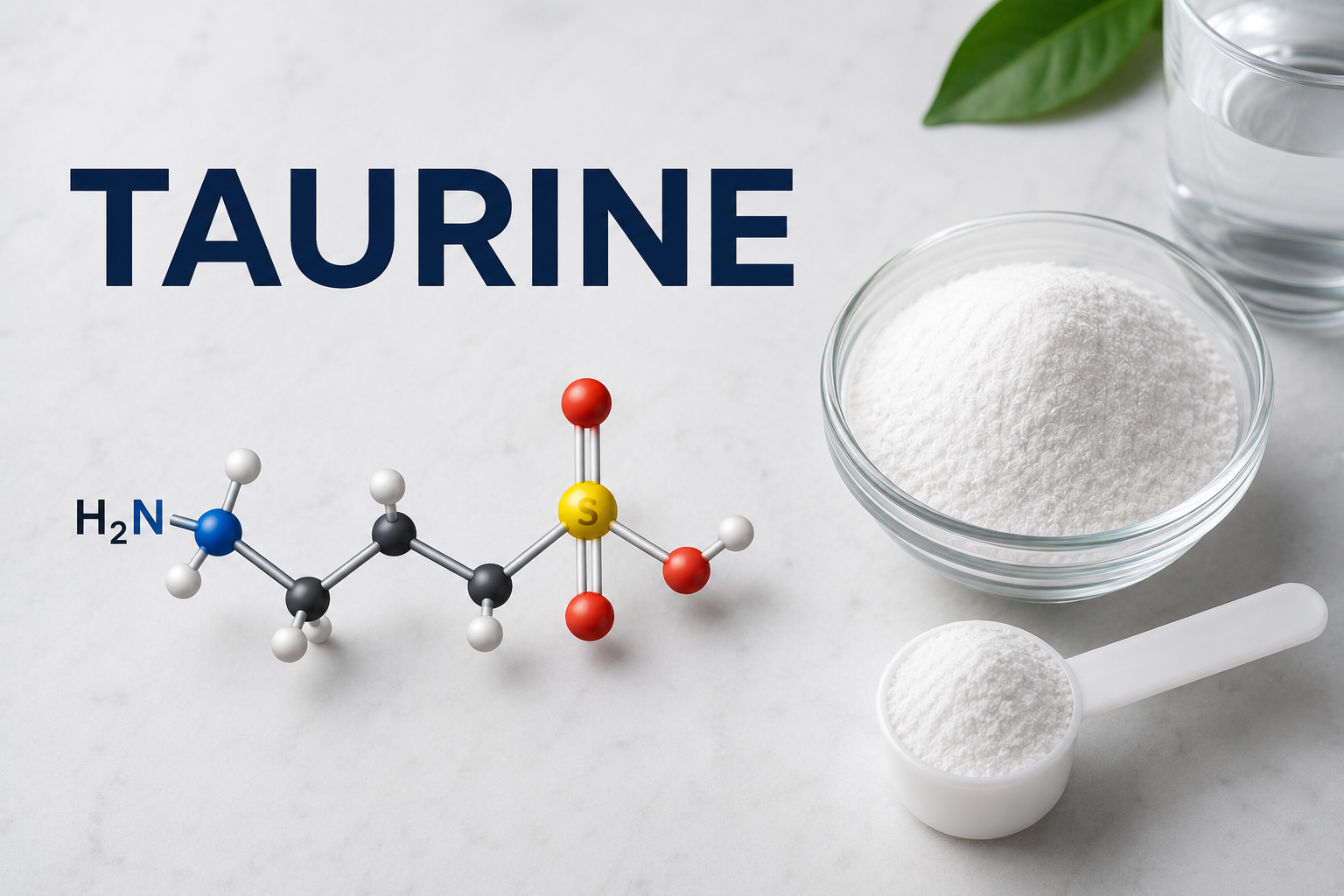
Because of this constant natural production, you will find high concentrations of it stored directly inside your brain, your retina, your heart, and your skeletal tissues. While your body makes a steady supply internally, you also absorb quite a bit from a standard diet. It is heavily concentrated in animal-based foods like meat, seafood, and dairy. This means people who eat a strict plant-based diet often have lower internal levels. But since it is naturally produced inside us, calling it an artificial chemical is completely inaccurate [2].
What Does Taurine Do For Your Body, And How Much Do You Need?
Taurine may not get as much attention as caffeine, but your body certainly knows what to do with it. It is involved in regulating cell volume, mineral movement, and the stability of cell membranes, while also supporting normal function in tissues such as the heart, brain, and muscles [1, 4]. Researchers are also studying its role in energy metabolism, antioxidant defence, glucose regulation, and exercise-related muscle function [4].
One controlled trial put this antioxidant angle to the test directly. Women aged 55 to 70 took 1.5 grams of taurine daily for 16 weeks, and researchers recorded a rise in the enzyme superoxide dismutase, a key part of the body’s natural antioxidant defence, along with lower markers of cell damage compared to a placebo group [3].
But here’s the interesting part: your body already makes taurine, so healthy adults don’t have an established daily requirement for it. You can also get some from foods such as meat and seafood [1, 2]. When taurine is taken as a supplement, studies have used a wide range of doses. Research on exercise has commonly explored amounts around 1 to 3 grams, while some studies have used higher doses [4].
These are research doses, however, not a recommended daily allowance. The right amount, if any, depends on why you’re taking it and your individual circumstances. The good news is that your body has a built-in way of keeping taurine levels in check. The kidneys help regulate taurine and remove excess through urine.
Why Is Taurine In Energy Drinks?
If taurine doesn’t provide the instant buzz you get from caffeine, you might wonder why energy drinks contain it in the first place. The answer isn’t as simple as “it gives you energy.” Taurine is involved in several processes related to muscle function, cellular balance, and nervous-system activity, which makes it an interesting ingredient for products marketed around physical and mental performance. [1, 2] Some research has also explored whether taurine may influence the effects of caffeine when the two are consumed together. But the evidence doesn’t support treating taurine as the main source of an energy drink’s stimulating effect. That reputation largely belongs to caffeine, which is the primary stimulant in these beverages.
Myth Buster: Does Taurine Come From Bull Sperm?
If you have ever heard the wild internet rumour that taurine is extracted from bull sperm, you are definitely not alone. This bizarre myth has circulated for years, and it actually traces back to simple science history. The name ‘taurine’ comes from the Latin word ‘taurus’, meaning ‘bull’. When scientists first isolated this amino acid back in 1827, they discovered it inside ox bile. Naturally, they gave it an animal-inspired name, and the label simply stuck for centuries.
But there is zero reason to panic about your favourite beverage or daily supplement. The taurine used in modern commercial drinks and nutritional powders is manufactured entirely in sterile pharmaceutical labs. It is synthesised completely from scratch, making it one hundred per cent vegan and safe for anyone to consume. No animals are involved in making the taurine sitting on grocery store shelves today.
Is Taurine Safe?
Taurine is far from the dangerous artificial stimulant many people think it is. It is a natural biological protector that keeps your heart, brain, and cells functioning smoothly. When it comes to overall safety, you really do not have much to worry about. Clinical research shows that supplementing with taurine is highly safe for most healthy adults because your kidneys naturally filter out whatever your body does not need. Just remember that getting your daily dose through sugary, high-caffeine energy drinks is never a healthy strategy. Stick to natural food sources or clean dietary supplements to safely enjoy its metabolic benefits.
FAQs
What exactly is taurine?
It is a naturally occurring amino acid that supports your heart, brain and overall cellular hydration.
Does taurine give you energy?
No. It actually calms your nervous system and helps smooth out the harsh effects of caffeine.
Is taurine safe to take every day?
Yes. Your body produces it naturally and your kidneys easily filter out whatever your cells do not need.
Can your body produce taurine naturally?
Yes. Your body can synthesise taurine from other amino acids, while dietary sources include meat, seafood and dairy.
Can taurine supplements cause side effects?
Taurine appears generally well tolerated, although reported side effects have included nausea, stomach discomfort and headaches at higher intakes.
References
1-Antonio J, Antonio B, Arent SM, Candow DG, Escalante G, Evans C, et al. Common questions and misconceptions about energy drinks: what does the scientific evidence really show? Nutrients. 2025;17(1):67. doi:10.3390/nu17010067.
2-Curran CP, Marczinski CA. Taurine, caffeine, and energy drinks: reviewing the risks to the adolescent brain. Birth Defects Res. 2017;109(20):1640-1648. doi:10.1002/bdr2.1177.
3- Abud GF, De Carvalho FG, Batitucci G, Travieso SG, Bueno Junior CR, Barbosa Junior F, et al. Taurine as a possible antiaging therapy: a controlled clinical trial on taurine antioxidant activity in women ages 55 to 70. Nutrition. 2022;101:111706. doi:10.1016/j.nut.2022.111706.
4- Chen Q, Li Z, Pinho RA, Gupta RC, Ugbolue UC, Thirupathi A, et al. The dose-response of taurine on aerobic and strength exercises: a systematic review. Front Physiol. 2021;12:700352. doi:10.3389/fphys.2021.700352.
(The article is written by Ehsan Siddiqui, Team Lead, Clinical Health & Content and reviewed by Monalisa Deka, Senior Health Content Editor)
Recommended Reads:
Simple Habits to Boost Vitamin D and Lower Cortisol Levels Naturally
Clinically Explained Vitamin D Supplements: Benefits, Dosage & Timing