








Trimach 20mg Tablet
Trimetazidine (20mg)
 Genuine
Authenticity Assured
 Prescription
required
Trimach 20mg Tablet is used to treat angina pectoris, a condition marked by chest pain due to reduced blood flow to the heart. It helps the heart work more efficiently by improving how it uses oxygen. It protects heart cells during reduced oxygen supply, helping reduce the number and severity of angina attacks.
Written By Dr. Subita Alagh, BDS,
Reviewed By Dr. Rajeev Sharma, MBA, MBBS,
Last updated on 22 Aug 2026 | 01:05 AM (IST)
Written By Dr. Subita Alagh, BDS,
Reviewed By Dr. Rajeev Sharma, MBA, MBBS,
Last updated on 22 Aug 2026 | 01:05 AM (IST)
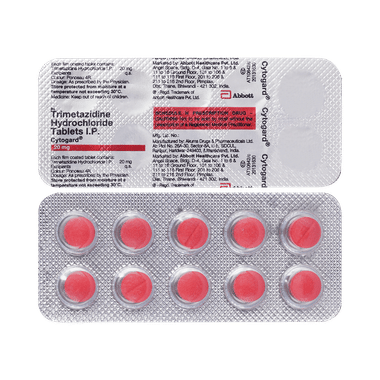
Available alternative from Abbott
Sold out

Trimach 20mg Tablet
strip of 10 tablets
₹41.6

Same composition
Cytogard Tablet
strip of 10 tablets
by Abbott
Get by Tomorrow
₹148
₹12.6 per tablet
₹126
order for
₹1200
Save more with additional offers

Get up to ₹75 cashback on a minimum order value (MOV) of ₹499 and above, valid once per customer.
Get up to ₹75 cashback on a minimum order value (MOV) of ₹499 and above, valid once per customer.

Get up to ₹75 cashback on a minimum order value (MOV) of ₹499 and above, valid once per customer.
Get up to ₹75 cashback on a minimum order value (MOV) of ₹499 and above, valid once per customer.

Flat Rs.150 on a Min Transaction of Rs.1000.
Flat Rs.150 on a Min Transaction of Rs.1000.
Get up to ₹75 cashback on a minimum order value (MOV) of ₹499 and above, valid once per customer.
Get up to ₹75 cashback on a minimum order value (MOV) of ₹499 and above, valid once per customer.
Get up to ₹75 cashback on a minimum order value (MOV) of ₹499 and above, valid once per customer.
Get up to ₹75 cashback on a minimum order value (MOV) of ₹499 and above, valid once per customer.
Flat Rs.150 on a Min Transaction of Rs.1000.
Flat Rs.150 on a Min Transaction of Rs.1000.

Assured cashback up to ₹300*. T&C Apply*
Assured cashback up to ₹300*. T&C Apply*
General Information

The content is shown in English




All substitutes for Trimach 20mg Tablet
For information purposes only. Consult a doctor before taking any medicine.
Flavedon 20 Tablet
by Servier India Private Limited
₹12.2/tablet
193% costlier
Carvidon 20 Tablet
by Micro Labs Ltd
₹8.7/tablet
109% costlier
Cytogard Tablet
by Abbott
₹14.8/tablet
256% costlier
Metagard Tablet
by Ipca Laboratories Ltd
₹9.09/tablet
119% costlier
Myovedon 20mg Tablet
by Veritaz Healthcare Ltd
₹10.1/tablet
143% costlier
Safety advice

Alcohol
CONSULT YOUR DOCTOR
It is not known whether it is safe to consume alcohol with Trimach 20mg Tablet. Please consult your doctor.

Pregnancy
CONSULT YOUR DOCTOR
The safety of Trimach 20mg Tablet during pregnancy has not been established. There are no adequate and well-controlled studies in pregnant women, and animal data on reproductive toxicity are insufficient. Your doctor will weigh the benefits and any potential risks before prescribing.

Breast feeding
CONSULT YOUR DOCTOR
Information regarding the use of Trimach 20mg Tablet during breastfeeding is not available. Please consult your doctor.

Driving
UNSAFE
Trimach 20mg Tablet may decrease alertness, affect your vision, or make you feel sleepy and dizzy. Do not drive if these symptoms occur.
Kidney
CAUTION
Trimach 20mg Tablet should be used with caution in patients with kidney disease. Dose adjustment may be needed.
Use of Trimach 20mg Tablet is contraindicated in patients with severe kidney disease.
Use of Trimach 20mg Tablet is contraindicated in patients with severe kidney disease.

Liver
CONSULT YOUR DOCTOR
There is limited data available on the use of Trimach 20mg Tablet in patients with liver disease.

References
- CiplaMed: Trimetazidine dihydrochloride [Prescribing Information]. [Accessed 29 Apr. 2025]. (online) Available from:

- Trimetazidine [Summary of Product Characteristics]. Suresnes, France: Les Laboratoires Servier; 2021. [Accessed 29 Apr. 2025]. Available from:
- Trimetazidine dihydrochloride [Prescribing Information]. Indrad, Mehsana: Torrent Pharmaceuticals Ltd. [Accessed 29 Apr. 2025]. (online) Available from:
- Central Drugs Standard Control Organisation (CDSCO). [Accessed 19 Mar. 2019] (online) Available from:
Related products
Products related to Trimach 20mg Tablet




100% genuine products

Safe & secure payments

No contact delivery

Fully sanitized facilities

Want to know more
We provide you with authentic, trustworthy and relevant information
Have issue with the content
Why we need a prescription?

