






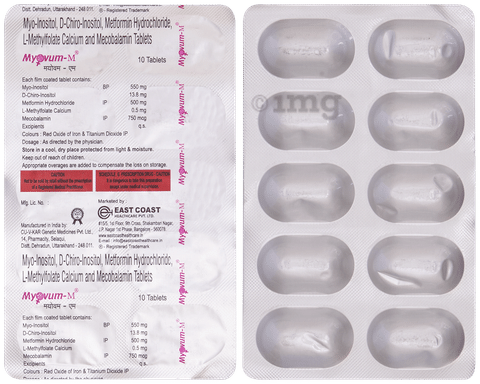
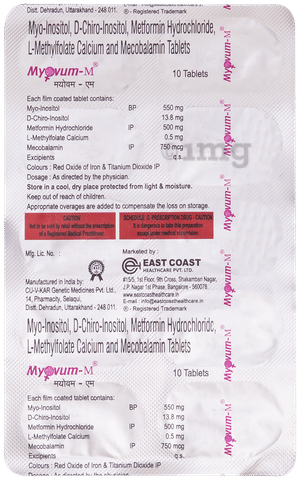

Myovum-M Tablet
Myo-Inositol (550mg)+ D-Chiro Inositol (13.8mg)+ Metformin (500mg)+ L-Methyl Folate Calcium (0.5mg)+ Methylcobalamin (750mcg)
 Genuine
Authenticity Assured
 Prescription
required
Myovum-M Tablet is a combination of medicines used in the treatment of polycystic ovarian syndrome (PCOS). It regulates ovulation and menstrual cycles (periods) in PCOS. It enhances the body's response to insulin, and maintains hormonal balance. This improves your overall health.
Written By Dr. Nikita Saini, MBA, MDS,
Reviewed By Dr. Dheeraj Kumar Sharma, PhD, M.Pharm,
Last updated on 13 Oct 2026 | 01:03 AM (IST)
Written By Dr. Nikita Saini, MBA, MDS,
Reviewed By Dr. Dheeraj Kumar Sharma, PhD, M.Pharm,
Last updated on 13 Oct 2026 | 01:03 AM (IST)

Save more with additional offers

Get upto Rs.150 Cashback on minimum transaction of Rs.599/- with Mobikwik UPI (@ikwik).
Get upto Rs.150 Cashback on minimum transaction of Rs.599/- with Mobikwik UPI (@ikwik).


Get up to ₹75 cashback on a minimum order value (MOV) of ₹499 and above, valid once per customer.
Get up to ₹75 cashback on a minimum order value (MOV) of ₹499 and above, valid once per customer.
Get up to ₹75 cashback on a minimum order value (MOV) of ₹499 and above, valid once per customer.
Get up to ₹75 cashback on a minimum order value (MOV) of ₹499 and above, valid once per customer.
Get upto Rs.150 Cashback on minimum transaction of Rs.599/- with Mobikwik UPI (@ikwik).
Get upto Rs.150 Cashback on minimum transaction of Rs.599/- with Mobikwik UPI (@ikwik).
Get up to ₹75 cashback on a minimum order value (MOV) of ₹499 and above, valid once per customer.
Get up to ₹75 cashback on a minimum order value (MOV) of ₹499 and above, valid once per customer.
Get up to ₹75 cashback on a minimum order value (MOV) of ₹499 and above, valid once per customer.
Get up to ₹75 cashback on a minimum order value (MOV) of ₹499 and above, valid once per customer.

Assured cashback up to ₹300*. T&C Apply*
Assured cashback up to ₹300*. T&C Apply*
General Information

The content is shown in English



Safety advice

Alcohol
UNSAFE
It is unsafe to consume alcohol with Myovum-M Tablet

Pregnancy
SAFE IF PRESCRIBED
Myovum-M Tablet is generally considered safe to use during pregnancy. Animal studies do not indicate harmful effects. However, there are limited human studies.

Breast feeding
CAUTION
Myovum-M Tablet should be used with caution during breastfeeding. Breastfeeding should be held until the treatment of the mother is completed and the drug is eliminated from the body.

Driving
CONSULT YOUR DOCTOR
It is not known whether Myovum-M Tablet alters the ability to drive. Do not drive if you experience any symptoms that affect your ability to concentrate and react. Please consult your doctor.

Kidney
CAUTION
Myovum-M Tablet should be used with caution in patients with severe kidney disease. Dose adjustment may be needed.
Use of Myovum-M Tablet is, however, not recommended in patients with severe kidney disease. Regular monitoring of kidney function test is advisable while you are taking this medicine.
Use of Myovum-M Tablet is, however, not recommended in patients with severe kidney disease. Regular monitoring of kidney function test is advisable while you are taking this medicine.

Liver
UNSAFE
Myovum-M Tablet is unsafe to use in patients with liver disease and should be avoided.
Myovum-M Tablet is generally started with low dose in patients with mild to moderate liver disease and its use is not recommended in patients with severe liver disease.
Myovum-M Tablet is generally started with low dose in patients with mild to moderate liver disease and its use is not recommended in patients with severe liver disease.
Related lab tests
References
- ScienceDirect. Vitamin D. [Accessed 05 Apr. 2019] (online) Available from:

- DailyMed. L-Methyl Calcium floate. [Accessed 25 Apr. 2019] (online) Available from:
- L-methylfolate calcium [Prescribing Information]. Tampa, FL: Virtus Pharmaceuticals, LLC; 2014. [Accessed 28th Sept. 2023] (online) Available from:
- Myo-Inositol, D-Chiro-Inositol, Metformin Hydrochloride, LMethylfolate Calcium, and Mecobalamin. Pune, Maharashtra: Epion Pharmaceuticals pvt. ltd.; [Accessed 11 Feb. 2026] (online). Available from:
Related products
Products related to Myovum-M Tablet



100% genuine products

Safe & secure payments

No contact delivery

Fully sanitized facilities

Want to know more
We provide you with authentic, trustworthy and relevant information
Have issue with the content
Why we need a prescription?

