







61 people
viewed recently
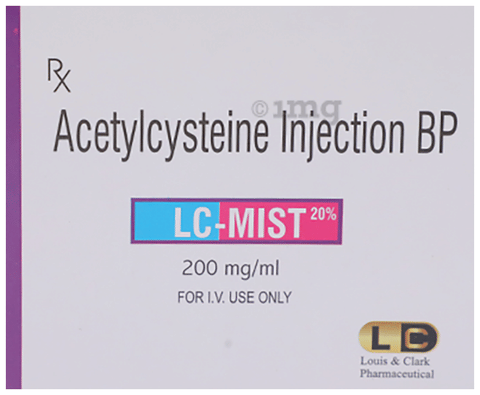
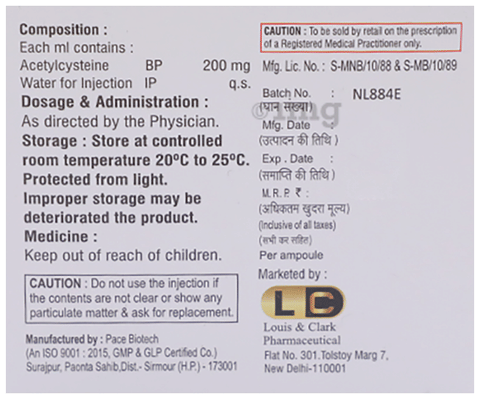
LC-Mist 20% Injection
Acetylcysteine (200mg/ml)


LC-Mist 20% Injection is an antidote medication. It is used in the treatment of paracetamol overdose (when you may have taken too much paracetamol medicine). It protects your liver and helps to reduce the extent of the injury.
Written By Dr. Swati Mishra, BDS,
Reviewed By Dr. Rajeev Sharma, MBA, MBBS,
Last updated on 10 Oct 2026 | 01:04 AM (IST)
Written By Dr. Swati Mishra, BDS,
Reviewed By Dr. Rajeev Sharma, MBA, MBBS,
Last updated on 10 Oct 2026 | 01:04 AM (IST)
₹42.7
MRP ₹45.94
7% off
(Inclusive of applicable taxes)
Get for
₹36.3

on orders above ₹1200
Use Code 1MGNEWPLUS
Get for
₹39.3

on orders above ₹300
Use Code 1MGNEW
1/2
Welcome Gift | For First Order
15% EXTRA OFF


Get Extra 4% off + Free Delivery
at ₹165 (3 months)


Are you sure you want to remove Care Plan?

2 ml Injection


Payment, Returns & Expiry

Cash on delivery available
Get your product first, then pay us once you're sure about your order

We don’t take this product back
Products such as this are non-returnable to make sure that the next person doesn’t get a used item

Product expires after Jan, 2027
Expiry date may vary by batch. All batches have a 3-month shelf life from the date of dispatch.

Price Info
MRP may vary by batch. Any additional charges, including packaging, handling, shipping or delivery charges, will be clearly disclosed before purchase.
Save more with additional offers

Get upto Rs.150 Cashback on minimum transaction of Rs.599/- with Mobikwik UPI (@ikwik).
Get upto Rs.150 Cashback on minimum transaction of Rs.599/- with Mobikwik UPI (@ikwik).


Get up to ₹75 cashback on a minimum order value (MOV) of ₹499 and above, valid once per customer.
Get up to ₹75 cashback on a minimum order value (MOV) of ₹499 and above, valid once per customer.
Get up to ₹75 cashback on a minimum order value (MOV) of ₹499 and above, valid once per customer.
Get up to ₹75 cashback on a minimum order value (MOV) of ₹499 and above, valid once per customer.
Get upto Rs.150 Cashback on minimum transaction of Rs.599/- with Mobikwik UPI (@ikwik).
Get upto Rs.150 Cashback on minimum transaction of Rs.599/- with Mobikwik UPI (@ikwik).
Get up to ₹75 cashback on a minimum order value (MOV) of ₹499 and above, valid once per customer.
Get up to ₹75 cashback on a minimum order value (MOV) of ₹499 and above, valid once per customer.
Get up to ₹75 cashback on a minimum order value (MOV) of ₹499 and above, valid once per customer.
Get up to ₹75 cashback on a minimum order value (MOV) of ₹499 and above, valid once per customer.

Assured cashback up to ₹300*. T&C Apply*
Assured cashback up to ₹300*. T&C Apply*
General Information

The content is shown in English



All substitutes for LC-Mist 20% Injection
For information purposes only. Consult a doctor before taking any medicine.
Mucomix Injection
by Samarth Life Sciences Pvt Ltd
₹50.48/injection
10% costlier
Mucomix Injection
by Samarth Life Sciences Pvt Ltd
₹25.23/injection
45% cheaper
Mudot Injection
by Flagship Biotech International
₹46.83/injection
2% costlier
Mucomyks Injection
by AAA Pharma Trade Pvt Ltd
₹45.94/injection
same price
Mucomyks 200mg/ml Injection
by AAA Pharma Trade Pvt Ltd
₹123.75/injection
169% costlier
Safety advice

Alcohol
CONSULT YOUR DOCTOR
It is not known whether it is safe to consume alcohol with LC-Mist 20% Injection. Please consult your doctor.

Pregnancy
SAFE IF PRESCRIBED
LC-Mist 20% Injection is generally considered safe to use during pregnancy. Animal studies do not indicate harmful effects. However, there are limited human studies.

Breast feeding
CONSULT YOUR DOCTOR
LC-Mist 20% Injection may be unsafe to use during breastfeeding. Limited human data suggests that the drug may pass into the breastmilk and harm the baby. It should be used only if the expected benefit outweighs the potential risk. Please consult your doctor.

Driving
SAFE
LC-Mist 20% Injection does not usually affect your ability to drive.

Kidney
CONSULT YOUR DOCTOR
There is limited data available on the use of LC-Mist 20% Injection in patients with kidney disease. Please consult your doctor.

Liver
CAUTION
LC-Mist 20% Injection should be used with caution in patients with severe liver disease. Dose adjustment may be needed.
References
- Briggs GG, Freeman RK, editors. A Reference Guide to Fetal and Neonatal Risk: Drugs in Pregnancy and Lactation. 10th ed. Philadelphia, PA: Wolters Kluwer Health; 2015. pp. 13-15.
- Acetylcysteine (N-Acetylcysteine). In: Hitchings A, Lonsdale D, Burrage D, et al., editors. The Top 100 Drugs: Clinical Pharmacology and Practical Pescribng. Churchil Livingstone Elsevier; 2015.
- Acetylcysteine [EMC Label]. Romford, Essex: Martindale Pharma; 2017. [Accessed 01 Apr. 2019] (online) Available from:

- Acetylcysteine [Prescribing Information]. Nashville, Tennessee: Cumberland Pharmaceuticals Inc.; 2013. [Accessed 31 Jan. 2019] (online) Available from:
- Acetylcysteine Injection [Prescribing Information]. Lake Zurich, IL: Fresenius Kabi; 2018. [Accessed 09 Jun 2023] (online) Available from:
- Acetadote® (acetylcysteine) Injection [Package insert]. Nashville, TN: Cumberland Pharmaceuticals Inc.; 2006. [Accessed 10 Feb 2025] (online) Available from:
Related products
Products related to LC-Mist 20% Injection




100% genuine products

Safe & secure payments

No contact delivery

Fully sanitized facilities

Want to know more
We provide you with authentic, trustworthy and relevant information
Have issue with the content
Why we need a prescription?

