






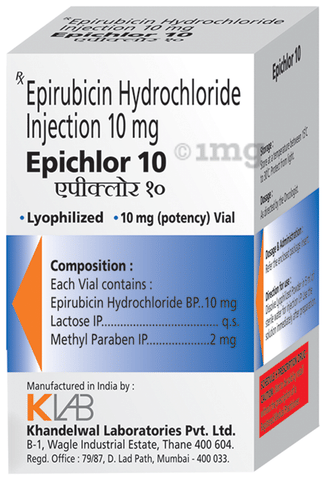


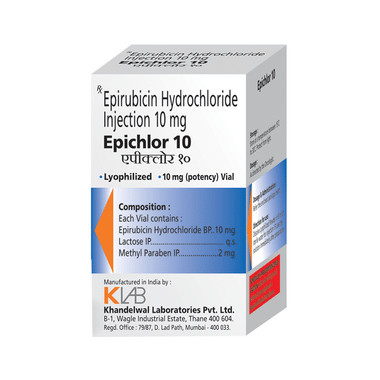
Epichlor 10 Injection
Epirubicin (10mg)
 Genuine
Authenticity Assured
 Prescription
required
Epichlor 10 Injection is used in the treatment of various types of cancers of blood, breast, stomach, lung, ovaries and soft tissues. It also helps to prevent the recurrence of bladder cancer after surgery.
Written By Dr. Swati Mishra, BDS,
Reviewed By Dr. Rajeev Sharma, MBA, MBBS,
Last updated on 10 Aug 2026 | 02:25 PM (IST)
Written By Dr. Swati Mishra, BDS,
Reviewed By Dr. Rajeev Sharma, MBA, MBBS,
Last updated on 10 Aug 2026 | 02:25 PM (IST)
Save more with additional offers

Assured cashback up to ₹300*. T&C Apply*
Assured cashback up to ₹300*. T&C Apply*


Get up to ₹75 cashback on a minimum order value (MOV) of ₹499 and above, valid once per customer.
Get up to ₹75 cashback on a minimum order value (MOV) of ₹499 and above, valid once per customer.

Get upto Rs.500 Cashback on minimum transaction of Rs.999/- with Mobikwik Wallet.
Get upto Rs.500 Cashback on minimum transaction of Rs.999/- with Mobikwik Wallet.
Assured cashback up to ₹300*. T&C Apply*
Assured cashback up to ₹300*. T&C Apply*
Get up to ₹75 cashback on a minimum order value (MOV) of ₹499 and above, valid once per customer.
Get up to ₹75 cashback on a minimum order value (MOV) of ₹499 and above, valid once per customer.
Get upto Rs.500 Cashback on minimum transaction of Rs.999/- with Mobikwik Wallet.
Get upto Rs.500 Cashback on minimum transaction of Rs.999/- with Mobikwik Wallet.
Get upto Rs.150 Cashback on minimum transaction of Rs.599/- with Mobikwik UPI.
Get upto Rs.150 Cashback on minimum transaction of Rs.599/- with Mobikwik UPI.
General Information

The content is shown in English



All substitutes for Epichlor 10 Injection
For information purposes only. Consult a doctor before taking any medicine.
Epialfa 10mg Injection
by Metta Life Sciences Private Limited
₹560/injection
84% costlier
Mapsepicin 10mg Injection
by AMPS Biotech Pvt Ltd
₹950/injection
212% costlier
Zyrubin Lyophilized 10mg Injection
by Zydus Lifesciences Ltd
₹507.1/injection
67% costlier
Epicin 10mg Injection
by Medion Biotech Pvt Ltd
₹491.5/injection
61% costlier
Adricin 10mg Injection
by Adley Formulations
₹339.64/injection
12% costlier
Safety advice

Alcohol
CONSULT YOUR DOCTOR
It is not known whether it is safe to consume alcohol with Epichlor 10 Injection. Please consult your doctor.

Pregnancy
CONSULT YOUR DOCTOR
Epichlor 10 Injection is not recommended during pregnancy as there is positive evidence of fetal risk based on animal studies. However, it may still be prescribed by a doctor in situations where the benefits outweigh the risks.

Breast feeding
UNSAFE
Epichlor 10 Injection is unsafe to use during breastfeeding. Data suggests that the drug may cause toxicity to the baby.

Driving
CONSULT YOUR DOCTOR
It is not known whether Epichlor 10 Injection alters the ability to drive. Do not drive if you experience any symptoms that affect your ability to concentrate and react. Please consult your doctor.
Epichlor 10 Injection may cause episodes of nausea and vomiting, which can temporarily lead to an impairment of the ability to drive.
Epichlor 10 Injection may cause episodes of nausea and vomiting, which can temporarily lead to an impairment of the ability to drive.

Kidney
SAFE IF PRESCRIBED
Epichlor 10 Injection is probably safe to use in patients with kidney disease. Limited data suggest dose adjustment may not be needed.
Lower doses may be considered in patients with serum creatinine > 5 mg/dL.
Lower doses may be considered in patients with serum creatinine > 5 mg/dL.

Liver
CAUTION
Epichlor 10 Injection should be used with caution in patients with liver disease. Dose adjustment may be needed.
Use of Epichlor 10 Injection is not recommended in patients with severe liver disease.
Use of Epichlor 10 Injection is not recommended in patients with severe liver disease.
References
- Chabner BA, Bertino J, Cleary J, et al. Cytotoxic Agents. In: Brunton LL, Chabner BA, Knollmann BC, editors. Goodman & Gilman’s: The Pharmacological Basis of Therapeutics. 12th ed. New York, New York: McGraw-Hill Medical; 2011. p. 1715.
- Chu E, Sartorelli AC. Cancer Chemotherapy. In: Katzung BG, Masters SB, Trevor AJ, editors. Basic and Clinical Pharmacology. 11th ed. New Delhi, India: Tata McGraw Hill Education Private Limited; 2009. p. 952.
- Briggs GG, Freeman RK, editors. A Reference Guide to Fetal and Neonatal Risk: Drugs in Pregnancy and Lactation. 10th ed. Philadelphia, PA: Wolters Kluwer Health; 2015. pp. 478-79.
- Epirubicin hydrochloride. Wedel, Germany: Medac GmbH; 2008 [revised Jun. 2016]. [Accessed 26 Mar. 2019] (online) Available from:

- Central Drugs Standard Control Organisation (CDSCO). [Accessed 27 Mar. 2019] (online) Available from:
Related products
Products related to Epichlor 10 Injection




100% genuine products

Safe & secure payments

No contact delivery

Fully sanitized facilities

Want to know more
We provide you with authentic, trustworthy and relevant information
Have issue with the content
Why we need a prescription?

