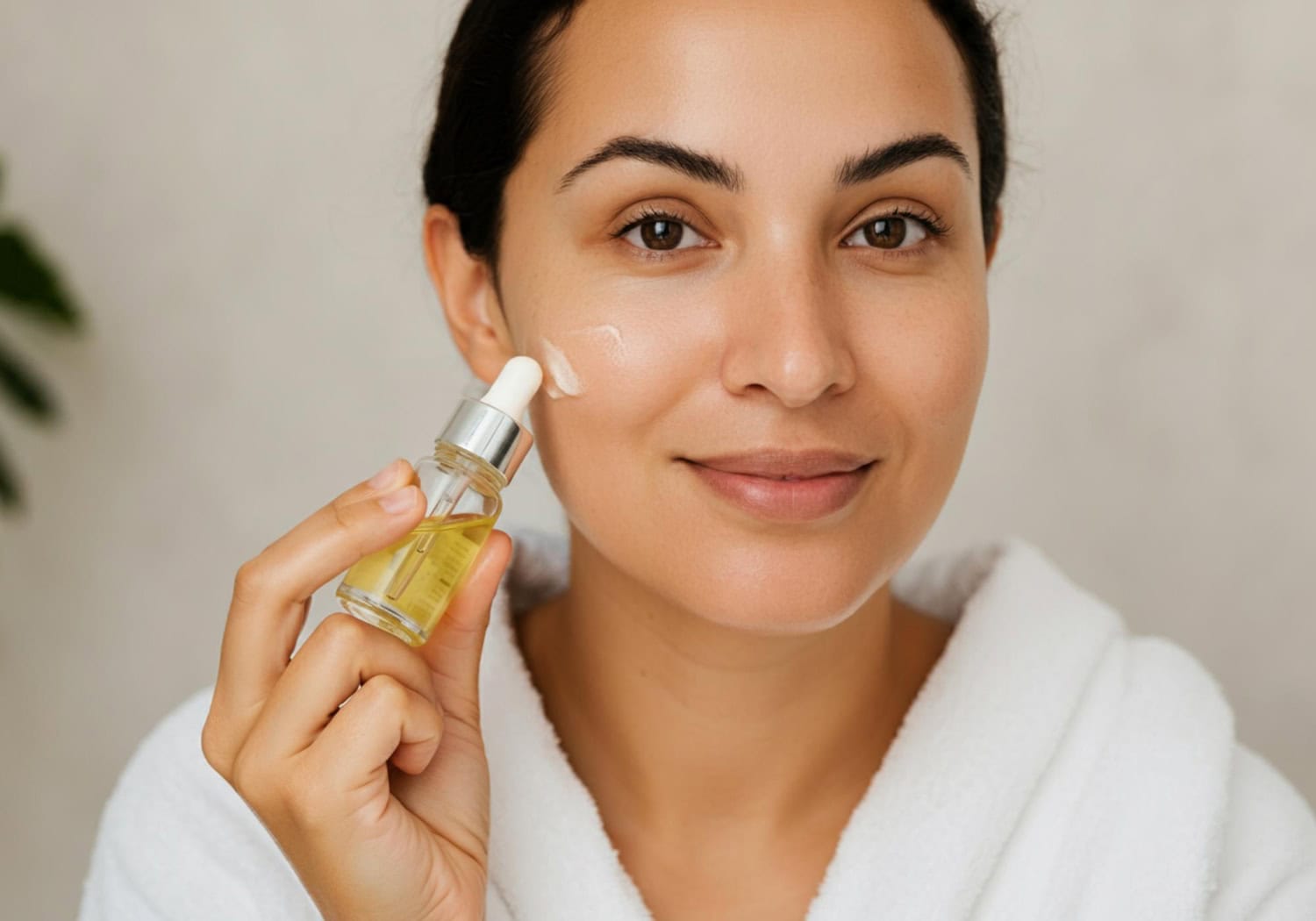
Castor oil has been part of traditional beauty routines for years. People use it on dry skin, around the eyes, and in homemade skincare preparations. It has also become popular among those looking for simple and affordable ways to care for their skin.
But does castor oil really help your face? Can it moisturize dry skin, reduce wrinkles, or fade dark spots? And is it safe to apply every day?
Castor oil contains ricinoleic acid, a fatty acid that has shown anti-inflammatory properties in experimental research. It is also used in cosmetic products because of its skin-conditioning properties. However, scientific evidence supporting its direct benefits for facial skin remains limited [1, 2].
Let’s understand its possible benefits, side effects, and the precautions you should take before using it.
What Is Castor Oil?

Castor oil is a vegetable oil extracted from the seeds of the castor plant (Ricinus communis). Around 90% of its fatty acid content consists of ricinoleic acid, along with smaller amounts of other fatty acids [2].
You’ll find castor oil in several cosmetic products, including moisturizers, cleansers, soaps, and lip care products. It works as a skin-conditioning ingredient and helps reduce moisture loss by forming an oily layer on the skin [1, 3].
However, there’s a difference between using castor oil as an ingredient in a formulated skincare product and applying undiluted oil directly to your face.
One more thing: ricin, the toxic protein naturally found in castor seeds, is different from castor oil. Properly processed cosmetic castor oil is not the same as raw castor seeds [3].
5 Possible Benefits of Castor Oil for Your Face

Castor oil has properties that may support skin conditioning and moisturization. However, most claims about its benefits for facial skin have not been established through large, well-designed human clinical trials.
1. May Help Moisturise Dry Skin
Does your skin feel tight or flaky, especially during winter? Castor oil may help reduce moisture loss.
Its fatty acid content gives it emollient properties. It forms a protective oily layer that helps soften the skin and reduce water loss [1, 3].
However, castor oil doesn’t replace the water your skin needs. It is better considered an additional skin-conditioning ingredient rather than a replacement for your regular moisturizer.
2. May Help Condition the Skin Barrier
Your skin barrier protects your body from irritants, allergens, and excessive moisture loss.
Castor oil can help condition the outer layer of your skin by reducing moisture loss. Its main fatty acid, ricinoleic acid, has also shown biological activity in experimental research [1].
However, there isn’t enough clinical evidence to establish that applying castor oil repairs a damaged skin barrier or treats conditions such as eczema.
If your skin barrier is irritated, a fragrance-free moisturizer containing ingredients such as ceramides is generally a more suitable choice.
3. Has Potential Anti-Inflammatory Properties
Castor oil contains ricinoleic acid, which has demonstrated anti-inflammatory activity in experimental studies [1].
This has led researchers to investigate its possible applications in skin health.
However, experimental findings don’t establish that applying castor oil will reduce facial inflammation, treat acne or relieve eczema. These conditions may need specific treatments recommended by a dermatologist.
4. May Temporarily Improve the Appearance of Fine Lines
Dry skin can make fine lines appear more noticeable. By helping reduce moisture loss, castor oil may temporarily make your skin look softer and smoother.
However, there is insufficient clinical evidence that applying castor oil directly to your face reduces wrinkles, increases collagen production, or reverses skin aging [1].
If you’re concerned about fine lines, daily sunscreen and evidence-based skincare ingredients such as retinoids have better-established benefits.
5. Is Used in Some Cosmetic Cleansers
Castor oil is used in cosmetic formulations because of its skin-conditioning, cleansing, and formulation properties [1, 3].
Some oil-based cleansers use castor oil as one of their ingredients to help dissolve makeup and other oil-based impurities.
However, this doesn’t mean pure castor oil is an effective replacement for your daily facial cleanser. A properly formulated cleanser is generally a more suitable option for removing dirt, excess oil and sunscreen.
Side Effects of Applying Castor Oil on Your Face

Natural doesn’t always mean suitable for every skin type. Although castor oil is used in cosmetic formulations, some people may experience unwanted reactions.
Here are some possible side effects.
1. Skin Irritation
Some people may experience redness, itching, burning, or discomfort after applying castor oil.
These reactions may occur because of irritation or sensitivity to the oil or other ingredients in a cosmetic product.
Stop using the product if you develop these symptoms.
2. Allergic Reactions
Castor oil can cause allergic contact dermatitis in some individuals.
A 2017 case report published in Cosmetics described two patients who developed allergic contact dermatitis associated with castor oil-containing cosmetic products [2].
Symptoms may include:
- Redness and itching
- Skin swelling
- A rash or eczema-like patches
- Burning or discomfort
These reports show that an allergic reaction is possible, although they don’t establish how commonly it occurs.
If you develop a persistent rash, consult a dermatologist. Seek urgent medical help if you experience swelling of the tongue or throat, difficulty breathing, or other signs of a severe allergic reaction.
3. May Not Suit Acne-Prone Skin
Castor oil has a thick and oily consistency. Some people with acne-prone skin may find heavy oil-based products uncomfortable or unsuitable for their skincare routine.
However, there isn’t sufficient clinical evidence to establish that castor oil directly causes acne or blocks pores.
If you notice new breakouts after introducing it, stop using the product and observe whether your skin improves.
4. Eye Irritation
Avoid putting castor oil directly into your eyes or applying it along the eyelid margins.
A cosmetic ingredient safety assessment reported mild, temporary discomfort in a small human study involving eye exposure to castor oil solutions. Another study reported changes to the corneal surface [3].
These findings concern direct eye exposure and should not be interpreted as evidence that ordinary facial application causes eye damage.
If castor oil accidentally enters your eyes, rinse them thoroughly with clean water. Seek medical advice if you experience persistent redness, pain, blurred vision, or irritation.
Who Should Avoid Using Castor Oil on Their Face?
Castor oil isn’t suitable for everyone. You should avoid using it or consult a dermatologist first if you:
- Have a known allergy to castor oil or any ingredient in the product.
- Have sensitive skin that reacts easily to new skincare products.
- Have active eczema, dermatitis, or significantly irritated skin.
- Experience frequent breakouts and find heavy oil-based products unsuitable.
- Have cuts, open wounds, or severely damaged skin.
If you have an existing skin condition, don’t use castor oil as a replacement for prescribed treatment.
How to Use Castor Oil on Your Face Safely
If you still want to try castor oil, follow these precautions to reduce the risk of an unwanted reaction.
- Choose a cosmetic-grade product from a reliable manufacturer.
- Perform a patch test before applying it to your face.
- Start with a small amount and avoid applying a thick layer.
- Avoid direct contact with your eyes, eyelid margins, and broken skin.
- Stop using it if you notice redness, itching, swelling, or irritation.
The American Academy of Dermatology recommends testing new skincare products on a small area of skin twice daily for 7–10 days. You can use the underside of your arm or the bend of your elbow as a test area [4].
If you develop a reaction, wash the product off and don’t use it again. A patch test can help identify possible reactions, but it cannot guarantee that a product will suit your facial skin.
FAQs
Q. Can I apply castor oil to my face every night?
It’s not necessary to apply castor oil every night. If your skin tolerates it, you may use a small amount occasionally. However, a regular facial moisturizer is generally a better choice for everyday hydration.
Q. Does castor oil remove dark spots?
There isn’t enough reliable clinical evidence to show that castor oil removes dark spots or pigmentation. Ingredients such as vitamin C, niacinamide, and retinoids have better-established evidence for managing uneven skin tone.
Q. Can castor oil help with wrinkles?
Castor oil may temporarily soften the appearance of fine lines by reducing moisture loss. However, it hasn’t been proven to remove wrinkles or stimulate collagen production.
Q. Is castor oil suitable for oily skin?
It may not be the best choice if you have oily or acne-prone skin. Its thick texture may feel uncomfortable, particularly if you already use several skincare products.
Q. Can I leave castor oil on my face overnight?
There is no established benefit to leaving castor oil on your face overnight. If you experience discomfort or irritation, wash it off. You don’t need prolonged exposure to get its skin-conditioning effect.
Q. Can castor oil cause pimples?
There isn’t enough evidence to establish that castor oil directly causes acne. However, heavy oil-based products may not suit everyone, particularly people who are prone to breakouts.
Q. Is castor oil better than coconut oil for the face?
Neither oil is automatically better for everyone. Both have skin-conditioning properties, but their composition and texture differ. Your choice should depend on your skin type and how your skin responds.
The Bottom Line
Castor oil may help reduce moisture loss and temporarily improve the appearance of dry skin. It also contains ricinoleic acid, which has shown anti-inflammatory activity in experimental research.
However, claims that it removes wrinkles, fades dark spots, treats acne, or repairs a damaged skin barrier aren’t supported by sufficient clinical evidence.
If you want to try it, start with a patch test and use a small amount. A simple skincare routine with a gentle cleanser, moisturizer, and broad-spectrum sunscreen remains a more reliable approach to everyday skin care.
References
1. Girdler K, Cabatu A, Olds H, Potts GA. Use of Castor Oil in Dermatology: A Narrative Review. Cureus. 2026;18(2):e103289. doi:10.7759/cureus.103289. Available from: https://pmc.ncbi.nlm.nih.gov/articles/PMC12978418/
2. Verheyden M, Rombouts S, Lambert J, Aerts O. Contact Allergy to Castor Oil, but Not to Castor Wax. Cosmetics. 2017;4(1):5. doi:10.3390/cosmetics4010005.
3. Becker LC, Bergfeld WF, Belsito DV, et al. Final report on the safety assessment of Ricinus Communis (Castor) Seed Oil, Hydrogenated Castor Oil, Glyceryl Ricinoleate, Glyceryl Ricinoleate SE, Ricinoleic Acid, Potassium Ricinoleate, Sodium Ricinoleate, Zinc Ricinoleate, Cetyl Ricinoleate, Ethyl Ricinoleate, Glycol Ricinoleate, Isopropyl Ricinoleate, Methyl Ricinoleate, and Octyldodecyl Ricinoleate. Int J Toxicol. 2007;26 Suppl 3:31-77. doi:10.1080/10915810701663150. Available from: https://pubmed.ncbi.nlm.nih.gov/18080873/
4. American Academy of Dermatology Association. How to test skin care products. Available from: https://www.aad.org/public/everyday-care/skin-care-secrets/prevent-skin-problems/test-skin-care-products
(The article is written by Mantasha, Sr. Executive, Clinical Health & Content, and reviewed by Monalisa Deka, Deputy Manager, Clinical Health & Content, Medical Affairs.)