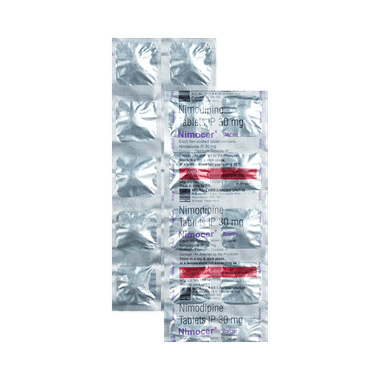


Nimotide 30mg Tablet is a medicine used to treat and prevent further damage to the brain after bleeding around the brain (subarachnoid hemorrhage or SAH). It is known as a calcium channel blocker and helps to improve blood flow to the brain and prevent changes in brain function.
Nimotide 30mg Tablet is usually started as soon as possible after bleeding around the brain (or SAH) is confirmed by the doctor. Your doctor will decide the exact dose and frequency depending on your medical condition and response to treatment. It may be taken with or without food. Take it regularly as advised by your doctor. Do not take any antacids for 2 hours before or after taking Nimotide 30mg Tablet, as this can prevent the medicine from working properly. Do not stop taking this medicine without first consulting your doctor. Your condition may worsen if this medicine is stopped too soon.
The most common side effects include decreased blood pressure, increased heart rate (tachycardia), headache, stomach discomfort, nausea, rash, muscle cramps, and edema (swelling over the whole body). Consult your doctor if any of these persist or worsen.
Before taking Nimotide 30mg Tablet, let your doctor know if you have any heart or liver-related problems. Some other medicines may affect how it works, especially those used to treat seizures (fits) and high blood pressure or heart conditions. Tell your doctor about all the medicines you are taking to make sure it is safe for you. Pregnant or breastfeeding women should also consult their doctor for advice before taking this medicine. Your doctor may monitor your blood pressure while you are taking this medicine.
Subarachnoid hemorrhage (SAH) is a life-threatening condition caused by bleeding in the space around the brain, often from a burst aneurysm. This bleeding can lead to complications like vasospasm, where brain blood vessels tighten, limiting blood flow. Nimotide 30mg Tablet is a medication that helps prevent this by relaxing and widening the blood vessels, improving blood flow and oxygen supply to the brain. By doing so, it reduces the risk of further brain damage, aiding in recovery and giving patients a better chance of surviving with fewer long-term effects.
Side effects of Nimotide Tablet
Most side effects do not require any medical attention and disappear as your body adjusts to the medicine. Consult your doctor if they persist or if you’re worried about them
Common side effects of Nimotide
Headache
Nausea
Hypotension (low blood pressure)
Slow heart rate
How to use Nimotide Tablet
Take this medicine in the dose and duration as advised by your doctor. Swallow it as a whole. Do not chew, crush or break it. Nimotide 30mg Tablet may be taken with or without food.
How Nimotide Tablet works
Nimotide 30mg Tablet is a calcium channel blocker. It relaxes the narrow blood vessels in the brain and makes the blood flow more easily. This prevents brain damage after bleeding around the brain.
Safety advice
Alcohol
CAUTION
Alcohol should be used with caution while taking Nimotide 30mg Tablet.

Pregnancy
CONSULT YOUR DOCTOR
The safety of Nimotide 30mg Tablet during pregnancy has not been established. There are no adequate and well-controlled studies in pregnant women, and animal data on reproductive toxicity are insufficient. Your doctor will weigh the benefits and any potential risks before prescribing.
Breast feeding
UNSAFE
Nimotide 30mg Tablet is unsafe to use during breastfeeding. Data suggests that the drug may cause toxicity to the baby.

Driving
UNSAFE
Nimotide 30mg Tablet may decrease alertness, affect your vision, or make you feel sleepy and dizzy. Do not drive if these symptoms occur.

Kidney
CAUTION
Nimotide 30mg Tablet should be used with caution in patients with kidney disease. Dose adjustment may be needed.

Liver
CAUTION
Nimotide 30mg Tablet should be used with caution in patients with liver disease. Dose adjustment may be needed.

What if you forget to take Nimotide Tablet?
If you miss a dose of Nimotide 30mg Tablet, take it as soon as possible. However, if it is almost time for your next dose, skip the missed dose and go back to your regular schedule. Do not double the dose.
All substitutes
For informational purposes only. Consult a doctor before taking any medicines.
Take it as per the dose and duration suggested by your doctor.
Do not take any antacids for 2 hours before or after taking Nimotide 30mg Tablet as it may affect the working of the medicine.
A sudden drop in your blood pressure may occur, especially when you first start taking Nimotide 30mg Tablet. To lower the chance of feeling dizzy or passing out, rise slowly if you have been sitting or lying down.
Your doctor will monitor your blood pressure and heart rate during the treatment with this medicine.
Inform your doctor if you are pregnant, planning a pregnancy or breastfeeding.
Fact Box
Chemical Class
Dihydropyridine carboxylic acid derivative
Habit Forming
No
Therapeutic Class
CARDIAC
Action Class
Calcium Channel Blockers- Dihydropyridines (DHP)
Interaction with drugs
Taking Nimotide with any of the following medicines can modify the effect of either of them and cause some undesirable side effects
Do not use Estradiol with Nimodipine, especially if you have heart disease. If concurrent use is essential, talk to your doctor and monitor your blood pressure regularly.
Concurre... More
Do not consume Carbamazepine with Nimodipine. If concurrent use is essential, your doctor may monitor your treatment and adjust the doses as per the observations. Carbamazepine may... More
My Mother is a brain haemorrhage Patient and doctor has advised RILUTEK 50MG OR RILUZOLE, I seek advice whether to take RILUTOR 50MG for my mother or not.
I am 14 weeks pregnant and had bleeding from last 2 weeks I had my USG done twice in last 3 weeks and it is showing Baby is fine But it is mentioned that there is a small Haemorrhage(5.7 ml) seen at lower pole In my last USG it is mentioned that there is Haemorrhage(10 ml) seen which is reduced to 5ml in my 2nd USG but again showing 5.7 in my latest one. I have been admitted for a week in hospital and discharged after that but 2 days back i have seen some more bleeding with some lower abdominal pain with some clots in the bleeding after that which I have done my latest USG in which it shows baby is fine and 5.7 inch haemorrhage. I am worried now and scared that it might lead to some worst conditions Please suggest me if this can be controlled I have attached my discharge medications and USG reports. Please help me with the answer
Dr. Suman Rao
Obstetrics and Gynaecology
You need to take care of few things- avoid travelling, avoid intercourse and lifting heavy weights. The bleeding should reduce. The blood collection inside will get absorbed with time. If at any time you notice fresh bleeding then contact your
What were the side-effects while using Nimotide 30mg Tablet?
Slow heart ra*
100%
*Slow heart rate
How do you take Nimotide Tablet?
With or witho*
100%
*With or without food
Please rate Nimotide 30mg Tablet on price
Expensive
67%
Average
33%
FAQs
What is Nimotide 30mg Tablet and what is it used for?
Nimotide 30mg Tablet belongs to a class of medicines known as calcium channel blockers. Nimotide 30mg Tablet is used to prevent any further damage to the brain function, which happens after subarachnoid hemorrhage (bleeding around the brain when a weak nerve in the brain bursts).
I am better now after taking Nimotide 30mg Tablet. Can I stop taking it?
No, do not stop taking Nimotide 30mg Tablet even if you start feeling better after taking it. This medicine is usually taken for 2 to 4 weeks. However, you must continue taking Nimotide 30mg Tablet in the dose and duration advised by your doctor. If you stop taking it suddenly without consulting your doctor, your condition may worsen. Therefore, it is very important to follow your doctor’s instructions carefully and keep your doctor informed if you face any issues while taking Nimotide 30mg Tablet.
What precautions do I need to take while taking Nimotide 30mg Tablet?
Before taking Nimotide 30mg Tablet, inform your doctor if you have any heart, brain, or liver problems, or if you have previously had a head injury or bleeding in or around the brain. Tell your doctor about all other medicines you are taking, as some medicines may interact with Nimotide 30mg Tablet and affect how it works. Avoid alcohol during treatment as it may increase dizziness, and do not drive or operate machinery if you feel less alert. Do not take this medicine if you are allergic to it or any of its ingredients, and consult your doctor before use if you are pregnant, breastfeeding, or planning a pregnancy.
How do I give Nimotide 30mg Tablet to a person who is unable to swallow properly?
If a person is unable to swallow properly, the doctor will suggest ways to give Nimotide 30mg Tablet via a nasogastric tube. You must not mix the contents of Nimotide 30mg Tablet into any other liquid or medicine as it may affect the working of the medicine. Nimotide 30mg Tablet should not be injected. Follow your doctor’s instructions carefully to get maximum benefit.
What if I take an overdose of Nimotide 30mg Tablet by mistake?
If you take an overdose of Nimotide 30mg Tablet by mistake, get emergency medical help. Your blood pressure may decrease considerably, and you may also feel lightheaded or faint. You may also experience irregular heart rate (fast or slow), making you feel sick or nauseated.
Can I take Nimotide 30mg Tablet with food?
Nimotide 30mg Tablet can be taken with or without food. Avoid eating grapefruit (chakotra) or drinking grapefruit juice while taking Nimotide 30mg Tablet.
Is Nimotide 30mg Tablet safe during pregnancy and breastfeeding?
No, Nimotide 30mg Tablet is not safe if you are pregnant, planning to conceive, or breastfeeding. Please consult your doctor before taking it, as it may cause harmful effects to the baby.
Want to share the information?
Disclaimer:
Tata 1mg's sole intention is to ensure that its consumers get information that is expert-reviewed, accurate and trustworthy. However, the information contained herein should NOT be used as a substitute for the advice of a qualified physician. The information provided here is for informational purposes only. This may not cover everything about particular health conditions, lab tests, medicines, all possible side effects, drug interactions, warnings, alerts, etc. Please consult your doctor and discuss all your queries related to any disease or medicine. We intend to support, not replace, the doctor-patient relationship.
References
Briggs GG, Freeman RK, editors. A Reference Guide to Fetal and Neonatal Risk: Drugs in Pregnancy and Lactation. 10th ed. Philadelphia, PA: Wolters Kluwer Health; 2015. pp. 980-82.
Nimodipine [Data Sheet]. Browns Bay, Auckland: Boucher & Muir (New Zealand) Limited t/a BNM Group; 2026. [Accessed 26 Feb. 2026] (online) Available from: