






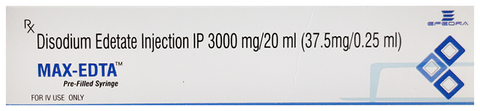
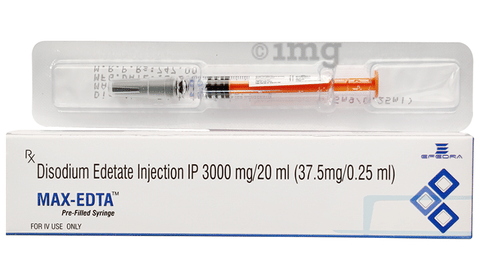

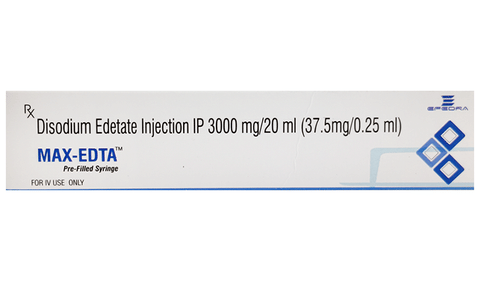
Max-EDTA Injection
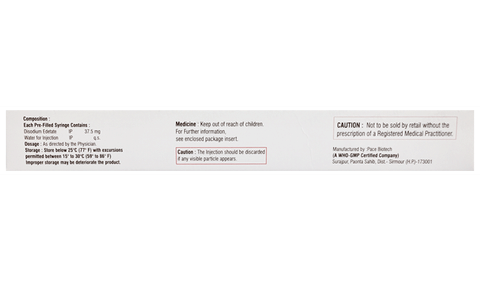
Disodium edetate (37.5mg)
 Genuine
Authenticity Assured
 Prescription
required
Max-EDTA Injection is a medicine used to treat lead poisoning and other heavy metal toxicity. It binds to metals in the bloodstream, forming a stable compound that is safely removed from the body through urine. Removing these toxins helps reduce their harmful effects on organs and tissues.
Written By Dr. Anuj Saini, MMST, MBBS,
Reviewed By Dr. Rajeev Sharma, MBA, MBBS,
Last updated on 03 Aug 2026 | 01:05 AM (IST)
Written By Dr. Anuj Saini, MMST, MBBS,
Reviewed By Dr. Rajeev Sharma, MBA, MBBS,
Last updated on 03 Aug 2026 | 01:05 AM (IST)
Save more with additional offers

Assured cashback up to ₹300*. T&C Apply*
Assured cashback up to ₹300*. T&C Apply*


Get up to ₹75 cashback on a minimum order value (MOV) of ₹499 and above, valid once per customer.
Get up to ₹75 cashback on a minimum order value (MOV) of ₹499 and above, valid once per customer.

Get upto Rs.500 Cashback on minimum transaction of Rs.999/- with Mobikwik Wallet.
Get upto Rs.500 Cashback on minimum transaction of Rs.999/- with Mobikwik Wallet.
Assured cashback up to ₹300*. T&C Apply*
Assured cashback up to ₹300*. T&C Apply*
Get up to ₹75 cashback on a minimum order value (MOV) of ₹499 and above, valid once per customer.
Get up to ₹75 cashback on a minimum order value (MOV) of ₹499 and above, valid once per customer.
Get upto Rs.500 Cashback on minimum transaction of Rs.999/- with Mobikwik Wallet.
Get upto Rs.500 Cashback on minimum transaction of Rs.999/- with Mobikwik Wallet.
Get upto Rs.150 Cashback on minimum transaction of Rs.599/- with Mobikwik UPI.
Get upto Rs.150 Cashback on minimum transaction of Rs.599/- with Mobikwik UPI.
General Information

The content is shown in English



All substitutes for Max-EDTA Injection
For information purposes only. Consult a doctor before taking any medicine.
Safety advice

Alcohol
CONSULT YOUR DOCTOR
It is not known whether it is safe to consume alcohol with Max-EDTA Injection. Please consult your doctor.

Pregnancy
CONSULT YOUR DOCTOR
Information regarding the use of Max-EDTA Injection during pregnancy is not available. Please consult your doctor.

Breast feeding
CONSULT YOUR DOCTOR
Information regarding the use of Max-EDTA Injection during breastfeeding is not available. Please consult your doctor.

Driving
SAFE
Max-EDTA Injection does not usually affect your ability to drive.

Kidney
There is no data available. Please consult doctor before consuming the drug.

Liver
There is no data available. Please consult doctor before consuming the drug.


Related products
Products related to Max-EDTA Injection


100% genuine products

Safe & secure payments

No contact delivery

Fully sanitized facilities

Want to know more
We provide you with authentic, trustworthy and relevant information
Have issue with the content
Why we need a prescription?

