






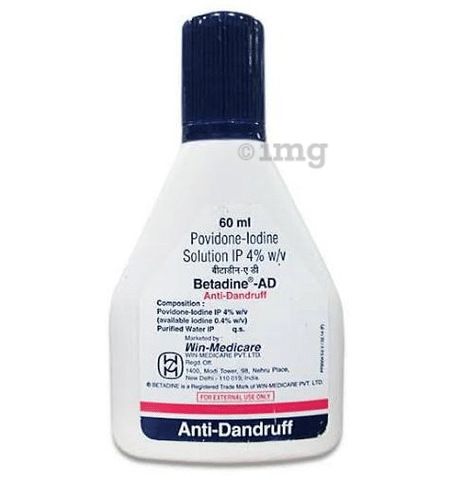

Betadine AD Shampoo
Povidone Iodine (4% w/v)
 Genuine
Authenticity Assured
Betadine AD Shampoo is an antiseptic and disinfectant agent used for the prevention and treatment of wound infection. It helps treat infections of the scalp associated with dandruff, itching, scaling, and redness of the scalp.
Written By Dr. Sakshi Jain, MS, BDS,
Reviewed By Dr. Mekhala Chandra, MD, MBBS,
Last updated on 07 Jan 2026 | 03:33 PM (IST)
Written By Dr. Sakshi Jain, MS, BDS,
Reviewed By Dr. Mekhala Chandra, MD, MBBS,
Last updated on 07 Jan 2026 | 03:33 PM (IST)
Save more with additional offers

Pay with Amazon Pay Balance and get cashback up to Rs. 75 with minimum cashback of Rs. 15
Pay with Amazon Pay Balance and get cashback up to Rs. 75 with minimum cashback of Rs. 15

Earn cashback up to Rs.75 with Amazon Pay Later
Earn cashback up to Rs.75 with Amazon Pay Later

Get upto Rs.500 Cashback on minimum transaction of Rs.999/- with Mobikwik Wallet.
Get upto Rs.500 Cashback on minimum transaction of Rs.999/- with Mobikwik Wallet.
Pay with Amazon Pay Balance and get cashback up to Rs. 75 with minimum cashback of Rs. 15
Pay with Amazon Pay Balance and get cashback up to Rs. 75 with minimum cashback of Rs. 15
Earn cashback up to Rs.75 with Amazon Pay Later
Earn cashback up to Rs.75 with Amazon Pay Later
Get upto Rs.500 Cashback on minimum transaction of Rs.999/- with Mobikwik Wallet.
Get upto Rs.500 Cashback on minimum transaction of Rs.999/- with Mobikwik Wallet.
Get upto Rs.150 Cashback on minimum transaction of Rs.599/- with Mobikwik UPI.
Get upto Rs.150 Cashback on minimum transaction of Rs.599/- with Mobikwik UPI.

Assured cashback up to ₹300 on minimum payment of ₹300 using Paytm UPI*
Assured cashback up to ₹300 on minimum payment of ₹300 using Paytm UPI*
General Information

The content is shown in English



Safety advice

Alcohol
No interaction found/established

Pregnancy
No interaction found/established

Breast feeding
No interaction found/established

Driving
No interaction found/established
Kidney
No interaction found/established

Liver
No interaction found/established
References
- Briggs GG, Freeman RK, editors. A Reference Guide to Fetal and Neonatal Risk: Drugs in Pregnancy and Lactation. 10th ed. Philadelphia, PA: Wolters Kluwer Health; 2015. p. 1139.
- Chaves RG, Lamounier JA. Breastfeeding and maternal medications. J Pediatr (Rio J). 2004;80(5 Suppl):S189-S198. [Accessed 29 Mar. 2019] (online) Available from:

- Central Drugs Standard Control Organisation (CDSCO). [Accessed 03 Apr. 2019] (online) Available from:

100% genuine products

Safe & secure payments

No contact delivery
Fully sanitized facilities

Want to know more
We provide you with authentic, trustworthy and relevant information
Have issue with the content
