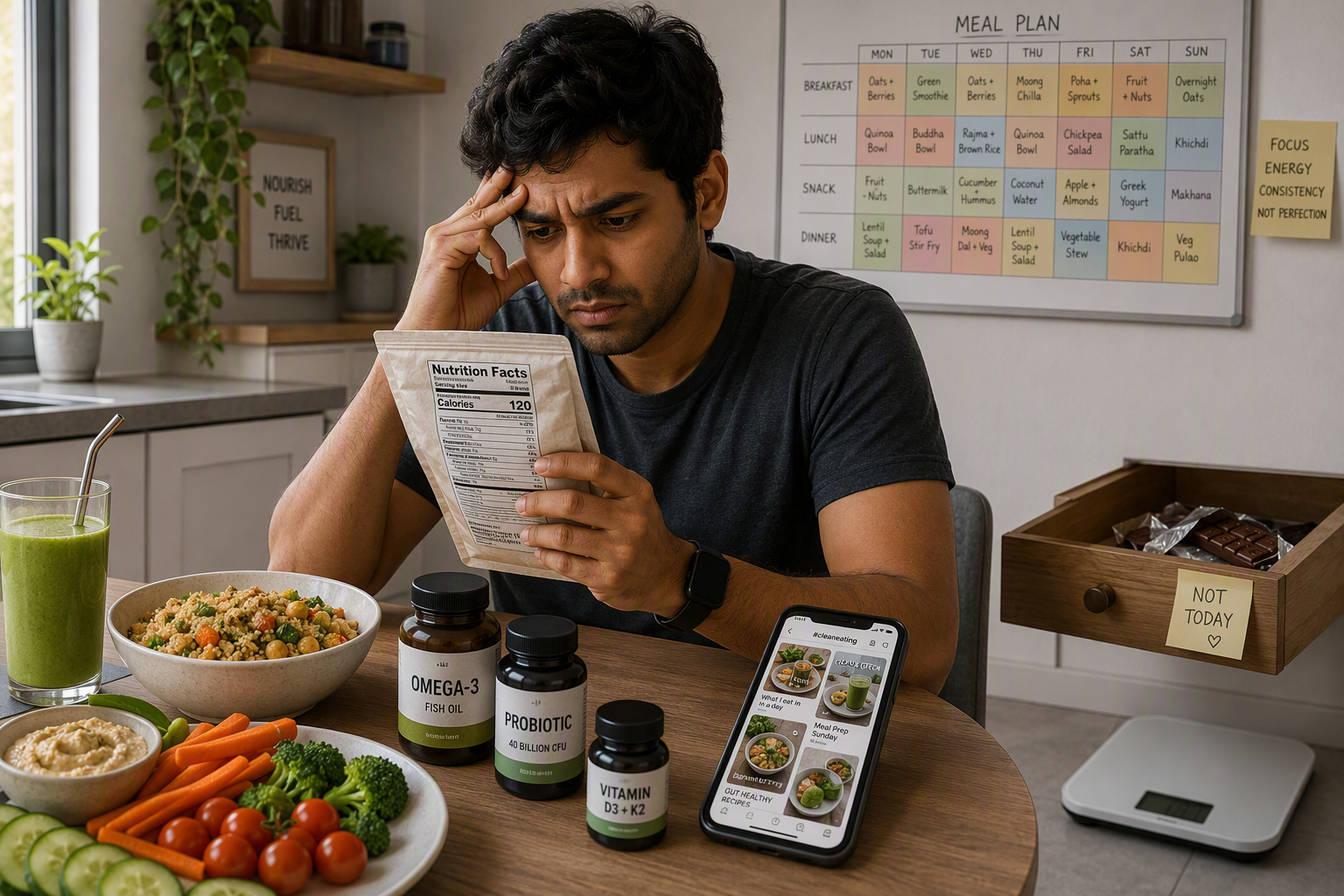
 You started eating “clean” to feel better. Now you panic if a meal has oil you didn’t measure, and you’ve stopped going out to eat because you can’t control what’s in the food. Somewhere along the way, healthy eating turns unhealthy, and you didn’t even notice the line you crossed. This is what doctors call orthorexia, and it’s more common than most people realize.[/caption]
What Is Orthorexia?
Orthorexia isn’t about eating too much or too little food. It’s about becoming so fixated on food “purity” and health rules that the obsession itself starts hurting you [1].
The term was first used by a doctor back in 1997, who noticed some people’s efforts to eat healthily had spiraled into something rigid and joyless [1]. Unlike anorexia, which usually focuses on quantity and weight, orthorexia is all about quality, rules, and control.
Additionally, orthorexia isn’t officially listed as its diagnosis in the main manuals doctors use, like the DSM-5 (Diagnostic and Statistical Manual of Mental Disorders, 5th Edition). That said, researchers widely agree it’s a real, distressing pattern that deserves attention, and there are proposed criteria doctors and therapists use to recognize it [2].
When Healthy Eating Turns Unhealthy: The Warning Signs

So how do you know when healthy habits have crossed a line? A few patterns tend to show up again and again [1,2]:
- You spend hours planning, shopping for, or prepping “safe” foods—way more time than actually makes sense.
- Eating something you’ve decided is “impure” leaves you feeling guilty, anxious, or even a little disgusted with yourself.
- You’ve cut out entire food groups for no medical reason, and somehow the list of banned foods just keeps growing.
- You care more about how “clean” something is than how it actually tastes.
- You find yourself judging other people’s plates, or feeling a bit superior about your own.
- You skip social events, restaurants, or family dinners because you can’t control what’s in the food.
- Your mood depends on whether you feel like you ate “correctly” that day.
That said, ticking off one or two of these doesn’t mean you have orthorexia. What really matters is the rigidity behind it, the distress it causes, and how much room it’s taking up in your life.
The “Health Food” Words People With Orthorexia Fixate On
Additionally, people with orthorexia often become preoccupied with specific labels, even when they have no allergy or medical reason to avoid these foods:
- Organic
- GMO-free
- Gluten-free
- Soy-free
- Raw or unprocessed
- Whole grain only
That said, using these labels to shop isn’t a problem on its own. It becomes a concern when a food is refused entirely just because it doesn’t carry the “right” label, even in situations where nothing else is available to eat.
Who’s Most at Risk?
Meanwhile, orthorexia doesn’t affect everyone equally. Certain groups show up more often in the research:
- Teenagers and young adults, especially those exposed to a lot of diet culture online
- Athletes and fitness enthusiasts, who often already track food closely for performance [3]
- Healthcare and nutrition professionals, ironically, since deep food knowledge can turn into obsessive control [4]
- Performers, models, and influencers, who may feel pressure to be seen as health role models
- People with a history of other eating disorders, since orthorexic patterns often show up alongside them [3]
For example, one study found that people already dealing with an eating disorder scored highest on orthorexia measures, even higher than dedicated endurance athletes [3]. So, this isn’t just a “wellness girl” stereotype; it touches a wide range of people.
That said, social media plays a genuine role too. Constant exposure to “what I eat in a day” videos and strict clean-eating content has been linked to higher orthorexic tendencies, especially on visually focused social media platforms.
Did You Know? Orthorexia Can Resemble OCDOrthorexia can involve strict food rules and repetitive thoughts, similar to obsessive-compulsive disorder (OCD). Both can involve a strong need for control and difficulty breaking certain routines [7,8]. |
When Nutrition Becomes Obsession: The Serious Effects of Untreated Orthorexia
Online, orthorexia often gets romanticized as just an “intense” way of living. But left unaddressed, it can take a real toll—physically and emotionally [4]:
- Malnutrition, since skipping whole food groups often means missing out on key nutrients
- Weight loss significant enough to need medical attention
- Isolation, as meals with friends, family gatherings, or dates get skipped more and more
- Anxiety and depression, often wrapped up in the fear of “getting it wrong”
- Strained relationships, since rigid food rules have a way of putting pressure on the people around you
None of this means caring about nutrition is dangerous. What matters is whether the habit is making your life bigger or quietly making it smaller.However, with orthorexia, food rules can take over your life. Breaking a “clean eating” rule may feel like a personal failure, rather than just a minor inconvenience.
How It Can Affect Children and Teens
That said, orthorexia can be especially concerning during childhood and the teen years, since this phase is a critical period for growth [9]:
- Delayed puberty and slowed growth, since ongoing malnutrition during this stage can disrupt normal development.
- Warning signs for parents to watch for: a sudden, rigid interest in “clean” eating, skipping meals, or irritability around food.
- Higher risk in kids already prone to anxiety or perfectionism [7].
- Family history may also play a role; eating disorders in general can run in families, though research specifically on orthorexia and genetics is still limited.
Even so, this doesn’t mean anyone who cares about nutrition is at risk. The difference is whether the habit is adding to your life or slowly shrinking it.
Orthorexia vs Anorexia: Key Differences

| Dimension | Orthorexia | Anorexia nervosa |
| Primary drive | Food quality/purity; “clean” eating | Weight/shape control; fear of weight gain |
| Motivation | Health, safety, moral purity | Thinness, body image, control over size |
| Restriction pattern | Avoids “impure” foods/groups; may still eat adequate calories if “clean” | Broad caloric restriction often aims to lose weight |
| Body image | May be secondary or absent | Central (distortion, overvaluation) |
| Weight loss | Possible side effect, not the goal | Often a central goal |
Honestly, this is the part most people get confused about. Eating well and having orthorexia can look similar from the outside, but they feel entirely different on the inside.
Someone eating healthily can still enjoy a slice of birthday cake without spiraling. They can eat out with friends without a panic attack over the menu. Their food choices flex around their life, not the other way around.
However, with orthorexia, food rules come first, and life gets rearranged to fit them. A missed “clean” meal isn’t just inconvenient; it feels like a personal failure.
How to Overcome Orthorexia?
If this scenario sounds familiar, either for you or someone you care about, please know it’s treatable. For most people, getting through this really does mean bringing in professional help—and ideally that looks like a therapist and a dietitian working together, with the dietitian specifically experienced in disordered eating.
A few approaches tend to help most:
- Cognitive behavioral therapy (CBT): This helps you catch the rigid thoughts and rules that keep you locked into restrictive eating and gradually replace them with something more workable.
- Exposure and response prevention: Feared foods get reintroduced slowly and safely, so the anxiety around them—and the intrusive thoughts that come with it—starts to lose its grip over time.
- Mindfulness and intuitive eating: Instead of following a rigid internal rulebook, you learn to listen to your body again, which helps you develop a more relaxed relationship with food.
If any of these symptoms sound familiar whether it’s you or someone you care about, please don’t brush it off. Reaching out to a therapist, doctor, or dietitian takes courage, but it’s often the turning point. Nobody has to go through these struggles alone, and a calmer, healthier relationship with food is possible.
FAQs
Is orthorexia just a fancy word for being a picky eater?
Not really. Picky eating is about taste preferences. Orthorexia runs on fear and guilt—an obsession with food “purity” that persists even when the food in question is perfectly healthy.
Can someone have orthorexia and still be at a “normal” weight?
Absolutely. This isn’t a weight-based condition. Someone can appear completely fine on the outside while quietly battling intense anxiety and rigid food rules on the inside.
Is orthorexia an official diagnosis?
Not officially—it’s not in the major diagnostic manuals yet. That said, clinicians and researchers overwhelmingly agree it’s a real and damaging pattern worth taking seriously.
How is orthorexia different from anorexia?
Anorexia tends to center on eating less and shrinking in size. Orthorexia is about obsessing over food quality and “cleanliness” weight loss, if it happens, is more a byproduct than the point.
Can “eating healthy” quietly turn into orthorexia?
Yes, and that’s what makes it so sneaky. It usually starts from a good place, which makes it hard to notice the moment the rules stop supporting your life and start running it instead.
Is social media to blame?
Not by itself, but there’s a real link. Constant exposure to “clean eating” content and diet culture online tends to feed orthorexic thinking, particularly in younger people.
What does treatment actually look like?
Usually a combination of therapy (CBT is common) plus a dietitian who understands disordered eating not the typical weight-focused kind of nutrition counselling.
I’m on a strict diet for medical reasons—should I be concerned?
Not necessarily. A diet your doctor prescribed for an actual medical condition is a different thing entirely. The red flag here is more about rules you’ve imposed on yourself out of fear or guilt, not medical necessity.
Disclaimer: This article is meant for general information and isn’t a stand-in for professional medical or psychological guidance. If any of this feels close to home—for you or someone you love—reaching out to a doctor, therapist, or dietitian is a good next step. And if this topic hits close to home for you personally, the National Alliance for Eating Disorders helpline is a solid place to start.
References:
1. Scarff JR. Orthorexia Nervosa: An Obsession With Healthy Eating. Fed Pract. 2017;34(6):36-39. PMC. Available from: https://pmc.ncbi.nlm.nih.gov/articles/PMC6370446/
2. Cena H, Barthels F, Cuzzolaro M, et al. Definition and diagnostic criteria for orthorexia nervosa: a narrative review of the literature. PubMed. Available from: https://pubmed.ncbi.nlm.nih.gov/30414078/
3. Assessing the presence and motivations of orthorexia nervosa among athletes and adults with eating disorders: a cross-sectional study. PMC. Available from: https://pmc.ncbi.nlm.nih.gov/articles/PMC10710386/
4. Horovitz O, Argyrides M. Orthorexia and Orthorexia Nervosa: A Comprehensive Examination of Prevalence, Risk Factors, Diagnosis, and Treatment. PMC. Available from: https://pmc.ncbi.nlm.nih.gov/articles/PMC10490497/
5. Orthorexia nervosa risk and associated factors among Chilean nutrition students: a pilot study. PMC. Available from: https://www.ncbi.nlm.nih.gov/pmc/articles/PMC8753887/
6. Niedzielski A, Kaźmierczak-Wojtaś N. Prevalence of Orthorexia Nervosa and Its Diagnostic Tools—A Literature Review. PMC. Available from: https://www.ncbi.nlm.nih.gov/pmc/articles/PMC8160773/
7. Mahfoud D, Pardini S, Mróz M, et al. Profiling orthorexia nervosa in young adults: the role of obsessive behaviour, perfectionism, and self-esteem. PMC. Available from: https://www.ncbi.nlm.nih.gov/pmc/articles/PMC10588191/
8. Striving for the perfect diet? The mediating role of perfectionism in the relationship between obsessive compulsive symptoms and traits of Orthorexia Nervosa. PMC. Available from: https://pmc.ncbi.nlm.nih.gov/articles/PMC11218215/
9. Soliman A, De Sanctis V, Elalaily R. Nutrition and pubertal development. PubMed. Available from: https://pubmed.ncbi.nlm.nih.gov/25538876/
(The article is written by Nancy Dixit, Associate Manager, Clinical Health & Content, Medical Affairs, and reviewed by Monalisa Deka, Deputy Manager, Clinical Health & Content, Medical Affairs.)
Recommended Reads:
Are You Just Overeating Occasionally Or Is It Binge Eating Disorder?
What Is ‘Food Noise’—And How to Quiet It for Better Eating Habits