
Optipres Eye Drop
Written By Dr. Sakshi Jain, MS, BDS
Reviewed By Dr. Mekhala Chandra, MD, MBBS
Last updated on 07 Apr 2026 | 03:01 PM (IST)
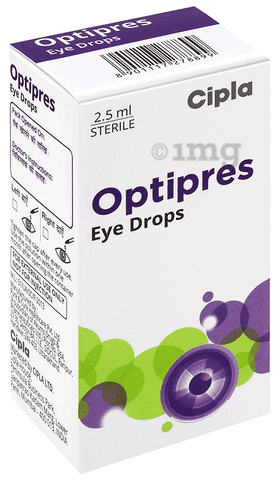
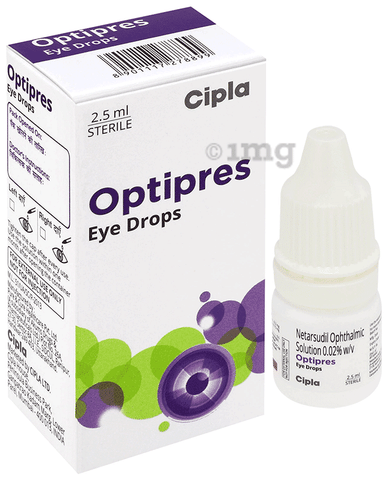
Optipres Eye Drop is a medicine used in the treatment of glaucoma and ocular hypertension. It helps reduce the pressure inside the eyes. This way, it helps treat glaucoma and ocular hypertension.
 Genuine
Authenticity Assured
 Prescription
required
 Cold stored
Stored between 2-8°C

Save more with additional offers

Pay with Amazon Pay Balance and get cashback up to Rs. 100 with minimum cashback of Rs. 20
Pay with Amazon Pay Balance and get cashback up to Rs. 100 with minimum cashback of Rs. 20

Earn cashback up to Rs. 100 with Amazon Pay Later
Earn cashback up to Rs. 100 with Amazon Pay Later

Assured cashback up to ₹300 on minimum payment of ₹300 using Paytm UPI*
Assured cashback up to ₹300 on minimum payment of ₹300 using Paytm UPI*
Save more with additional offers
Pay with Amazon Pay Balance and get cashback up to Rs. 100 with minimum cashback of Rs. 20
Pay with Amazon Pay Balance and get cashback up to Rs. 100 with minimum cashback of Rs. 20
Earn cashback up to Rs. 100 with Amazon Pay Later
Earn cashback up to Rs. 100 with Amazon Pay Later
Assured cashback up to ₹300 on minimum payment of ₹300 using Paytm UPI*
Assured cashback up to ₹300 on minimum payment of ₹300 using Paytm UPI*
10% cashback up to 200 on Min Transaction of Rs.1000, for first time users of Airtel Payments Bank.
10% cashback up to 200 on Min Transaction of Rs.1000, for first time users of Airtel Payments Bank.

Get cashback up to ₹500
Get upto Rs.500 Cashback on minimum transaction of Rs.999/- with Mobikwik Wallet.
Get upto Rs.150 Cashback
Get upto Rs.150 Cashback
General Information
Contains
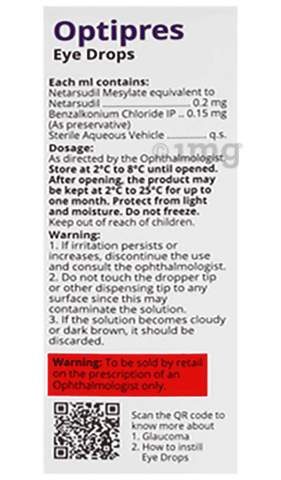
Netarsudil (0.2mg)
Marketer
Cipla Ltd
Storage
Store in a refrigerator (2 - 8°C). Do not freeze.
Preservative
Benzalkonium chloride
The content is shown in English



Safety advice

Alcohol
No interaction found/established

Pregnancy
CONSULT YOUR DOCTOR
Information regarding the use of Optipres Eye Drop during pregnancy is not available. Please consult your doctor.

Breast feeding
CONSULT YOUR DOCTOR
Information regarding the use of Optipres Eye Drop during breastfeeding is not available. Please consult your doctor.

Driving
UNSAFE
Optipres Eye Drop may cause temporary visual disturbances. Do not drive until your vision is clear.

Kidney
No interaction found/established

Liver
No interaction found/established
References
- Netarsudil ophthalmic solution [Prescribing Information]. [Accessed 03 Aug, 2021] (online) Available from:

- Netarsudil ophthalmic solution [Prescribing Information]. Aerie Pharmaceuticals, Inc., Irvine, CA: 2017. [Accessed 03 Apr. 2025] (online) Available from:
- Netarsudil ophthalmic solution [Prescribing Information]. Texas, USA: Alcon Laboratories Inc.; 2024. [Accessed 03 Apr. 2025] (online) Available from:
Related products
Products related to Optipres Eye Drop



100% genuine products

Safe & secure payments

No contact delivery

Fully sanitized facilities

Want to know more
We provide you with authentic, trustworthy and relevant information
Have issue with the content
Why we need a prescription?
Provide right medicines
Prescriptions are complex documents. We proof read and recheck at various steps to provide you the right medication in the correct form and dose

In accordance with the law
Most medicines cannot be sold without a valid prescription, as per the Drugs and Cosmetics Act, 1940 and Rules, 1945