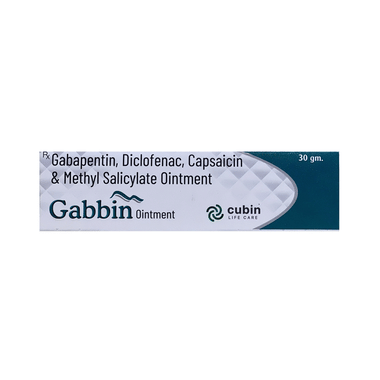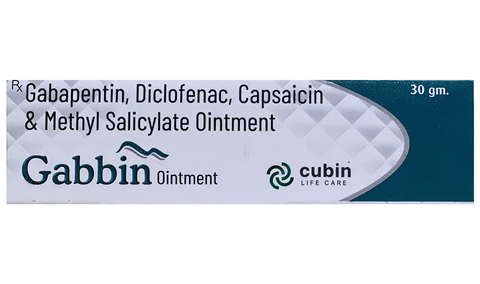


Gabbin Ointment
Prescription Required
View available alternative with same salt composition

Product introduction
Gabbin Ointment is a prescription medicine used for the treatment of neuropathic pain. It works by first cooling and then warming up the skin. Thus, it calms the damaged or overactive nerves by acting on the brain, thereby decreasing the sensation of pain.
Gabbin Ointment is for external use only. You should use this in the dose and duration advised by your doctor. Clean and dry the affected area before applying this medicine to the skin. You should always wash your hands after applying it, unless hands are the affected area.
There are no major side effects associated with this medicine, but it can cause some application site burning or irritation. However, these side effects are temporary and usually resolve on their own. Please consult your doctor if these do not subside or bother you.
Uses of Gabbin Ointment
Benefits of Gabbin Ointment
In Neuropathic pain
Gabbin Ointment is used to treat long-lasting (chronic) pain caused by nerve damage due to diabetes, shingles or spinal cord injury. It interferes with pain signals that travel through the damaged nerves and the brain. Using this medicine regularly will improve your physical and social functioning and overall quality of life.
Side effects of Gabbin Ointment
Most side effects do not require any medical attention and disappear as your body adjusts to the medicine. Consult your doctor if they persist or if you’re worried about them
Common side effects of Gabbin
- Application site burning
- Irritation
How to use Gabbin Ointment
This medicine is for external use only. Use it in the dose and duration as advised by your doctor. Check the label for directions before use. Clean and dry the affected area and gently massage the ointment.
How Gabbin Ointment works
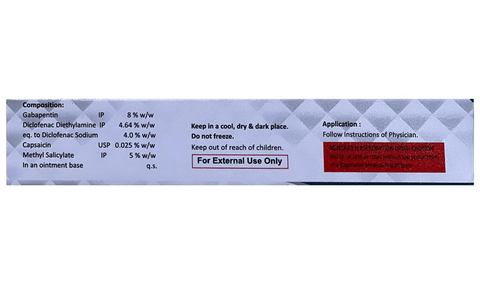
Gabbin Ointment is a combination of four medicines: Capsaicin, Diclofenac, Gabapentin, and Methyl Salicylate. Capsaicin is a plant derivative which activates certain receptors to cause prolonged desensitization of the local pain nerves. Diclofenac is a non-steroidal anti-inflammatory drugs (NSAIDs). It works by blocking the release of certain chemical messengers that cause pain and inflammation (redness and swelling). Gabapentin is an alpha 2 delta ligand which decreases pain by modulating calcium channel activity of the nerve cells. Methyl Salicylate is used as topical analgesic (pain reliever). It works by first cooling the skin then warming it up. This cooling and warming up action interferes with the pain signal transmission through nerves. Together, they relieve neuropathic pain (pain from damaged nerves).
Safety advice
Alcohol
No interaction found/established

Pregnancy
CONSULT YOUR DOCTOR
The safety of Gabbin Ointment during pregnancy has not been established. There are no adequate and well-controlled studies in pregnant women, and animal data on reproductive toxicity are insufficient. Your doctor will weigh the benefits and any potential risks before prescribing.
Breast feeding
CONSULT YOUR DOCTOR
Information regarding the use of Gabbin Ointment during breastfeeding is not available. Please consult your doctor.

Driving
No interaction found/established
Kidney
No interaction found/established

Liver
No interaction found/established

What if you forget to take Gabbin Ointment?
If you miss a dose of Gabbin Ointment, apply it as soon as possible. However, if it is almost time for your next dose, skip the missed dose and go back to your regular schedule. Do not double the dose.
All substitutes
For informational purposes only. Consult a doctor before taking any medicines.
Gabbin Ointment
₹9.17/gm of Ointment
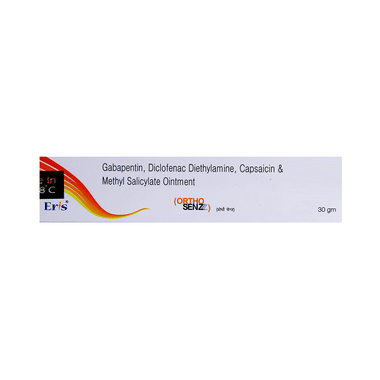
Orthosenz Ointment
Eris Lifesciences Ltd
₹8.93/gm of ointment
3% cheaper
Quick tips
- Gabbin Ointment is used to treat certain types of long-lasting pain caused by damage to nerves.
- Wash your hands before and after applying Gabbin Ointment to the affected area.
- Inform your doctor if you are taking any other pain-relieving medicines.
- Along with taking Gabbin Ointment, your doctor might advise you to undergo physiotherapy to get relief from pain.
Fact Box
Habit Forming
No
Therapeutic Class
PAIN ANALGESICS
Patient concerns
FAQs
What kinds of pain does Gabbin Ointment help with?
Gabbin Ointment is used to manage neuropathic pain caused by nerve damage. Your doctor may also prescribe this medicine for temporary relief of muscle and joint pain, especially pain caused by arthritis, strains, or sprains. It helps reduce pain, inflammation, and stiffness.
How quickly can I expect pain relief after applying Gabbin Ointment?
The exact time Gabbin Ointment takes to relieve pain is not known. However, many people start feeling pain relief within thirty minutes, but the full effects can take a few days of regular use.
Can I use Gabbin Ointment on my back or shoulders?
Gabbin Ointment is suitable for use on various muscle and joint areas, including back, knees, elbows, and shoulders. Just make sure to follow your doctor’s instructions and avoid applying to broken or irritated skin.
Can Gabbin Ointment cause any skin reactions?
Some people may experience mild burning, redness, itching, or dryness at the Gabbin Ointment application site. If these persist, contact your doctor.
Can I use Gabbin Ointment if I have nerve pain due to injury or diabetes?
Yes, gabapentin in Gabbin Ointment targets neuropathic pain from nerve damage, helping ease such discomfort. The other ingredients present in this medicine also help with inflammation and pain.
Should I avoid sun exposure after applying Gabbin Ointment?
Yes, it is best to protect the treated area from direct sunlight because some ingredients in Gabbin Ointment can make your skin more sensitive.
Can Gabbin Ointment help improve my mobility by reducing swelling?
Yes, by reducing inflammation and pain, Gabbin Ointment can help you move more comfortably and restore joint or muscle function.
Disclaimer:
Tata 1mg's sole intention is to ensure that its consumers get information that is expert-reviewed, accurate and trustworthy. However, the information contained herein should NOT be used as a substitute for the advice of a qualified physician. The information provided here is for informational purposes only. This may not cover everything about particular health conditions, lab tests, medicines, all possible side effects, drug interactions, warnings, alerts, etc. Please consult your doctor and discuss all your queries related to any disease or medicine. We intend to support, not replace, the doctor-patient relationship.References
- Porters RJ, Meldrum BS. Antiseizure Drugs. In: Katzung BG, Masters SB, Trevor AJ, editors. Basic and Clinical Pharmacology. 11th ed. New Delhi, India: Tata McGraw Hill Education Private Limited; 2009. p. 410.
- Furst DE, Ulrich RW, Varkey-Altamirano C. Nonsteroidal Anti-Inflammatory Drugs, Disease Modifying Antirheumatic Drugs, Nonopioids Analgesics, & Drugs Used in Gout. In: Katzung BG, Masters SB, Trevor AJ, editors. Basic and Clinical Pharmacology. 11th ed. New Delhi, India: Tata McGraw Hill Education Private Limited; 2009. p. 626.
- Grosser T, Smyth E, FitzGerald GA. Anti-Inflammatory, Antipyretic, and Analgesic Agents; Pharmacotherapy of Gout. In: Brunton LL, Chabner BA, Knollmann BC, editors. Goodman & Gilman’s: The Pharmacological Basis of Therapeutics. 12th ed. New York, New York: McGraw-Hill Medical; 2011. pp. 986-87.
- Stahl SM, editor. Gabapentin. In: Stahl's Essential Pschopharmacology: Prescriber's Guide. 5th ed. New York, New York: Cambridge University Press; 2014. pp. 275-77.
- McNamara JO. Pharmacotherapy of the Epilepsies. In: Brunton LL, Chabner BA, Knollmann BC, editors. Goodman & Gilman’s: The Pharmacological Basis of Therapeutics. 12th ed. New York, New York: McGraw-Hill Medical; 2011. p. 599.
Marketer details
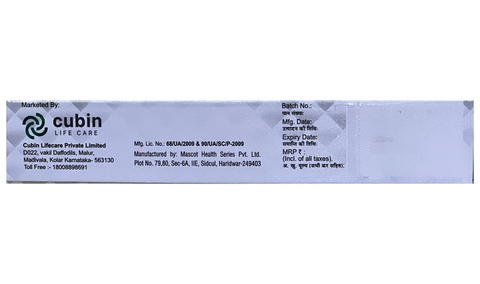
Name: Cubin Life Care Pvt Ltd
Address: D022, vakil Daffodils, Malur, Madivala, Kolar Karnataka 563130
Country of origin: India
Lab tests offered by us
Related/Popular tests