






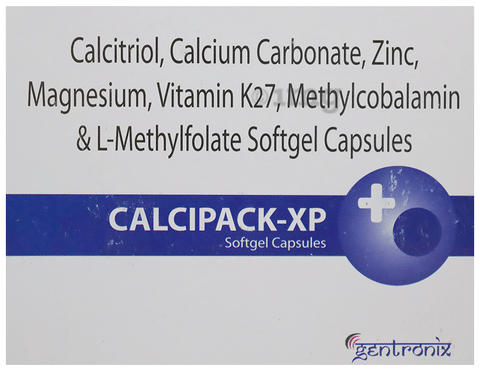
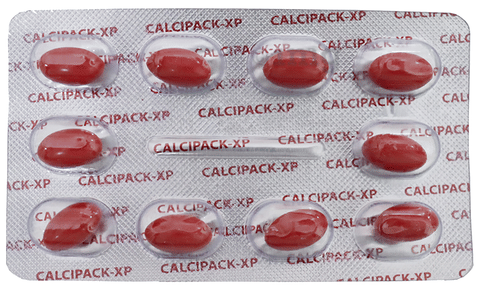

Calcipack-XP Softgel Capsule
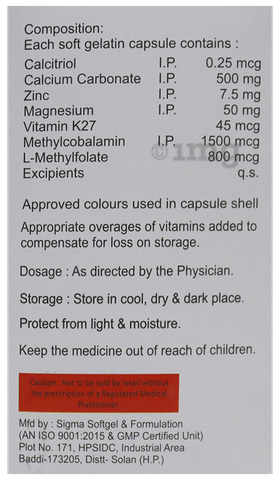
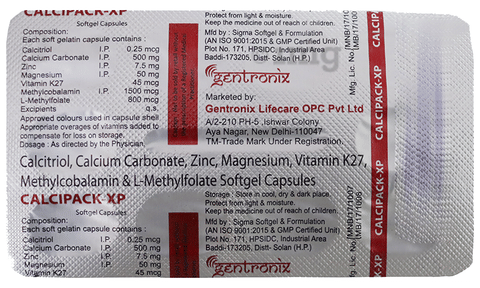
Calcitriol (0.25mcg)+ Calcium Carbonate (500mg)+ Zinc (7.5mg)+ Magnesium (50mg)+ Vitamin K2-7 (40mcg)+ Methylcobalamin (1500mcg)+ L-Methyl Folate (800mcg)
 Genuine
Authenticity Assured
 Prescription
required
Calcipack-XP Softgel Capsule is a nutritional supplement used in the treatment of calcium deficiency. It is prescribed when your diet alone cannot provide the necessary supplements your body needs. It increases the absorption of calcium and helps in bone growth. It also reduces the risk of bone disorders.
Written By Dr. Nikita Saini, MBA, MDS,
Reviewed By Dr. Dheeraj Kumar Sharma, PhD, M.Pharm,
Last updated on 25 Oct 2026 | 01:02 AM (IST)
Written By Dr. Nikita Saini, MBA, MDS,
Reviewed By Dr. Dheeraj Kumar Sharma, PhD, M.Pharm,
Last updated on 25 Oct 2026 | 01:02 AM (IST)
Save more with additional offers

Get upto Rs.150 Cashback on minimum transaction of Rs.599/- with Mobikwik UPI (@ikwik).
Get upto Rs.150 Cashback on minimum transaction of Rs.599/- with Mobikwik UPI (@ikwik).


Get up to ₹75 cashback on a minimum order value (MOV) of ₹499 and above, valid once per customer.
Get up to ₹75 cashback on a minimum order value (MOV) of ₹499 and above, valid once per customer.
Get up to ₹75 cashback on a minimum order value (MOV) of ₹499 and above, valid once per customer.
Get up to ₹75 cashback on a minimum order value (MOV) of ₹499 and above, valid once per customer.
Get upto Rs.150 Cashback on minimum transaction of Rs.599/- with Mobikwik UPI (@ikwik).
Get upto Rs.150 Cashback on minimum transaction of Rs.599/- with Mobikwik UPI (@ikwik).
Get up to ₹75 cashback on a minimum order value (MOV) of ₹499 and above, valid once per customer.
Get up to ₹75 cashback on a minimum order value (MOV) of ₹499 and above, valid once per customer.
Get up to ₹75 cashback on a minimum order value (MOV) of ₹499 and above, valid once per customer.
Get up to ₹75 cashback on a minimum order value (MOV) of ₹499 and above, valid once per customer.

Assured cashback up to ₹300*. T&C Apply*
Assured cashback up to ₹300*. T&C Apply*
General Information

The content is shown in English



Safety advice

Alcohol
CONSULT YOUR DOCTOR
It is not known whether it is safe to consume alcohol with Calcipack-XP Softgel Capsule. Please consult your doctor.

Pregnancy
CONSULT YOUR DOCTOR
Calcipack-XP Softgel Capsule is not recommended during pregnancy as there is positive evidence of fetal risk based on animal studies. However, it may still be prescribed by a doctor in situations where the benefits outweigh the risks.

Breast feeding
CAUTION
Calcipack-XP Softgel Capsule should be used with caution during breastfeeding. Breastfeeding should be held until the treatment of the mother is completed and the drug is eliminated from the body.

Driving
SAFE
Calcipack-XP Softgel Capsule does not usually affect your ability to drive.
Kidney
CAUTION
Calcipack-XP Softgel Capsule should be used with caution in patients with kidney disease. Dose adjustment may be needed.

Liver
CAUTION
Calcipack-XP Softgel Capsule should be used with caution in patients with severe liver disease. Dose adjustment may be needed.
References
- National Helth Institute. Office of Dietary Supplements: Zinc. [Accessed 14 Aug. 2024] (online) Available from:

- National Helth Institute. Office of Dietary Supplements: Vitamin B12. [Accessed 14 Aug. 2024] (online) Available from:
- Cholecalciferol [Summary of Product Characteristics]. Brehna, Germany: mibe GmbH Arzneimittel; 2020. [Accessed 14 Aug. 2024] (online) Available from:

100% genuine products

Safe & secure payments

No contact delivery

Fully sanitized facilities

Want to know more
We provide you with authentic, trustworthy and relevant information
Have issue with the content
Why we need a prescription?

