







 Genuine
Authenticity Assured
 Prescription
required
Combilite Cream is a medicine that contains a combination of medicines that is used to treat melasma. It helps in quick skin renewal. It provides relief from redness, swelling, and itching.
Written By Dr. Syeda Aafia, MBA, BDS,
Reviewed By Dr. Mekhala Chandra, MD, MBBS,
Last updated on 07 Sep 2026 | 01:03 AM (IST)
Written By Dr. Syeda Aafia, MBA, BDS,
Reviewed By Dr. Mekhala Chandra, MD, MBBS,
Last updated on 07 Sep 2026 | 01:03 AM (IST)
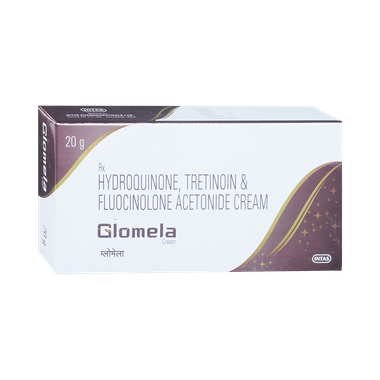
Available alternative from Top Brand
Sold out

Combilite Cream
tube of 20 gm Cream
₹154

Same composition
GLomela Cream
tube of 20 gm Cream
by Intas Pharmaceuticals Ltd
Get by 4pm
₹304
₹12.9 per gm
₹258
order for
₹1200
Save more with additional offers

Get upto Rs.150 Cashback on minimum transaction of Rs.599/- with Mobikwik UPI (@ikwik).
Get upto Rs.150 Cashback on minimum transaction of Rs.599/- with Mobikwik UPI (@ikwik).


Get up to ₹75 cashback on a minimum order value (MOV) of ₹499 and above, valid once per customer.
Get up to ₹75 cashback on a minimum order value (MOV) of ₹499 and above, valid once per customer.
Get up to ₹75 cashback on a minimum order value (MOV) of ₹499 and above, valid once per customer.
Get up to ₹75 cashback on a minimum order value (MOV) of ₹499 and above, valid once per customer.
Get upto Rs.150 Cashback on minimum transaction of Rs.599/- with Mobikwik UPI (@ikwik).
Get upto Rs.150 Cashback on minimum transaction of Rs.599/- with Mobikwik UPI (@ikwik).
Get up to ₹75 cashback on a minimum order value (MOV) of ₹499 and above, valid once per customer.
Get up to ₹75 cashback on a minimum order value (MOV) of ₹499 and above, valid once per customer.
Get up to ₹75 cashback on a minimum order value (MOV) of ₹499 and above, valid once per customer.
Get up to ₹75 cashback on a minimum order value (MOV) of ₹499 and above, valid once per customer.

Assured cashback up to ₹300*. T&C Apply*
Assured cashback up to ₹300*. T&C Apply*
General Information

The content is shown in English




All substitutes for Combilite Cream
For information purposes only. Consult a doctor before taking any medicine.
Clearz Max Cream
by Eris Oaknet Healthcare Pvt Ltd
₹24.27/gm of cream
215% costlier
Cutilite Cream
by Glowderma Labs Pvt Ltd
₹10.4/gm of cream
35% costlier
GLomela Cream
by Intas Pharmaceuticals Ltd
₹15.2/gm of cream
97% costlier
Melapik Plus Cream
by KLM Laboratories Pvt Ltd
₹10.4/gm of cream
35% costlier
I Glow Night Cream
by MRHM Pharma Pvt Ltd
₹8.35/gm of cream
8% costlier
Safety advice

Alcohol
No interaction found/established

Pregnancy
UNSAFE
Combilite Cream is highly unsafe during pregnancy. It can cause serious harm to the unborn baby, including birth defects and pregnancy loss. Do not use this medicine if you are pregnant or planning to become pregnant.

Breast feeding
SAFE IF PRESCRIBED
Combilite Cream may be safe to use during breastfeeding. Animal studies have shown low or no adverse effects to the developing baby; however, there are limited human studies.

Driving
No interaction found/established

Kidney
No interaction found/established

Liver
No interaction found/established
References
- Fluocinolone acetonide, hydroquinone, and tretinoin [Prescribing Information]. Canada: G Production Inc.; 2014. [Accessed 29 Apr. 2019] (online) Available from:

- Fluocinolone acetonide + hydroquinone + tretinoin [Prescribing Information]. Canada: G Production Inc.; 2013. [Accessed 29 Apr. 2019] (online) Available from:
- CiplaMed. Fluocinolone acetonide + Hydroquinone + Tretinoin [Prescribing Information]. [Accessed 14 Aug. 2024] (online) Available from:
- Fluocinolone acetonide, hydroquinone, tretinoin [Prescribing Information]. Dallas, TX: Galderma Laboratories, LP; 2023.
Related products
Products related to Combilite Cream



100% genuine products

Safe & secure payments

No contact delivery

Fully sanitized facilities

Want to know more
We provide you with authentic, trustworthy and relevant information
Have issue with the content
Why we need a prescription?

