Sign in to your account
or
By signing in you agree to our
Terms & conditions
 and 
Privacy policy

Solifenacin

Written By Dr. Anuj SainiReviewed By Dr. Rajeev Sharma
Last updated 03 Nov 2025 | 11:11 AM (UTC)

Solifenacin Uses

Solifenacin is used in the treatment of Overactive bladder (OAB) . OAB is a collection of urinary symptoms, including frequent urination, urgent need to urinate, and inability to control urination.

Available generics for Solifenacin

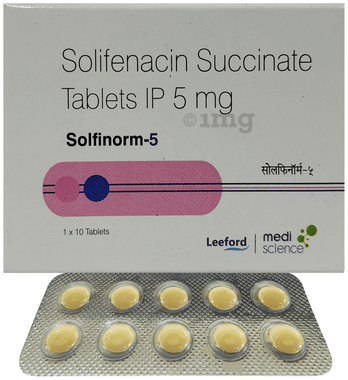
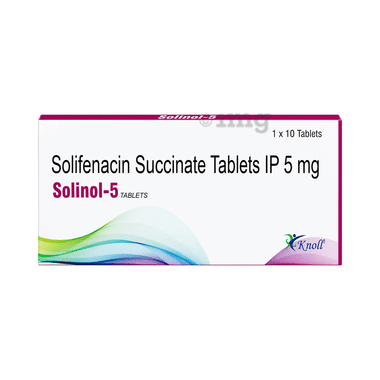
Order with generics and save upto 50%
How Solifenacin works

Solifenacin is an antimuscarinic. It works by relaxing muscles of the urinary bladder to prevent frequent, urgent or uncontrolled urination.

Common side effects of Solifenacin

Dryness in mouth, Constipation, Blurred vision, Dry eye, Urinary retention
prefix_icon
Get medicines for Solifenacin
suffix_icon
Authenticity

Want to Know More

Read Our Editorial Policy

Expert advice for Solifenacin

  • Solifenacin helps you to have better control over your urination by relaxing your bladder which increases its capacity to hold urine, thereby reducing the need to pass urine.
  • It may cause blurred vision, fatigue and sleepiness. Be cautious while driving or doing anything that requires focus.
  • It may cause dry mouth. Try chewing on sugar-free gum or taking small sips of water.
  • Avoid caffeine, alcohol or carbonated drinks as they can worsen your symptoms.
  • Do not stop taking this medicine if you do not notice an improvement in your symptoms as it may take some time for your bladder to adapt and your symptoms to improve.
  • Solifenacin helps you to have better control over your urination by relaxing your bladder which increases its capacity to hold urine, thereby reducing the need to pass urine.
  • It may cause blurred vision, fatigue and sleepiness. Be cautious while driving or doing anything that requires focus.
  • It may cause dry mouth. Try chewing on sugar-free gum or taking small sips of water.
  • Avoid caffeine, alcohol or carbonated drinks as they can worsen your symptoms.
  • Do not stop taking this medicine if you do not notice an improvement in your symptoms as it may take some time for your bladder to adapt and your symptoms to improve.

Frequently asked questions for Solifenacin

Solifenacin should be taken exactly as prescribed by your doctor. Generally, it is recommended that the medicine should be taken once daily, preferably at the same time. It can be taken with or without food.
In rare cases, Solifenacin may cause confusion and hallucinations (seeing things or hearing voices that do not exist) as side effects. It may also cause delirium in very few people (disturbed state of mind characterized by restlessness, illusions, and incoherence). Though there are studies which support that Solifenacin may cause dementia, it is still to be confirmed.
Overactive bladder is a condition where the nerve signals coming from the brain directs your bladder to empty even when it is not full. Consequently, this may affect a person’s ability to control bladder contractions. Rapid uncontrollable contractions cause symptoms of overactive bladder which are urinary frequency, urinary urgency, and urinary incontinence (leakage).
Yes, Solifenacin needs to be taken once daily as advised by your doctor. You should not take it only when the symptoms are bothersome as it will not work properly. Furthermore, if you forget to take a dose, continue taking it next day as per the prescribed schedule. Additionally, it is advised to not take 2 doses on the same day.
Solifenacin may start showing improvement in symptoms of overactive bladder within a week. However, it may take up to 4 weeks to show maximum benefits. This may vary from person to person. Do not stop taking it even if considerable improvement is not observed, but consult with the doctor.
Solifenacin is to be prescribed by the doctor only. This medicine is meant for adults. Its consumption should be avoided by patients who are allergic to Solifenacin, who are unable to empty their bladder (urinary retention), have delayed or slow emptying of the stomach (gastric obstruction), or have increased pressure in eyes with vision problems (narrow angle glaucoma).
You should avoid driving or operating heavy machinery if you experience drowsiness or blurred vision while taking Solifenacin, as it can be dangerous.