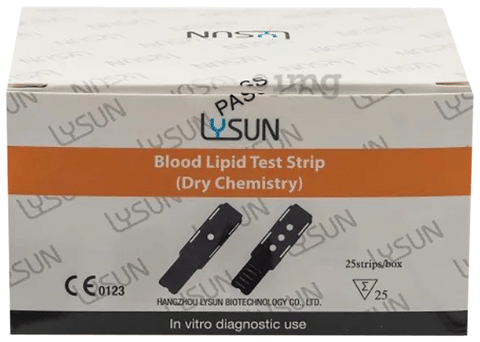
Lysun Lipid Meter Test Strip Accurex Lysun Lipid Meter Test Strip The blood lipid test strip (dry chemistry) work with the blood lipid analysis meter or dry biochemical analysis meter to measure the lipid concentration in whole blood, plasma and serum. The 3-1 lipid panel is used to measure the concentrations of total cholesterol (tc), high density lipoprotein cholesterol (hdl) and triglycerides (tg). it is also used to calculate ldl, tc/hdl.
Uses: The blood lipid analysis system is intended for the quantitative determination of total cholesterol (tc), high density lipoprotein cholesterol (hdl), triglycerides (tg), and the calculated ratio of tc/hdl and low density lipoprotein cholesterol (ldl) in capillary blood, venous whole blood, plasma and serum.
Product Specifications And Features:
The Blood Lipid Test Strip (Dry Chemistry) use a timed-endpoint method to measure the Total Cholesterol (TC), High Density Lipoprotein Cholesterol (HDL) and Triglycerides (TG) concentrations in whole blood, serum or plasma
The concentration of Low Density Lipoprotein Cholesterol (LDL) is calculated by the values of TC, TG and HDL. The system monitors the change in absorbance at 620 nm at a fixed-time interval
The change in absorbance is directly proportional to the concentration of lipid in the specimen
TC: The free cholesterol is oxidized to cholesten-3-one and hydrogen peroxide by cholesterol oxidase
Peroxidase catalyzes the reaction of hydrogen peroxide with 4-aminoantipyrine and phenol to produce colored quinoneimine product
HDL: The dextran slulphate/Mg2+ on the test strip precipitates the chylomicrons, VLDL and LDL, leaving HDL in the specimen. The cholesterol concentration of this HDL is then determined enzymatically, the same as TC
TG: Triglycerides in the specimen are hydrolyzed to glycerol and free fatty acids by the action of lipase
A sequence of three coupled enzymatic steps using glycerol kinase (GK), glycerophosphate oxidase (GPO), and peroxidase (POD) causes the oxidative coupling of 4-aminoantipyrine to form a blue dye LDL
When the concentration of TG in the specimen is equal to or lower than 400mg/dL, LDL concentration can be calculated by the meter with the following equation: LDL=TC-HDL-TG/2.2(mmol/L); LDL=TC-HDL-TG/5(mg/dL)
Directions For Use:
Allow the test strip, specimen, and/or controls to reach operating temperature (10-35℃) prior to testing
Insert the code chip into the meter and code the meter correctly. Refer to coding the meter section in the User’s Manual for details
Compare the code number on the code chip with the code number printed on the test strip canister or foil pouch and ensure the two numbers are identical to avoid inaccurate results
Check that the specimen type is same as the specimen type tested. If not, set the correct specimen type. Refer to the User’s Manual for details. Remove the test strip from the test strip canister or foil pouch
Wait for the meter to display Insert Strip. Insert the test strip completely into the test strip channel in the same direction as the arrows printed on the test strip
Prepare the specimen to be tested. For venous whole blood/plasma/serum specimens: mix the specimen for about 15minutes. For capillary blood specimen: wipe away the first drop of blood
Collect 35µL of the second or third drop of capillary blood specimen using a capillary transfer tube or pipette. Hold the tube slightly downward and touch the tip of the capillary transfer tube to the blood drop
Draw the specimen and stop drawing when the specimen comes to the fill line
While the meter is flashing the blood drop symbol, apply 35µL specimen to the specimen application area of the test strip using a pipette or capillary transfer tube
Align the tip of the pipette or capillary transfer tube with the specimen application area to apply the blood. 4 dashed lines will appear on the meter to show the test is in progress
Read the results on the screen in 2 minutes. Refer to the user’s manual for detail test procedures
Safety Information:
For in vitro diagnostic use only
The test strips should remain in the original package until use
Do not use it after the expiration date
Do not touch the reagent area of the test strips
Discard any discolored or damaged test strips
All specimens should be considered potentially hazardous and handled in the same manner as an infectious agent
The used test strips should be discarded according to local regulations after testing
Check the code chip before performing a test. Make sure to use the code chip that is included with the package of test strips. Insert the code chip into the code chip slot. The code chip slot is located on the left side of the meter
Check that the specimen type is same as the specimen type tested
Decisions of medical relevance are not to be taken without consultation of a doctor. Changes to treatment should only be made after proper training
Store as packaged in the sealed pouch or canister, either at room temperature or refrigerated (2-30℃)
Keep out of direct sunlight. Test strips are stable through the expiration date printed on the test strip canister or foil pouch
Remove only enough test strips for immediate use. Replace the cap on the strips canister immediately and tightly
Do not freeze. Do not use it beyond the expiration date