Sign in to your account
or
By signing in you agree to our
Terms & conditions
 and 
Privacy policy

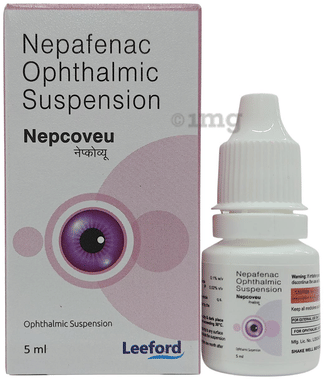
Nepafenac

Written By Dr. MayankReviewed By Dr. Rajeev Sharma
Last updated 18 Feb 2020 | 11:51 AM (UTC)

Nepafenac Uses

Nepafenac is used for post-operative eye pain and inflammation.

Available generics for Nepafenac

Order with generics and save upto 50%

How Nepafenac works

Nepafenac is a non-steroidal anti-inflammatory drugs (NSAID) which works by blocking the release of certain chemical messengers that cause pain and inflammation (redness and swelling).

Common side effects of Nepafenac

Eye discomfort, Ocular hyperemia, Eye itching, Transient blurred vision, Stickiness
prefix_icon
Get medicines for Nepafenac
suffix_icon
Authenticity

Want to Know More

Read Our Editorial Policy

Expert advice for Nepafenac

  • Your doctor has prescribed Nepafenac for the relief of post-operative eye pain and inflammation (redness and swelling).
  • Apply pressure on the corner of the eye (close to the nose) for about 1 minute, immediately after instilling the drop.
  • Usually, a 4 to 6-week course may be necessary.
  • Wait for at least 5-10 minutes before delivering the next medication in the same eye to avoid dilution.
  • Stinging sensation may occur for 1-2 mins. Notify your doctor if it persists for longer.
  • Notify your doctor if you are on blood thinners or have bleeding problems.
  • Use the eye drops within 4 weeks of opening the bottle.

Frequently asked questions for Nepafenac

Nepafenac ophthalmic suspension is used to prevent and treat redness, pain and swelling that occurs after cataract surgery and to reduce the risk of postoperative macular edema (swelling of a layer present at the back of the eye) associated with cataract surgery in diabetic patients
Nepafenac ophthalmic suspension is a solution containing pain-relieving and anti-inflammatory medication Nepafenac for use as eye drops to prevent and treat redness, pain and swelling that occurs after cataract surgery and to reduce the risk of postoperative macular edema (swelling of a layer present at the back of the eye) associated with cataract surgery in diabetic patients.