Aceclofenac + Thiocolchicoside
Written By Dr. Anuj SainiLast updated 20 Feb 2025 | 06:44 AM (UTC)
Aceclofenac + Thiocolchicoside Uses
Aceclofenac+Thiocolchicoside is used in muscle spasm.
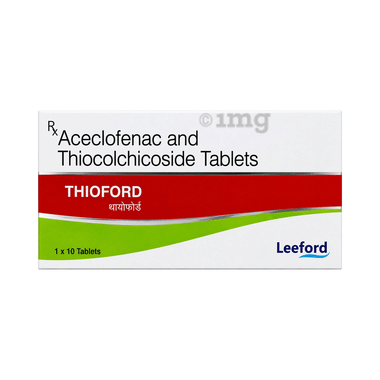
Available generics for Aceclofenac + Thiocolchicoside
Order with generics and save upto 50%
Show more

How Aceclofenac + Thiocolchicoside works
Aceclofenac is a non-steroidal anti-inflammatory drug (NSAID) which works by blocking the release of certain chemical messengers that cause pain and inflammation (redness and swelling). Thiocolchicoside is a muscle relaxant. It works on the centres in the brain and spinal cord to relieve muscle stiffness or spasm and to improve pain and movement of muscles.
Common side effects of Aceclofenac + Thiocolchicoside
Nausea, Dyspepsia, Abdominal pain, Increased liver enzymes, Dizziness, Diarrhea

Get medicines for Aceclofenac + Thiocolchicoside

Want to Know More
Read Our Editorial PolicyMedicine brands for Aceclofenac + Thiocolchicoside
Zerodol TH
Ipca Laboratories Ltd
₹251 to ₹386
2 variant(s)
Hifenac TH
Intas Pharmaceuticals Ltd
₹196 to ₹383
4 variant(s)
Miofree A
Lupin Ltd
₹321 to ₹452
2 variant(s)
Thiospas-A
Abbott
₹314 to ₹527
3 variant(s)
Zix-MR
Jenburkt Pharmaceuticals Ltd
₹236 to ₹286
3 variant(s)
Thichoren AC
La Renon Healthcare Pvt Ltd
₹245 to ₹390
2 variant(s)
Thioceclo
Aristo Pharmaceuticals Pvt Ltd
₹128 to ₹246
4 variant(s)
Equiflex
Pfizer Ltd
₹155 to ₹236
2 variant(s)
Thiox OD
Wallace Pharmaceuticals Pvt Ltd
₹179 to ₹237
2 variant(s)
AC MR
MMC Healthcare Ltd
₹201 to ₹201
1 variant(s)
Expert advice for Aceclofenac + Thiocolchicoside
- Aceclofenac + Thiocolchicoside helps relieve pain and muscle spasm that may occur due to strains, sprains, and muscle injuries.
- It is usually used along with rest and physical therapy.
- Take it with food to avoid an upset stomach.
- It may cause dizziness. Do not drive or do anything requiring concentration until you know how it affects you.
- Avoid consuming alcohol when taking Aceclofenac + Thiocolchicoside as it may cause excessive drowsiness.
Frequently asked questions for Aceclofenac + Thiocolchicoside
Aceclofenac+Thiocolchicoside is a combination of two medicines: Aceclofenac and Thiocolchicoside. This medication helps in relieving muscle pain. It relaxes the muscles by acting on the central nervous system and lowering chemical substance in the body that cause pain and inflammation.
Yes, Aceclofenac+Thiocolchicoside is safe for most of the patients. However, in some patients it may cause some common unwanted side effects like nausea, vomiting, stomach pain, heartburn, diarrhoea and other uncommon and rare side effects. Inform your doctor if you experience any persistent problem due to the medication.
Aceclofenac+Thiocolchicoside is usually used for short term and can be discontinued when the pain is relieved. However, Aceclofenac+Thiocolchicoside should be continued if your doctor has advised you to do so.
Yes, the use of Aceclofenac+Thiocolchicoside can cause dizziness (feeling faint, weak, unsteady or lightheaded) in some patients. If you feel dizzy or lightheaded, it is better to rest for some time and resume once you feel better.
The use of Aceclofenac+Thiocolchicoside is considered to be harmful for patients with known allergy to painkillers or any of the components or excipients of this medicine. The use of this medicine should preferably be avoided in patients with a history of stomach ulcer or in patients with active, recurrent stomach ulcer/bleeding. It should also be avoided in patients with history of heart failure, high blood pressure, and liver or kidney disease.
Yes, Aceclofenac+Thiocolchicoside can be taken with Vitamin B-complex preparations. While Aceclofenac+Thiocolchicoside helps to relieve pain, Vitamin B-complex can help to correct the vitamin deficiency that might be causing your symptoms.
Yes, the long-term use of Aceclofenac+Thiocolchicoside can cause damage to the kidneys. Normal kidneys produce a chemical called prostaglandins that protects them from damage. Use of painkillers lower the levels of prostaglandins in the body which leads to kidney damage on long-term use. Use of painkillers is not recommended in patients with underlying kidney disease.
No, taking more of this medicine will not make it more effective, rather it can lead to increased side effects. If the symptoms are getting severe, please consult the doctor for re-evaluation.