






Parijat
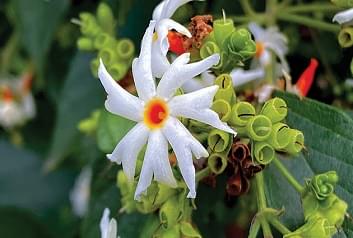
Parijat, also known as Night-flowering Jasmine, is an important plant used in traditional medicines for the treatment of various diseases. The plant is used as a herbal remedy for treating various infectious and non-infectious diseases[1].
Traditionally, different parts of the plant have been used as herbal remedies for treating conditions like intermittent fevers, arthritis, and sciatica. The plant shows anti-inflammatory and antipyretic (fever-reducing) properties which help in managing pain and fever. It is also used as a laxative, in rheumatism, skin ailments, and as a sedative[2].
As per the Ayurveda textbook, the plant provides relief from the symptoms of cough and cold. Drinking fresh Parijat leaves juice with honey helps to reduce the symptoms of fever due to its Ushna (hot) property. The plant also helps in the treatment of arthritis. It balances the aggravated Vata which is considered as a major reason for symptoms.
Some researchers suggest its use on the hair scalp to get relief from hair fall[3]. The leaves of the plant can be used to treat ringworm and other skin diseases[4]. According to Ayurveda, the paste of the Parijat plant leaves, when applied externally, can provide benefits in reducing the pain caused due to an imbalance of Vata dosha due to its Vata-balancing property.
It is advised to do a patch test before applying Parijat externally in any form to avoid any allergy.
Traditionally, different parts of the plant have been used as herbal remedies for treating conditions like intermittent fevers, arthritis, and sciatica. The plant shows anti-inflammatory and antipyretic (fever-reducing) properties which help in managing pain and fever. It is also used as a laxative, in rheumatism, skin ailments, and as a sedative[2].
As per the Ayurveda textbook, the plant provides relief from the symptoms of cough and cold. Drinking fresh Parijat leaves juice with honey helps to reduce the symptoms of fever due to its Ushna (hot) property. The plant also helps in the treatment of arthritis. It balances the aggravated Vata which is considered as a major reason for symptoms.
Some researchers suggest its use on the hair scalp to get relief from hair fall[3]. The leaves of the plant can be used to treat ringworm and other skin diseases[4]. According to Ayurveda, the paste of the Parijat plant leaves, when applied externally, can provide benefits in reducing the pain caused due to an imbalance of Vata dosha due to its Vata-balancing property.
It is advised to do a patch test before applying Parijat externally in any form to avoid any allergy.
What are the synonyms of Parijat?
Harsingar, Night jasmine, Hengra bubar,, Night-flowering jasmine, Shiuli, Night jasmine, Parijatha, Sephalika, Parijatakam, Jayaparvati, Gangasiuli
What is the source of Parijat?
Plant Based
Benefits of Parijat
1.Joint pain
Parijat oil can help to reduce bone and joint pain. According to Ayurveda, bones and joints are considered a site of Vata in the body. Pain in the joints is mainly caused due to an imbalanced Vata. Applying Parijat oil helps to reduce joint pain due to its Vata-balancing property.
Tip
Take 5-10 drops of Parijat essential oil
Mix with coconut oil and apply on the affected area once or twice a day to get relief in joint pain
2.Hairfall
Parijat has Keshya (hair tonic) property which helps to control hair fall and promote hair growth. Juice of Parijat flower or paste of the seeds, when applied to the scalp, can give quick results and also promote hair growth.
Tip
Extract the juice of Parijat flowers or make a paste out of the seeds
Apply it to the scalp
Leave it 20 to 30 minutes then wash with plain water
Repeat the process same twice a week to get quick results
3.Ringworm
Ringworm or Dadru with itching and burning sensation is due to an imbalance of Kapha and Pitta dosha. Parijat leaves juice helps to control fungal infections and itching associated with ringworm. This is due to its Kushtghna (useful in skin disease) and Kapha pacifying properties.
Tip
Take Parijat flower or leaves juice 10-20ml or as per requirement
Apply it to the affected area
Leave it 20 to 30 minutes then wash with plain water
Repeat the process same twice a week to get quick relief in ringworm lesion(s)
Parijat oil can help to reduce bone and joint pain. According to Ayurveda, bones and joints are considered a site of Vata in the body. Pain in the joints is mainly caused due to an imbalanced Vata. Applying Parijat oil helps to reduce joint pain due to its Vata-balancing property.
Tip
Take 5-10 drops of Parijat essential oil
Mix with coconut oil and apply on the affected area once or twice a day to get relief in joint pain
2.Hairfall
Parijat has Keshya (hair tonic) property which helps to control hair fall and promote hair growth. Juice of Parijat flower or paste of the seeds, when applied to the scalp, can give quick results and also promote hair growth.
Tip
Extract the juice of Parijat flowers or make a paste out of the seeds
Apply it to the scalp
Leave it 20 to 30 minutes then wash with plain water
Repeat the process same twice a week to get quick results
3.Ringworm
Ringworm or Dadru with itching and burning sensation is due to an imbalance of Kapha and Pitta dosha. Parijat leaves juice helps to control fungal infections and itching associated with ringworm. This is due to its Kushtghna (useful in skin disease) and Kapha pacifying properties.
Tip
Take Parijat flower or leaves juice 10-20ml or as per requirement
Apply it to the affected area
Leave it 20 to 30 minutes then wash with plain water
Repeat the process same twice a week to get quick relief in ringworm lesion(s)
Recommended Dosage of Parijat
- Parijat Oil - 5-10 drops or as per your requirement
- Parijat Juice - 10-20ml or as per your requirement
How to use Parijat
-Take Parijat flower or leaves juice 10-20ml or as per requirement
-Apply it to the affected area
-Leave it 20 to 30 minutes then wash with plain water
-Repeat the process same twice a week to get quick relief in the skin disease
-Apply it to the affected area
-Leave it 20 to 30 minutes then wash with plain water
-Repeat the process same twice a week to get quick relief in the skin disease
Frequently asked questions
Q. What is Parijat called in English?

MODERN SCIENCE VIEW
Parijat is commonly called as night jasmine in English. Its botanical name is Nyctanthes arbor-tristis. It is also called Hengra bubara and Shiuli.
Q. Are Harsingar and Parijat the same?
MODERN SCIENCE VIEW
Yes, Harsingar and Parijat are the same. The plant is a large shrub that grows about 10 m tall with flaky grey bark. It is one of the well-known medicinal plants used for various ailments like sciatica pain, arthritis and fever. It is also beneficial in the management of diabetes due to its anti-diabetic properties[8].
Q. What are the benefits of Parijat leaves?
MODERN SCIENCE VIEW
Parijat leaves provide various beneficial health effects due to the presence of anti-bacterial, anti-inflammatory, antipyretic (fever controlling) and anthelmintic (parasitic worm expeller) properties. Studies suggest that Parijat leaves also have anti-asthmatic and anti-allergic properties[11].
References
- Hussain A and Ramteke A. Flower extract of Nyctanthes arbor-tristis modulates glutathione level in hydrogen peroxide treated lymphocytes. Pharmacognosy Res. 2012 Oct-Dec; 4(4): 230–233

- Agrawal J and Pal A. Nyctanthes arbor-tristis Linn--a critical ethnopharmacological review. J Ethnopharmacol. 2013 Apr 19;146(3):645-58
- Uses of Nyctanthes arbor-tristis L
- Meshram MM, Rangari SB, Kshirsagar SB. NYCTANTHES ARBOR-TRISTIS A HERBAL PANACEA. Int J PHARM SCI RES.
- Shrivastava R, Bharadwaj AK. Nyctanthes arbortristis an Important Medicinal Plant of Madhya Pradesh State - A Review. Pharm Biosci J
- Tripathi A, Kumar S and Srivastava SK. Medicinal Properties of Harsingar (Nyctanthes Arbor-tristis Linn.): A Review. Int J Creat Res Thoughts. 2021. Volume 9, Issue 1.
- Rani C, Chawla S, Mangal M, Mangal AK, Kajla S, Dhawan A. Nyctanthes arbor-tristis Linn. (night jasmine): A sacred ornamental plant with immense medicinal potential. Indian J Tradit knowl. 3: 427-435.
- Rangika BS, Dayananda PD, and Peiris DC. Hypoglycemic and hypolipidemic activities of aqueous extract of flowers from Nycantus arbor-tristis L. in male mice. BMC Complement Altern Med. 2015; 15: 289.
- Tripathi A, Kumar S and Srivastava SK. Medicinal Properties of Harsingar (Nyctanthes Arbor-tristis Linn.): A Review. Int J Creat Res Thoughts. 2021. Volume 9, Issue 1.
- Thokala M. A LITERARY REVIEW OF NYCTANTHES ARBORTRISTISLINN (PARIJATHA) LINN IN AYURVEDIC CLASSICS. World J Pharm Res. Volume 7, Issue 04, 410-419.
- Sopi RB and Khan MFH. Bronchodilatory effect of ethanolic extract of the leaves of Nyctanthes arbortristis. Pharmacognosy Res. 2013 Jul-Sep; 5(3): 169–172.
- Meshram MM, Rangari SB, Kshirsagar SB. NYCTANTHES ARBOR-TRISTIS A HERBAL PANACEA. Int J PHARM SCI RES.
- NIF. Uses of Nyctanthes arbor-tristis L
Disclaimer
The content is purely informative and educational in nature and should not be construed as medical advice. Please use the content only in consultation with an appropriate certified medical or healthcare professional.
Author Details

BAMS

BDS
Last updated 29 Mar 2025 | 01:35 PM (IST)

Introduction
Benefits
Recommended dosage
How to use
FAQs
References