






Mooli
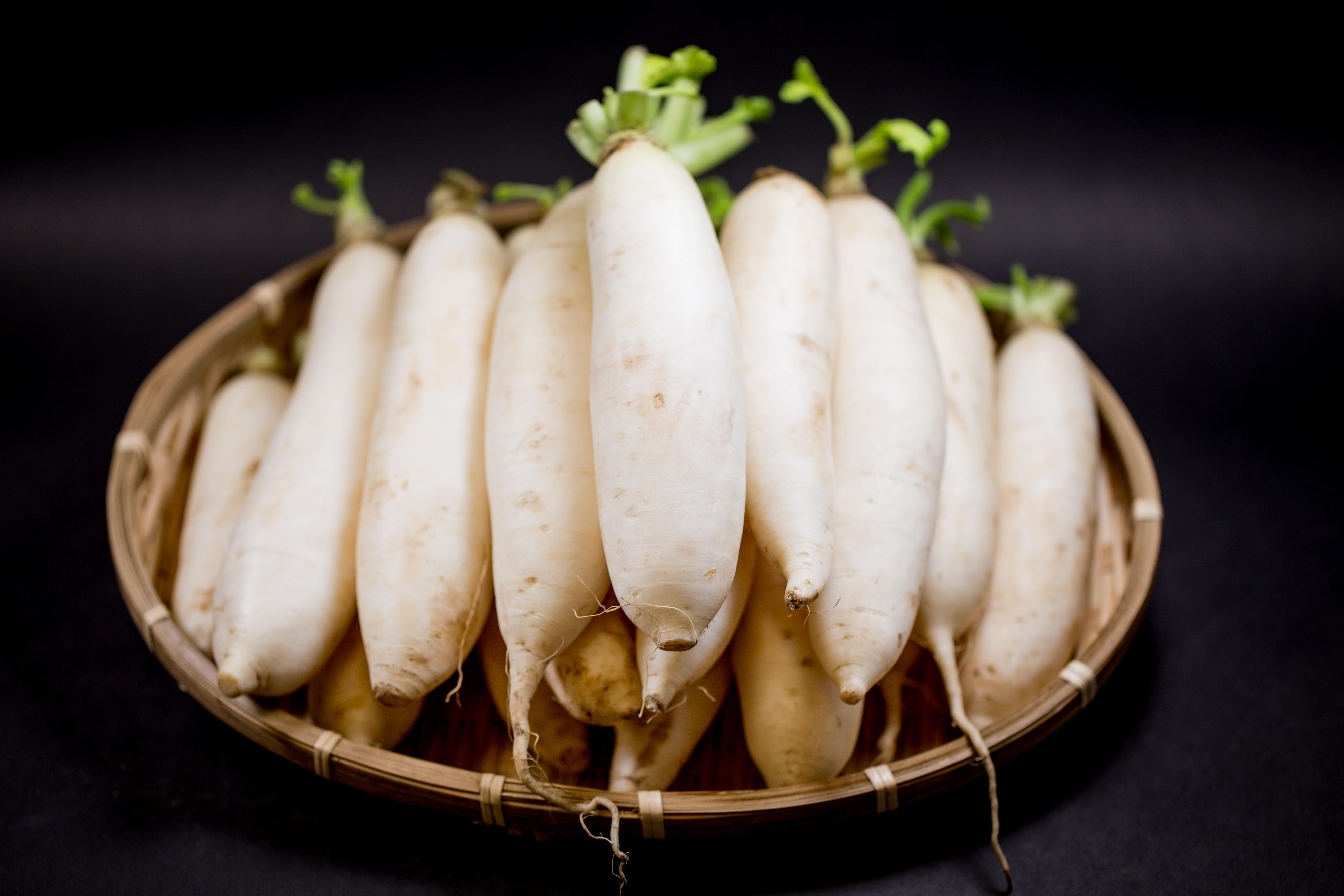
Mooli or Radish is a root vegetable that has a number of medicinal properties. It can be consumed in a raw, cooked or pickled form due to its high nutritional content. It is one of the most loved vegetables during winters in India. Mooli (Radish) leaves are rich in vitamin C, vitamin B6, magnesium, phosphorus, iron and calcium. They helps in bone building as it is a good source of calcium.
Mooli might help in weight loss as it is low in calories, helps improve digestion and enhances body metabolism due to the presence of fibers. It also helps improve diabetic conditions due to its antioxidant property as it fights against the free radicals and prevents cell damage. Taking Mooli juice before food is considered beneficial for urinary diseases such as urinary tract infections due to its diuretic property. It increases the production of urine and also acts as a kidney cleanser. Eating Mooli on a regular basis helps manage eye diseases (eyeball development and good eyesight) due to the presence of certain vitamins.
According to Ayurveda, eating Mooli before taking meals should be avoided as it might cause burning in the stomach due to its Ushna property[1][2][7].
Mooli might help in weight loss as it is low in calories, helps improve digestion and enhances body metabolism due to the presence of fibers. It also helps improve diabetic conditions due to its antioxidant property as it fights against the free radicals and prevents cell damage. Taking Mooli juice before food is considered beneficial for urinary diseases such as urinary tract infections due to its diuretic property. It increases the production of urine and also acts as a kidney cleanser. Eating Mooli on a regular basis helps manage eye diseases (eyeball development and good eyesight) due to the presence of certain vitamins.
According to Ayurveda, eating Mooli before taking meals should be avoided as it might cause burning in the stomach due to its Ushna property[1][2][7].
What are the synonyms of Mooli?
Raphanus sativus, Salamarkataka, Saleya, Marusambhava, Mulo, Mula, Radish, Muli, Mullangi, Mugunigadde, Moolangi, Moolaogi, Mullanki, Rakhyasmula, Moolak, Moolee, Moola, Mulakam, Mullangu, Millangi, Turb, Visra
What is the source of Mooli?
Plant Based
Benefits of Mooli
What are the benefits of Mooli for Appetite stimulant?

MODERN SCIENCE VIEW
Mooli might help in loss of appetite by increasing the hunger. It acts as a tonic and stimulates the digestive enzymes which improve digestion and thereby increase the urge for food[15][16].

AYURVEDIC VIEW
Mooli help to improve appetite when it is made a part of daily diet. In Ayurveda, loss of appetite is due to Agnimandya (weak digestion). It is caused by an aggravation of Vata, Pitta, and Kapha doshas leading to incomplete digestion of food. This causes insufficient secretion of gastric juice in the stomach resulting in appetite loss. Mooli stimulates digestion fire and improves appetite due to its Deepan (appetizer) property.
Tip
1.Add fresh Mooli into your daily diet in the form of salad to get improve your appetite
Tip
1.Add fresh Mooli into your daily diet in the form of salad to get improve your appetite
What are the benefits of Mooli for Infections?
MODERN SCIENCE VIEW
Mooli can be used in infections as it contains certain constituent (raphanine) which has antibacterial and antifungal properties. It fights against several microorganisms(bacteria and fungi) responsible for causing various infections in the body[17-18].
What are the benefits of Mooli for Fever?
MODERN SCIENCE VIEW
Enough scientific evidence is not available to support the role of Mooli in fevers.
What are the benefits of Mooli for Common cold?
MODERN SCIENCE VIEW
Enough scientific evidence is not available to support the role of Mooli in cold.
What are the benefits of Mooli for Cough?
MODERN SCIENCE VIEW
Although enough scientific evidence is not available to show the role of Mooli in cough. However, research suggests that dry seeds of Mooli have expectorant and antitussive properties. It may loosen the mucus in the respiratory tract and help to expel it. It may also suppress the cough reflex and thus helps in cough[19].
What are the benefits of Mooli for Gallbladder stones?
MODERN SCIENCE VIEW
Mooli may help in digestive disorders due to bile duct problems as blocked bile ducts may cause gall stones or digestive disorders. Mooli juice may helps to decrease the cholesterol and triglycerides levels by improving cholesterol metabolism and remove cholesterol gallstones[20].
What are the benefits of Mooli for Inflammation of the airways (bronchitis)?
MODERN SCIENCE VIEW
Although enough scientific evidence is not available to explain the role of Mooli in bronchitis. However, it may be used in bronchitis since it has anti-inflammatory property. It may help to reduce the inflammation of the respiratory tract and give relief in bronchitis[21-22].
AYURVEDIC VIEW
Mooli is good if you have a cough related problems like bronchitis. In Ayurveda, this disease is known as Kasroga and is caused by poor digestion. Poor diet and incomplete elimination of wastes lead to the formation of Ama (toxic remains in the body due to improper digestion) in the form of mucus in the lungs. This leads to bronchitis. Mooli has Deepan (appetizer) and Ushna(hot) properties. It reduces Ama and expels excessive mucus from the lungs thus gives relief from the symptoms of bronchitis.
Tip
1.Take 6-8 teaspoon of Mooli juice
2.Add the same quantity of water and drink before food once a day to get rid of the symptoms of bronchitis.
Tip
1.Take 6-8 teaspoon of Mooli juice
2.Add the same quantity of water and drink before food once a day to get rid of the symptoms of bronchitis.
What are the benefits of Mooli for Sore throat?
MODERN SCIENCE VIEW
Mooli may help in the sore throat as it contains certain active constituent(flavonoids) which has anti-inflammatory activity. It reduces the pain and irritation of the throat and helps to eliminate excess mucus from the throat, thus it may give relief from sore throat[14].
AYURVEDIC VIEW
Sore throat is a condition which occurs due to an imbalance of Vata and Kapha dosha and result in the formation and accumulation of mucus in the throat that causes irritation. Mooli might help to manage this condition if eaten raw, due to its Tridosha (Vata, Pitta and Kapha) balancing property. Its seeds are used to balance the Kapha dosha. It also helps to improve digestion and release out the mucus from body due to its Pachan (digestion), Mridu Rechan (mild laxative) and Mutral (diuretic) properties.
How effective is Mooli?
Insufficient evidence
Appetite stimulant, Common cold, Cough, Fever, Gallbladder stones, Infections, Inflammation of the airways (bronchitis), Sore throat
Precautions when using Mooli
Advice from Experts
AYURVEDIC VIEW
Do not take Mooli with milk or fish since it is a wrong food combination.
AYURVEDIC VIEW
Use Mooli kshar, a special Ayurvedic preparation of Mooli only under medical supervision.
How to use Mooli
1. Fresh Mooli
a. Eat fresh Mooli as per your taste.
b. You can include Mooli in your daily diet in the form of salad.
2. Mooli Juice
a. Take 6-8 teaspoons of Mooli juice.
b. Add the same quantity of water and drink before food once a day.
3. Mooli Kshar
a. To 2-4 pinch of Mooli Kshar.
b. Add honey and take after lunch and dinner.
a. Eat fresh Mooli as per your taste.
b. You can include Mooli in your daily diet in the form of salad.
2. Mooli Juice
a. Take 6-8 teaspoons of Mooli juice.
b. Add the same quantity of water and drink before food once a day.
3. Mooli Kshar
a. To 2-4 pinch of Mooli Kshar.
b. Add honey and take after lunch and dinner.
Frequently asked questions
Q. What are the chemical constituents of Mooli?
MODERN SCIENCE VIEW
It contains carbohydrates, ascorbic acid, folic acid, potassium, vitamin B6, riboflavin, magnesium and sulforaphane which provide nutrients and serve medicinal purposes. The main bioactive compounds present in mooli are glucosinolates and isothiocyanates. Mooli also contain anthocyanins a potent antioxidant flavonoid which is useful in improving diabetic conditions.
Q. What forms of Mooli is available in the market?
MODERN SCIENCE VIEW
Fresh Mooli is very easily available in the market. You can include it into your diet as a salad. Other forms of Mooli which are available in the market is Churna, Juice and Kshar (Ash) under various brands.
Q. Can I eat Mooli (radish) at night?
MODERN SCIENCE VIEW
Yes, you can eat Mooli (radish) at any time of the day. Mooli is low in calories and high in fiber which makes it good for digestion.
AYURVEDIC VIEW
Yes, you can eat Mooli at any time of the day, but it should preferably be taken along with food as it helps promote digestion.
Q. Is it harmful to eat radish and curd together?
MODERN SCIENCE VIEW
Although enough scientific evidence is not available, but eating radish and curd together is not considered as a good food option. So, it is generally advised to avoid taking both together[8].
Q. How many calories are there in Mooli?
MODERN SCIENCE VIEW
There are approximately 18 calories in 100g Mooli.
References
- Saleem Ali Banihani.Radish (Raphanus sativus) and Diabetes.Nutrients. 2017;9(9):1014.
- Yu R, Xu L, Zhang W, et al.De novo Taproot transcriptome sequencing and analysis of major genes involved in sucrose metabolism in radish (Raphanus sativus L.).Front Plant Sci. 2016;7: 585.
- Shukla S, Chatterji S, Mehta S, et al.Antidiabetic effect of Raphanus sativus root juice.Pharm Biol. 2011 Jan;49(1):32-7.
- https://www.webmd.com/vitamins/ai/in gredientmono-502/radish
- Baldec J. 90+ Smoothies & Juices: Delicious Blender Recipes For High Speed Ninja Blenders.Speedy publishing LLC.2014.

- Baldec J. Detox Drinks: Juice Fasting Detoxification & Fat Burning Smoothies: Speedy publishing LLC. 2013.
- Baviskar K. nature cure in eye care. B. Jain Publishers. 2006.
- Satyanand A. Surya Chikitsa. Diamond pocket books (P) ltd. 2000.
- Perez -Gutierrez RM, Perez RL. Raphanus sativus (Radish): Their Chemistry
and Biology. The scientific world journal. 2004;4:811-837.
- Murray MT, Pizzomo J. The encyclopedia of healing foods. Simon and Schuster. 2010.
- Bakhru HK. Foods that heal: The natural way to good health. Orient paperbacks. 2014.
- Cormier N.201 Organic Smoothies and Juices for a Healthy Pregnancy: Nutrient-Rich Recipes for Your Pregnancy Diet. Simon and Schuster. 2013.
- Khan MTH, Ather A.White radish for skin. Lead Molecules from Natural Products: Discovery and New Trends. Elsevier. 2006.
- Sreelekshmi G, Kulkarni P. A safe body through Moolaka - Raphanus sativus Linn.IAMJ. 2015;3(10):3090-3096.
- Rani I, Akhund S, ABRO H.Antimicrobial potential of seed extract of Raphanus sativus.Pak. J. Bot. 2008;40(4):1793-1798.
- Vangalapati M, Madhuri YG, Vidya Sagar T, et al.Experimental studies and Development of Modelling equation of Quercetin from Raphanus Sativus using Soxhlet Extractor. IJIRSET.2014;3(5):12214-12221.
- Shukla S, Chatterji S, Yadav DK, et al.Antimicrobial efficacy of Raphanus sativus root juice.Int J Pharm Pharm Sci.2011;3(5):89-92.
- Jadoun J, Yazbak A, Rushrush S, et al.Identification of a New Antibacterial Sulfur Compound from Raphanus sativus Seeds.Evidence-Based Complementary and Alternative Medicine.2016.http://dx.doi.org/10.1155/2016/9271285.
- Sabishruthi ,Rajan AK *, Sai AC ,et al.A Disquisition on Raphanus sativus Linn- A Propitious Medicinal Plant.International Journal of ChemTech Research.2018;11(11): 48-55.
- Castro-Torres IG, Naranjo-Rodríguez EB, Domínguez-Ortíz MÁ, et al.Antilithiasic and hypolipidaemic effects of Raphanus sativus L. var. niger on mice fed with a lithogenic diet.J Biomed Biotechnol. 2012. doi:10.1155/2012/161205
- Choi KC, Cho SW, Kook SH, et al. Intestinal anti-inflammatory activity of the seeds of Raphanus sativus L. in experimental ulcerative colitis models. Journal of Ethnopharmacology. 2016;179:55-65
- Kumar R, Patwa R. Antioxidant activity of RAPHANUS SATIVUS L. of jhansi district, Uttar pradesh, India. Int Res J Pharm.2018;9(1):98-102.
Disclaimer
The content is purely informative and educational in nature and should not be construed as medical advice. Please use the content only in consultation with an appropriate certified medical or healthcare professional.
Author Details

BAMS

MBA, MBBS

M.Tech, B.Tech
Last updated 24 Mar 2025 | 04:57 PM (IST)

Introduction
Benefits
Precautions
How to use
FAQs
References