






Apricot
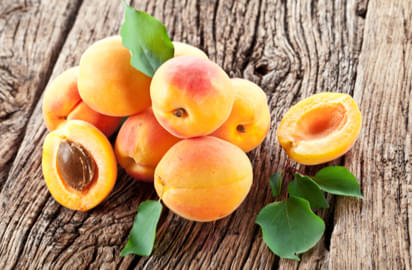
Apricot is a yellowish-orange fleshy fruit with a slight tinge of red on one side. It has a thin outer skin and can be eaten without peeling. It is a rich source of vitamin A, vitamin C and potassium.
Apricot is useful for the management of constipation as it adds bulk to the food and improves bowel movements due to its laxative property. It also improves gut health and helps in managing digestion-related issues. It might also help in managing anaemia due to its high iron content. Apricots, being rich in vitamin A, helps to improve eye health and promotes healthy bone formation due to calcium present in it. Being full of minerals, it also helps to maintain electrolyte balance in the body. Apricot might help manage asthma by preventing damage to the respiratory cells caused by free radicals due to its antioxidant properties.
Apricot oil can be applied on the skin to delay the signs of aging due to its antioxidant property. Apricot is also used as an ingredient in various cosmetic products such as face wash and scrub. Scrubbing your face with Apricot face scrub may help you to get rid of blackheads.
Apricots are safe to be eaten in food quantities however excessive consumption may lead to bloating and abdominal pain[1][2].
Apricot is useful for the management of constipation as it adds bulk to the food and improves bowel movements due to its laxative property. It also improves gut health and helps in managing digestion-related issues. It might also help in managing anaemia due to its high iron content. Apricots, being rich in vitamin A, helps to improve eye health and promotes healthy bone formation due to calcium present in it. Being full of minerals, it also helps to maintain electrolyte balance in the body. Apricot might help manage asthma by preventing damage to the respiratory cells caused by free radicals due to its antioxidant properties.
Apricot oil can be applied on the skin to delay the signs of aging due to its antioxidant property. Apricot is also used as an ingredient in various cosmetic products such as face wash and scrub. Scrubbing your face with Apricot face scrub may help you to get rid of blackheads.
Apricots are safe to be eaten in food quantities however excessive consumption may lead to bloating and abdominal pain[1][2].
What are the synonyms of Apricot?
Prunus armeniaca, Urumana, Zardalu, Malhoi, Khubani fal, Jardalu, Khubani, Jardaloo, Khubani badam, Apricot pandlu, Khurmani
What is the source of Apricot?
Plant Based
Benefits of Apricot
What are the benefits of Apricot for Constipation?

MODERN SCIENCE VIEW
Apricot might be beneficial in the management of constipation. Apricot increases the contraction of the colon and helps in easy expulsion of stool. Thus, Apricot can be used as a laxative[3][5].

AYURVEDIC VIEW
Constipation is caused due to an aggravated Vata dosha. This can be due to the frequent consumption of junk food, excess intake of coffee or tea, sleeping late at night, stress and depression. All these factors aggravate Vata in the large intestine and cause constipation. Eating Apricot helps to control constipation because of its Rechana (laxative) properties which increases bowel movements and clean the digestive tract.
Tips:
1. Take 4-5 Apricots in a day to control constipation.
2. Apricot can be eaten raw as well as in dried form.
Tips:
1. Take 4-5 Apricots in a day to control constipation.
2. Apricot can be eaten raw as well as in dried form.
How effective is Apricot?
Insufficient evidence
Asthma, Bleeding, Constipation, Cough, Eye infection, Infertility
Precautions when using Apricot
Breastfeeding
MODERN SCIENCE VIEW
It is safe to take Apricot in food amounts. However, it is advised to consult your doctor before taking Apricot supplements during breast-feeding[3].
Pregnancy
MODERN SCIENCE VIEW
It is safe to take Apricot in food amounts. However, it is advised to consult your doctor before taking Apricot supplements during pregnancy[3].
Recommended Dosage of Apricot
- Apricot Capsule - 1-2 capsule twice a day.
How to use Apricot
1. Apricot Raw Fruit
Eat ripe Apricot preferably in the breakfast or in the afternoon.
Eat ripe Apricot preferably in the breakfast or in the afternoon.
Frequently asked questions
Q. Can you eat Apricot skin?
MODERN SCIENCE VIEW
Apricots can be eaten along with the skin. But the skin needs to be removed if you are using Apricots to make bakery items. This is because the skin can change the texture and appearance of the final product.
Q. How much Apricot can you eat in a day?
MODERN SCIENCE VIEW
1 cup of sliced Apricots (approximately 4½ fruits) gives you an average of 85 calories and 3.5 grams of fiber.
Q. How many calories are there in Apricot?
MODERN SCIENCE VIEW
There are approximately 17 calories in one Apricot.
References
- Raj V, Jain A, Chaudhary J.Prunus Armeniaca (Apricot): An Overview.Journal of Pharmacy Research.2012;5(8):3964-3966.
- Yılmaz I.The Biological and Pharmacological Importance of Apricot.SOJ Pharmacy & Pharmaceutical Sciences.2018;5(1):1-4.
- WebMD.Apricot: Uses, Side effects, Doses, Interactions [Internet].Atlanta [last updated in 2016].
- Akyildiz BN, Kurtoğlu S, Kondolot M,et.al.Cyanide poisoning caused by ingestion of apricot seeds.Ann Trop Paediatr. 2010;30(1):39-43.
- Yang XJ, Zhang M, Zhu HM, et al. Epidemiological study: Correlation between diet habits and constipation among elderly in Beijing region. World J Gastroenterol.2016;22(39):8806-8811.
- Yigit D, Yigit N, Mavi A. Antioxidant and antimicrobial activities of bitter and sweet apricot (Prunus armeniaca L.) kernels. Braz J Med Biol Res.2009;42(4):346-352.
- Kim CS, Jo K, Lee IS, et al. Topical application of Apricot kernel extract improves dry eye symptoms in a unilateral exorbital lacrimal gland excision mouse. Nutrients.2016;8,750.
- Kim CS, Jo K, Lee IS, Kim J. Topical Application of Apricot Kernel Extract Improves Dry Eye Symptoms in a Unilateral Exorbital Lacrimal Gland Excision Mouse. Nutrients. 2016;8(11):1-10.

- Minaiyan M, Ghannadi A, Asadi M, Etemad M, Mahzouni P. Anti-inflammatory effect of Prunus armeniaca L. (Apricot) extracts ameliorates TNBS-induced ulcerative colitis in rats. Res Pharm Sci. 2014;9(4):225-31.
- Fatima T et al. Nutritional and health benefits of apricots. International Journal of Unani and Integrative Medicine. 2018; 2(2): 05-09.
- Al-Bachir et al.Trace Elements Measurement In Apricot (Prunus Armeniaca.) Seeds By Neutron Activation Analysis. Journal of Biotechnology and Biomedical Science.2018;1(3):1-12.
- Hosseini B, Berthon BS, Wark P, Wood LG. Effects of Fruit and Vegetable Consumption on Risk of Asthma, Wheezing and Immune Responses: A Systematic Review and Meta-Analysis. Nutrients. 2017 Mar 29;9(4):2-26.
- Higgs J, Derbyshire E, Styles K. Nutrition and osteoporosis prevention for the orthopaedic surgeon: A wholefoods approach. EFORT Open Rev. 2017;2(6):300-308.
- Jain A, Chaudhary J, Raj V. Prunus Armeniaca (Apricot): An Overview. Journal of Pharmacy Research.2012;5(8):3964-3966.
- Raj V, Mishra A, Mishra A, et al.Hepatoprotective effect of Prunus armeniaca L. (Apricot) leaf extracts on Paracetamol induced liver damage in Wistar rats. Pharmacognosy Journal. 2016;8: 154-158.
Disclaimer
The content is purely informative and educational in nature and should not be construed as medical advice. Please use the content only in consultation with an appropriate certified medical or healthcare professional.
Author Details

BAMS

M.Tech, B.Tech

MBA, MBBS
Last updated 29 Aug 2022 | 04:38 PM (IST)

Introduction
Benefits
Precautions
Recommended dosage
How to use
FAQs
References