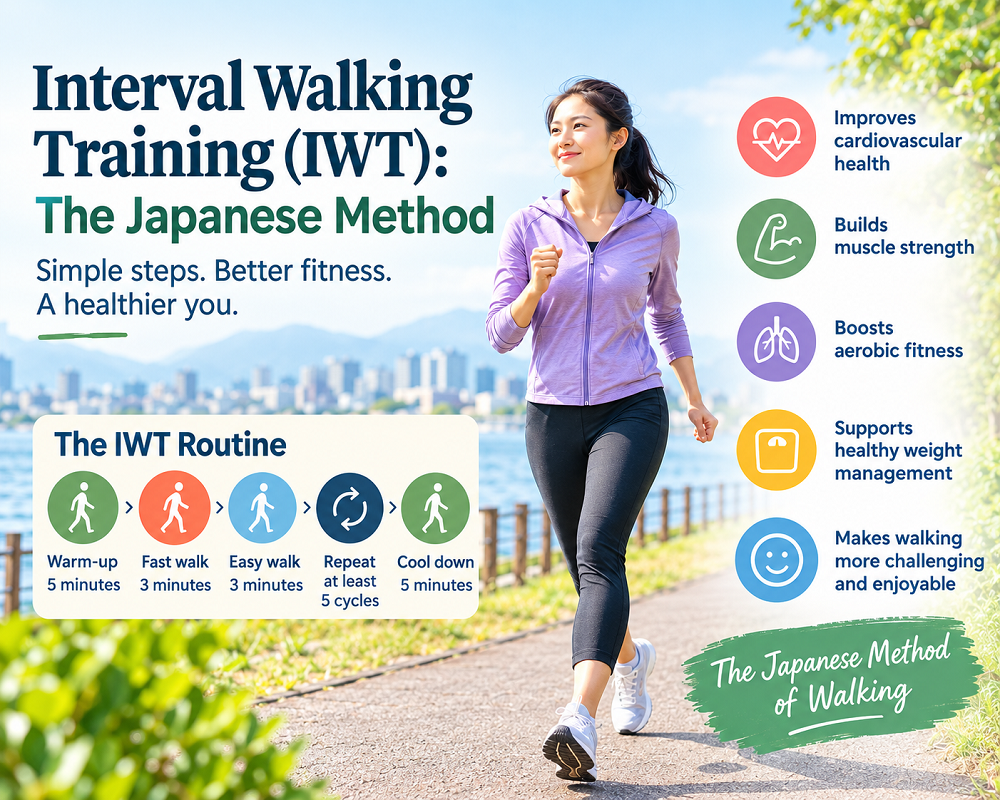
Walking is the easiest way to keep active, but walking at the same pace again and again is not effective enough to improve physical fitness. That’s where Interval walking training (IWT) can help. You don’t maintain one speed for the entire workout, but rather alternate between spurts of fast walking and slower walking.
Created and researched in Japan, this workout type is attractive to people because it has the convenience of regular walking while delivering the training effect provided by interval training. Studies have shown that middle-aged and elderly people undergoing a particular program of IWT experience increased aerobic fitness and better health indicators.[1]
However, what exactly is this peculiar method of walking, and how can one apply it?
What is Interval Walking Training?

Interval Walking Training is a particular type of walking in which faster walking alternates with slower walking.
The method developed by researchers at Shinshu University typically uses:
- 3 minutes of fast walking
- 3 minutes of slow or easy walking
- At least 5 cycles per session
- Around 4 or more days per week
Participants in the study had to walk at least 70% of their maximum aerobic capacity during fast intervals and at about 40% of the same during slower intervals.[1]
This means that in a typical workout, the total time spent walking could be 30 min, although a beginner may not have to adhere to the complete protocol.
How Is IWT Different from Regular Walking?
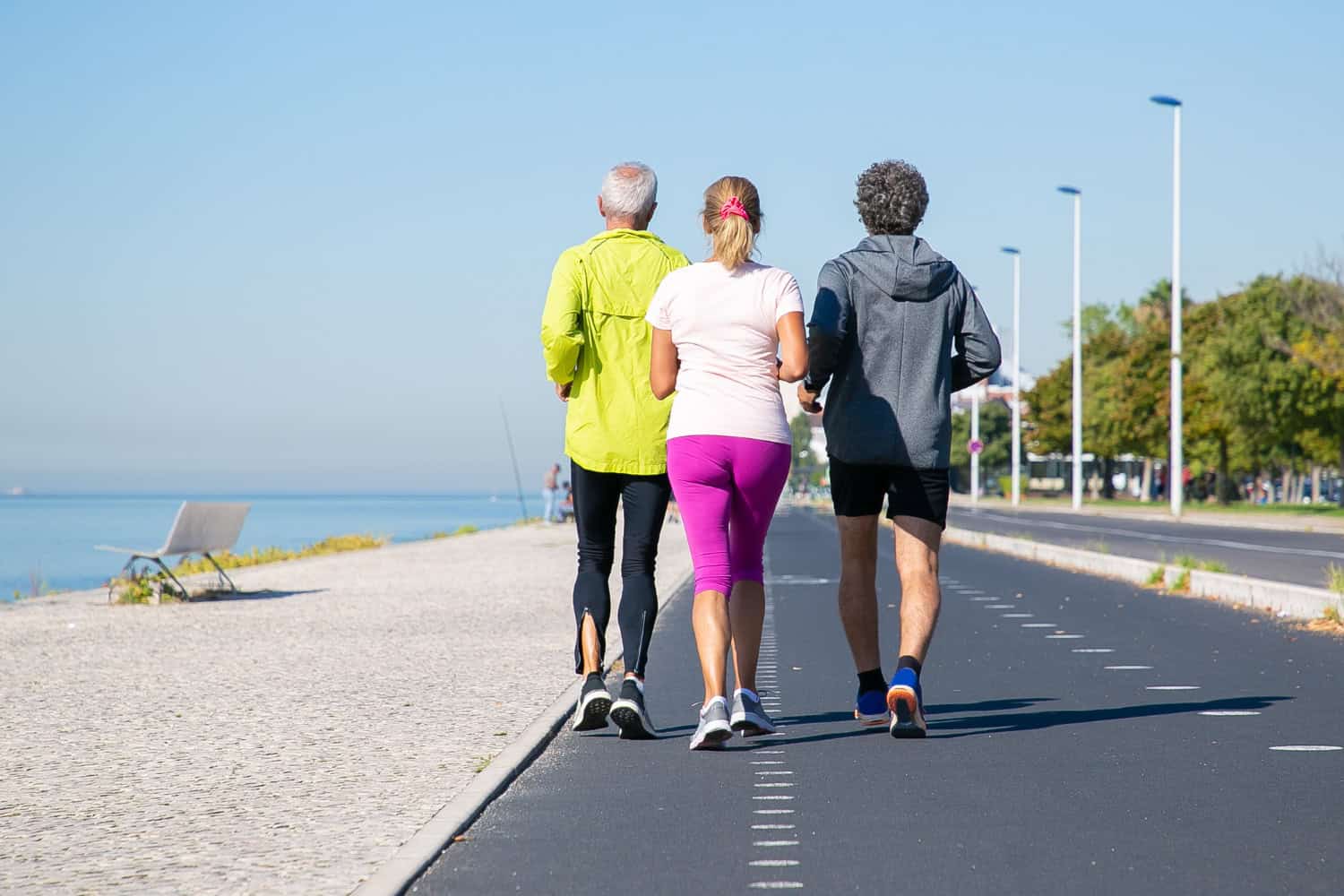
In a standard moderate-paced walking workout, you typically utilize a consistent intensity level throughout.
Conversely, IWT includes deliberate changes in effort. You will find that your heart rate, breathing, and muscle exertion level go up while running high-intensity intervals.
Consequently, this makes the exercise similar to interval training characteristics but without losing the low-impact feature of walking.
Research comparing IWT and moderate continuous walking indicates that high-intensity intervals provide greater improvements in the strength of thigh muscles and peak aerobic capacity among middle-aged and older people.[1,2]
As a result, this method may be beneficial for people who have trouble engaging in regular high-impact activities.
The Basic Japanese IWT Routine
The classic IWT session looks like this:
Step 1: Warm-up — 5 minutes
Start slow; just walk comfortably to prepare your muscles and cardiovascular system gradually.
Step 2: Fast Walk — 3 minutes
Increase your pace so much that you can feel yourself working hard. Breathing should be fast, but you should still be able to keep the pace.
Step 3: Easy Walk — 3 minutes
Slow down so that your breathing rate returns to normal.
Step 4: Repeat
The protocol involves at least five cycles of 3-minute high- and low-intensity circuits.
Step 5: Cool-down – 5 minutes
You’re going to end up with easy and comfortable walking.
The procedure used in this study included five rounds of three minutes of easy walking followed by three minutes of fast walking, conducted at least four days a week.[1]
How Do I Know the Intensity of Fast Walking?

You really don’t need any gadget or lab test in order to start. For many people, judging the pace is done by simply how it feels.
During the slow interval, you should feel comfortable and should be able to have a conversation normally.
During the fast interval, your breathing should be more rapid and deeper. You should feel challenged but still have control over your body and good walking form.
For beginners, the fast period can be “fast walking” rather than executing a sprint.
The original research used individual aerobic-capacity measurements to prescribe intensity, so the exact 70% target used in scientific studies should not be interpreted as a universal pace for everyone.
What Advantages Can Be Derived from IWT?

1. It may enhance aerobic fitness
An important justification for using interval walking is based on its possible benefits for the cardiovascular system.
As per a study on 679 people aged over the age of 40, five months of IWT resulted in an improvement in aerobic capacity of 14% on average. Further, the research has shown that the lifestyle disease score decreased.[3]
Aerobic performance is vital as it indicates the efficacy of oxygen utilization by an organism during workouts.
2. It can be more difficult on the muscles than slow walking
Walking fast or walking uphill will demand more work from leg muscles. The original randomized study showed that high-intensity interval walking improved thigh muscle strength and aerobic capacity more than a moderate continuous workout.[1]
This makes IWT a useful option for people who have outgrown leisurely walks but want to avoid immediately moving to running.
3. It may support cardiovascular health
It has been indicated by research that there may be improvements in various cardiovascular risk factors after completing programs that include interval walking. Still, there are conflicting findings.
For instance, a study conducted among Japanese adults with an average age of around 75 showed that the differences in blood pressure between the IWT group and control group were not statistically significant five months after the program; still, greater time spent on fast walking correlated with larger decreases in certain blood pressure indices among men.[4]
This serves as a reminder: IWT may contribute to the improvement of heart health, but should not be used as a means to reduce blood pressure.
4. It may be a difficult walk
If you feel that your walking workouts are getting too easy for you, you can try walking a bit longer in distance.
The incorporation of intervals in your walking routine may increase the workout intensity without the need to pursue a completely new form of exercising.
This helps make IWT very attractive to those individuals who enjoy walking but want to have more structure in their workouts.
5. It may be beneficial for physical health in general
Studies have examined IWT in older people for things other than aerobic fitness. A randomized trial conducted on older adults assessed 20 weeks of conducting IWT compared to normal walking. The result was improvements in the measures of cognitive performance and arterial function in both groups; therefore, it is still not proven that the improvements were a result of only practicing IWT.[5]
Nonetheless, it provides another piece of evidence that structured walking should be regarded as a useful tool in achieving healthy ageing.
Can IWT Be Beneficial in Losing Weight?

IWT can definitely play its part in the calorie-burning program, yet it does not work miracles when it comes to weight-loss workouts.
The actual weight loss process relies mostly on the correlation between the calories we consume and the energy we spend over a period of time. Increasing walking intensity increases the workload for the session, yet dieting, the total daily activities we undertake and the sleeping routine also matter.
A study conducted in Japan with older and overweight patients revealed positive results after 16 weeks of using high-intensity interval walking. For those who combined the training with a limited number of calories, a better outcome was achieved in different aspects.[6]
Thus, we can say that IWT is used more as a part of the program aimed at improving our physical condition and health rather than as a way of losing weight.
How Often Should You Do IWT?

According to the Japanese protocol of IWT, the method should be used at least four times per week, and at least five cycles of the fast and slow walking should be practised.
Yet, beginners can start with some relatively easy activities.
For example
Beginner:
2–3 minutes easy + 1–2 minutes brisk, repeated several times.
Intermediate:
3 minutes easy + 3 minutes brisk, repeated four to five times.
Research-style protocol:
3 minutes easy + 3 minutes fast, repeated at least five times, on four or more days per week.
The right starting point depends on your current fitness, age, health status, and previous exercise experience.
Is IWT Possible for Everyone To Do?

Walking is easy for most people, but doing the faster segments of IWT can make training more painful than casual walking.
If you have not exercised for a long time or are used to low-intensity exercise, begin doing moderate workouts for at least some time before trying high-intensity workouts.
If you have a known history of heart disease, uncontrolled hypertension, major joint problems, or issues with balance or other health problems, consult your doctor before performing any vigorous exercises.
If you notice dangerous symptoms such as pain in the chest, faintness, difficulty in breathing, and unusual dizziness, stop exercising and go see your doctor.
The Summary

Interval walking training is a simple way of exercising by using strolling alone. One may interrupt the workout with alternations of several minutes spent walking fast and then taking a rest for easier walking. As a result, Interval Walking Training is a useful method for a person who wants to exercise without running.
Studies conducted in Japan show that this form of physical activity is beneficial since it can improve aerobic fitness and work capacity. Nevertheless, not all studies prove its usefulness in terms of health benefits.[3]
To make the walking challenge again, it would be reasonable to add intervals of fast walking at a controllable pace.
FAQs
Q. What is Interval walking?
Interval walking uses brisk and moderate muscle movement in order to make a regular, boring walking program more effective.
Q. What does IWT stand for?
IWT refers to Interval Walking Training, the Japanese concept of physical training, which involves alternating periods of running and walking.
Q. What is the Japanese method of walking?
The Japanese method of walking is simply interval walking training, involving cycles of slow and fast walking.
Q. How does Training Japanese Walking work?
Training Japanese walking basically uses a combination of walking at a higher intensity mixed with walking at a lower intensity.
Q. How long does an Interval walking workout last?
A typical Interval Walking session may last around 30 minutes, including repeated fast and slow walking intervals, plus warm-up and cool-down.
Q. Is IWT superior to walking?
IWT can be more demanding fitness-wise than simply walking, as it incorporates more intense intervals. However, both activities can contribute to physical activity nonetheless.
Q. Can the Japanese method of walking help with fitness?
Indeed, studies have associated the Japanese method of walking with improvements in such areas as aerobic fitness, muscular strength, and other health parameters, particularly among middle-aged and older individuals.
Q. How often can I do Japanese walking training?
The existing studies on Japanese walking training show that IWT should normally be practiced several times a week, but those who are beginners need to start with less intense and more frequent training sessions as per their fitness condition.
(The article is written by Deepa Sarkar, Senior Medical Writer, and reviewed by Monalisa Deka, Deputy Manager, Clinical Health & Content, Medical Affairs)
Recommended Reads
Trying to Lose Weight? Learn About The Link Between Sleep and Weight Loss!
References
1. Nemoto KI, Gen-no H, Masuki S, Okazaki K, Nose H. Effects of high-intensity interval walking training on physical fitness and blood pressure in middle-aged and older people. Mayo Clin Proc [Internet]. 2007;82(7):803–11. Available from: http://dx.doi.org/10.4065/82.7.803
2. Karstoft K, Thorsen IK, Nielsen JS, Solomon TPJ, Masuki S, Nose H, et al. Health benefits of interval walking training. Appl Physiol Nutr Metab [Internet]. 2024;49(7):1002–7. Available from: http://dx.doi.org/10.1139/apnm-2023-0595
3. Masuki S, Morikawa M, Nose H. High-intensity walking time is a key determinant to increase physical fitness and improve health outcomes after interval walking training in middle-aged and older people. Mayo Clin Proc [Internet]. 2019;94(12):2415–26. Available from: http://dx.doi.org/10.1016/j.mayocp.2019.04.039
4. Tsuda K, Hayashi E, Kamiya K, Kudo A, Kakihana H, Nakayama S, et al. Effects of interval-walking training on blood pressure in community-dwelling Japanese older adults. J Sports Med Phys Fitness [Internet]. 2023;63(3):492–502. Available from: http://dx.doi.org/10.23736/S0022-4707.22.14263-5
5. Okamoto T, Hashimoto Y, Kobayashi R. Effects of interval walking training compared to normal walking training on cognitive function and arterial function in older adults: a randomized controlled trial. Aging Clin Exp Res [Internet]. 2019;31(10):1451–9. Available from: http://dx.doi.org/10.1007/s40520-018-1093-8
6. Sawashita J, Onitsuka S, Gen-no H, Ishikawa S, Iino F, Tateishi N, et al. Effects of mild calorie restriction and high-intensity interval walking in middle-aged and older overweight Japanese. Exp Gerontol [Internet]. 2009;44(10):666–75. Available from: http://dx.doi.org/10.1016/j.exger.2009.07.007