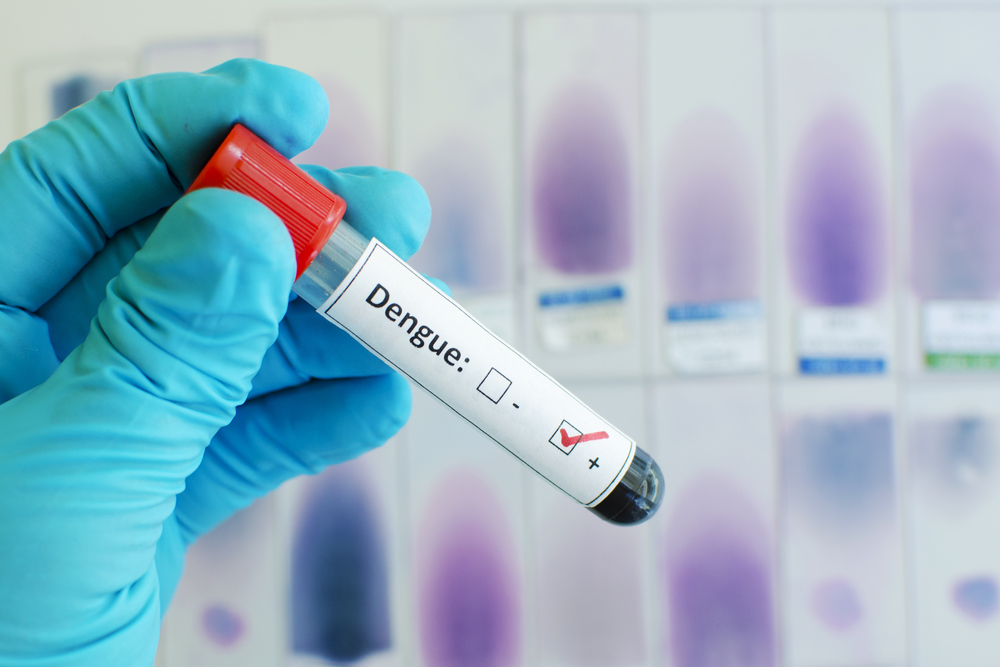
Dengue virus infection is the most notable cause of thrombocytopenia (low platelet count). Platelet count (alone) is not a good predictor of overall severity; the severity of dengue is determined by clinical outcomes & combination of factors including how fast platelets are dropping, signs of bleeding, evidence of fluid leaking from blood vessels (plasma leakage), and the patient’s overall circulatory stability.
The World Health Organization (WHO) identifies three phases of dengue:
- Febrile phase
- Critical phase
- Recovery phase
The onset of platelet count decline generally corresponds to the late febrile phase, with platelet counts reaching their lowest level during the critical phase between days 4-6 of an episode.
Patients/caregivers can use their understanding of platelet count significance to determine when monitoring is adequate and when urgent medical attention is needed [1,2].
Why Do Platelets Fall in Dengue?
Platelet numbers may decline in dengue for multiple reasons:
- The virus affects bone marrow and produces fewer platelets.
- The immune system may mistakenly destroy platelets in an effort to combat the viral infection.
- As a result of virus-induced inflammation, use of platelets increases.
- Severe cases of dengue may cause fluid to leak from blood vessels, which would affect blood circulation and lead to complications associated with low platelet counts.
As a patient progresses through their infection, platelet counts may decrease rapidly, especially during the critical phase of illness, when capillary permeability is increased.
It is important to recognize that the severity of thrombocytopenia is not related to the risk of bleeding[3].
What Is a Normal Platelet Count?

The normal platelet count of healthy adults is generally:
Normal Platelet Count: 150,000 to 400,000/mm3 [4].
Laboratory-defined ranges may vary slightly.
When evaluating the patient with dengue, clinicians assess not only the patient’s actual platelet count but also the rate of decline and the presence of clinical symptoms, plasma leakage and bleeding.
Classification of Dengue Patients Based On Platelet Count

Above 100,000/mm³
Patients who are > 100,000/mm³ do not typically have a significant risk of experiencing spontaneous bleeding.
Treatment typically includes:
- Oral hydration
- Monitoring of symptoms
- Outpatient follow-up
Admission to the hospital is usually not necessary unless warning signs are present.
Between 50,000 and 100,000/mm³
This platelet count indicates moderate thrombocytopenia.
Clinical monitoring becomes critical as platelet counts tend to continue to decrease during the critical phase of illness.
Patients should be assessed for signs of:
- Mucosal bleeding
- Persistent vomiting
- Abdominal pain
- An increase in hematocrit (It is the percentage of red blood cells by volume in total blood ant not just RBC )
- Fluid accumulation
Like above, usually more than one CBC will be done.
Between 20,000 and 50,000/mm³
Patients in this platelet range have a significantly increased risk of bleeding.
Some of the common bleeds include:
- Petechiae (Tiny dots on skin that often appear in clusters, resembling a rash)
- Easy bruising
- Bleeding gums
- Epistaxis (Nose bleeding)
Certain patients may require hospital observation, depending upon their overall clinical condition.
Counts Below 20000/mm³
Thrombocytopenia is considered to be severe when the platelet count is below 20,000/µL.
The risk of spontaneous hemorrhage significantly increases at this level.
Monitoring is warranted for:
- Gastrointestinal Bleeding
- Intracranial hemorrhage, a type of bleeding that occurs inside the skull (cranium) or brain tissue.
- Severe mucosal bleeding such as bleeding from the gums, etc.
Counts Below 10000/mm³
A platelet count below 10000/mm³ is indicative of profound thrombocytopenia, which entails life-threatening bleeding complications.
Management should occur in a hospital setting as soon as possible [2,5].
Why Platelet Count Alone Cannot Predict Severity?
Many people erroneously equate a low platelet value (less than 20000/mm³ ) with a diagnosis of “severe dengue.”
A more accurate definition of “severe dengue” is based upon the presence of:
- Severe plasma leakage
- Shock
- Severe respiratory distress (Breathing issues)
- Severe bleeding
- Organ failure
There are many patients whose platelet counts are below 20,000/mm³ who are clinically stable, while there are also many patients who have higher platelet counts than this yet develop severe complications.
Consequently, WHO guidelines encourage clinicians to depend on their clinical judgement rather than platelet count when diagnosing severe dengue [1].
The Critical Phase: The Most Important Period
The critical phase of the disease begins approximately the time that the fever resolves, usually between Days 4 and 6 of illness.
Many patients believe that they have begun to recover when their fever resolves, but actually, they are at an increased risk of developing complications during this time.
Clinical Changes During Critical Phase
1. Rapidly Decreasing Platelet Count
The initial rapid decline in platelet count occurs over a 24–48-hour period.
2. Rising Hematocrit (RBC’S) Level
An increase in hematocrit may indicate that plasma has leaked out of the vessels.
3. Increased Capillary Leakiness
Blood vessels are leaky, causing plasma to be lost into the surrounding of tissues
4. Fluid Accumulation
Accumulation of fluid can occur in:
- Pleural space (space between the lungs and the chest walls )
- Abdominal cavity (space in the body, housing most of the gastrointestinal tract and vital organs )
- Soft tissue
Fluid accumulation can cause both respiratory distress and decreased circulation.
Warning Signs That Require Immediate Hospitalization

The WHO (World Health Organization) identifies several warning signs that require urgent medical assessment.
- Persistent vomiting: Persistent vomiting can lead to significant dehydration and severe disease.
- Severe abdominal pain: Abdominal pain with some degree of tenderness may indicate that significant plasma is leaking from blood vessels into the abdominal cavity.
- Mucosal Bleeding: Gums, Nose, Vaginal, Gastrointestinal bleeding.
- Fatigue or Restlessness (in cases of impaired circulation or case of shock)
- Rising hematocrit with decreasing platelet count.
- Breathing issues such as rapid breathing [6]
When Should A Platelet Transfusion Be Considered?
The requirement for platelet transfusions in the management of dengue has traditionally been misunderstood. At this time, WHO and national recommendations do not support prophylactic transfusions based solely on low platelet counts.
In general, platelet transfusions will be given when:
- The platelet count is <10,000
- Active bleeding exists
- There is severe hemorrhage.
- Invasive procedures are to be performed.
Why Routine Transfusions Are Discouraged?
Unnecessary platelet transfusions could:
- Cause transfusion reactions
- Be of minimal clinical benefit to the patient.
- Delay appropriate fluid management to the patient.
Thus, clinical status is the primary determinant for treatment decisions rather than platelet count alone.
Recovery Phase: What Happens to the Platelets?
The recovery phase occurs after completion of the critical phase.
Clinical improvements that occur during this phase include:
- Increased appetite
- Increased hydration
- Decreased fatigue
- Stable blood pressure
During this phase, platelet counts will generally begin to rise.
In the uncomplicated form of dengue, the lowest value of the platelet count will occur between days 4 and 6. Recovery will begin after the 7th day. Following this, platelet counts will begin to return to normal at a gradual rate.
The Bottom Line
Platelet count is an important laboratory marker for dengue infection, but should never be evaluated alone. The normal range for platelet count is 150,000 – 400,000/mm³. Platelet counts under 100,000/mm³ should be followed closely, while platelet counts less than 20,000/mm³ should be urgently investigated.
Pay more attention to clinical warning signs such as persistent vomiting, abdominal pain, bleeding, increasing hematocrit, plasma leakage, and instability in the patient’s circulatory system. These clinical warning signs are typically more reflective of the severity of illness than platelet counts alone.
Timely assessment of dengue patients, adequate hydration, serial laboratory assessments, and recognition of clinical warning signs will be key to avoiding severe complications from dengue.
FAQs
Q. What platelet count is considered normal in dengue?
Platelet count between 150000 and 400000/mm³ (1.5 lacs to 4 lacs/uL) will be considered normal.
Q. At what platelet count does bleeding risk increase?
A platelet count below 50000 usually raises the risk of bleeding , particularly if there are any other warning signs .
Q. Is a platelet count from less than 1 Lakh dangerous?
Not necessarily. Patients with lower than 100000 mm³ may still recover without any complications.
Q. When does the platelet count reach its lowest level during dengue?
Most patients will reach their nadir (lowest level) in the days 4 to 6 of the illness during the critical phase.
Q. Should all patients who have low platelet counts be hospitalized?
Not all patients with low platelet counts require hospitalisation. The decision depends on the degree of thrombocytopenia, the presence of WHO warning signs, the patient’s ability to maintain oral hydration, and access to follow-up care. Patients with counts below 20,000/mm³ , active bleeding, or any warning signs should be evaluated in a hospital setting.
Q. What is the indication for platelet transfusion?
Platelet transfusion is generally indicated when counts fall below 10,000/mm³ , or between 10,000–20,000/mm³ with active significant bleeding.
Q. Why is the hematocrit level monitored along with the platelet count?
The hematocrit level is monitored to determine if there is increasing evidence of plasma leakage, which is often seen with severe Dengue fever infections.
Q. Can platelet counts recover without treatment?
In most uncomplicated cases, if the patient recovers from the infection, then they will also have a return of their platelet count as well.
(The article is written by Deepa Sarkar, Senior Medical Writer, and reviewed by Monalisa Deka, Deputy Manager, Clinical Health & Content, Medical Affairs)
References
1. Who.int. [cited 2026 June 18]. Available from: https://cdn.who.int/media/docs/default-source/2021-dha-docs/5_national-clinical-guideline-of-dengue-timor-leste_clean_final-12-dec-2022.pdf?sfvrsn=e80bf9cd_1
2. Gov.in. [cited 2026 June 17]. Available from: https://ncvbdc.mohfw.gov.in/Doc/National%20Guidelines%20for%20Clinical%20Management%20of%20Dengue%20Fever%202023.pdf
3. Schaefer TJ, Panda PK, Wolford RW. Dengue fever. StatPearls Publishing, Treasure Island; 2025.
4. Platelet count [Internet]. Cleveland Clinic. 2021 [cited 2026 June 18]. Available from: https://my.clevelandclinic.org/health/diagnostics/21782-platelet-count
5. Vikhe VB, Khandol D, Faruqi AA, Reddy A. A study on the clinical profile of patients presenting with dengue fever and the precision prediction of dengue severity using platelet count at presentation. Cureus [Internet]. 2024;16(6):e63255. Available from: http://dx.doi.org/10.7759/cureus.63255
6. Presumptive Diagnosis. Dengue Case Management [Internet]. Cdc.gov. [cited 2026 June 18]. Available from: https://www.cdc.gov/dengue/media/pdfs/2024/05/20240521_342849-B_PRESS_READY_PocketGuideDCMC_UPDATE.pdf