
So your doctor put you on a statin, and somewhere along the way, someone mentioned CoQ10. Maybe it was your cardiologist. Maybe it was a friend who read about it online. Either way, understanding CoQ10 benefits and dosage is worth ten minutes of your time before you decide anything.
Here’s the short version: CoQ10 lives inside nearly every cell in your body and helps your heart, muscles, and brain make energy. However, statins can lower how much of it your body makes on its own, and that’s the connection worth understanding. This guide covers CoQ10 benefits and dosage, how it actually works, and why it comes up so often in statin conversations. No jargon, just the plain facts.
What Is CoQ10, and How Does It Work?
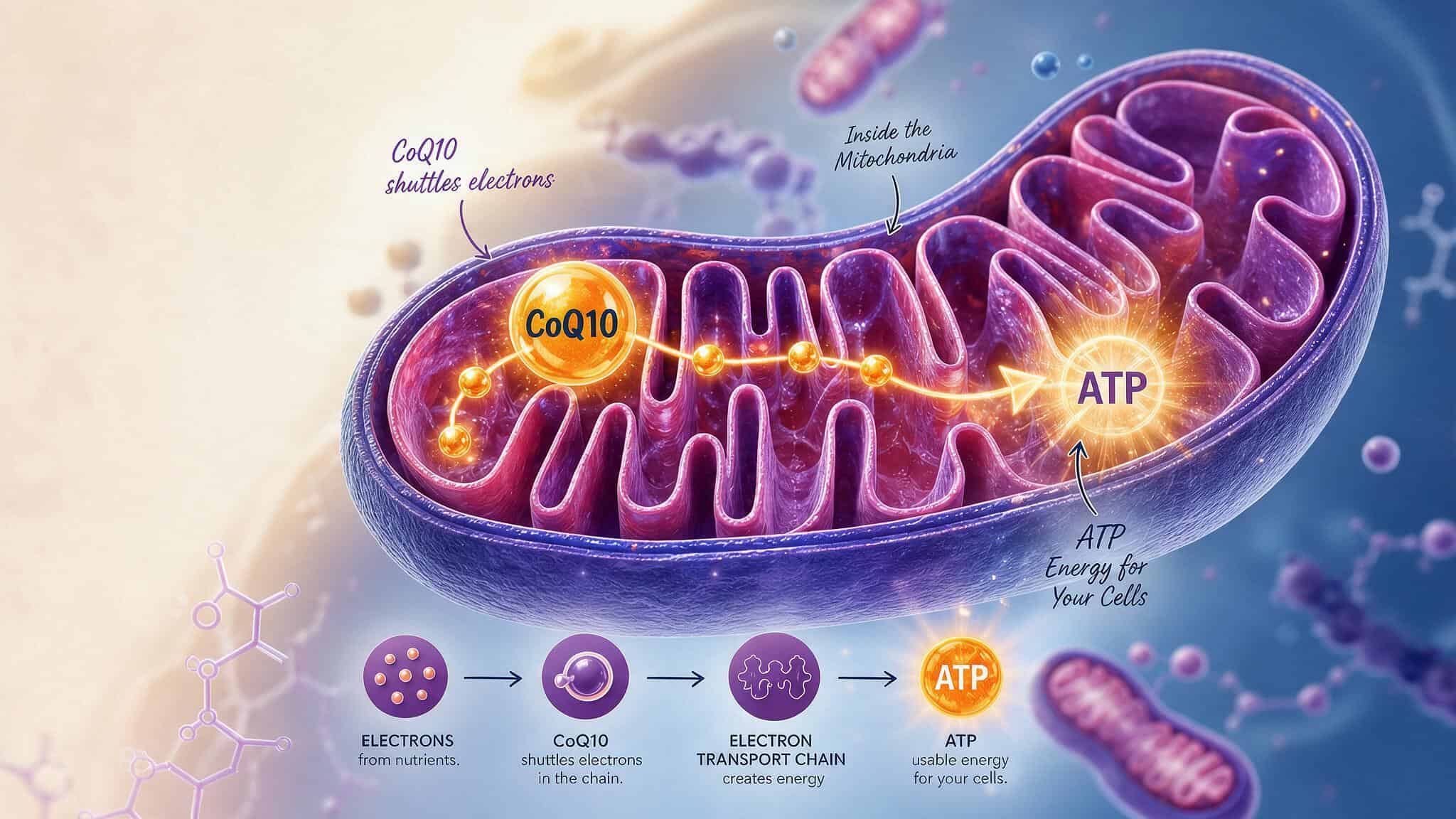
CoQ10, short for coenzyme Q10, is a vitamin-like molecule your body makes on its own. It comes in two forms:
- Ubiquinone (the active, oxidized form)
- Ubiquinol (the reduced form).
Interestingly, ubiquinol makes up about 95% of the CoQ10 floating around in your blood [1].
So what does it actually do? Here’s the breakdown [1,2]:
- Powers your cells: CoQ10 works inside your mitochondria, the tiny “power plants” in every cell,helping to shuttle electrons around while making ATP, basically fuel for your cells.
- Concentrates where it’s needed most:The heart, liver, and kidneys work hard nonstop, so they naturally have the largest amounts of CoQ10 in your body.
- Acts as an antioxidant: It helps to neutralize free radicals and calms inflammation.
- Protects blood vessels: It helps preserve nitric oxide, which keeps blood flowing smoothly.
That said, your natural CoQ10 production slows down with age. Certain conditions like heart failure, diabetes, and fibromyalgia (widespread body pain, fatigue, and tenderness) also lower circulating levels [1].
CoQ10 Benefits and Dosage: What the Research Actually Shows
Research on CoQ10 benefits spans several areas of health, though the strength of evidence varies. Here’s a brief snapshot before we go deeper [1]:
- Supports heart health and may alleviate heart failure symptoms
- May ease statin-induced muscle aches
- Shows promise for migraine prevention
- May relieve fatigue and improve exercise performance
- Could support fertility outcomes in assisted reproduction
- May help protect the skin from oxidative damage
Now, here’s what the research actually shows for each one.
Heart Health and Heart Failure

- This is where CoQ10 has the strongest backing. According to 2022 heart failure guidelines from major U.S. cardiology bodies, CoQ10 supplementation alongside standard treatment was linked to reduced vascular mortality, lower all-cause mortality, and fewer hospital stays over two years [1].
- Meanwhile, CoQ10 may also improve endothelial function, basically, how well your blood vessels dilate and function in people with ischemic heart failure and in those with type 2 diabetes and high cholesterol [1].
That said, not every study agrees on how much this helps day-to-day, so results can vary from person to person.
Statin-Related Muscle Symptoms

- For people who get muscle aches on statins, CoQ10 has shown real promise. A meta-analysis of randomized controlled trials found that supplementing with 100 to 600 mg per day reduced statin-associated muscle symptoms [1][3].
- In contrast, not every study agrees on how much this actually helps day-to-day function, so results can vary from person to person.
Migraine Prevention

- CoQ10 also shows up in migraine research. One study found that 300 mg daily was safe and worked better than a placebo for migraine prevention, while another study in women found that 400 mg daily made migraines less frequent, less severe, and shorter [1].
- Even a lower 100 mg dose reduced headache frequency and severity in some sufferers [1].
Energy, Fatigue, and Exercise Performance

- Feeling tired and low on energy? CoQ10 may help with fatigue in some people, although research is still limited. Studies in fibromyalgia patients found that CoQ10 reduced pain, fatigue, and morning tiredness compared to a placebo [1].
- Plus, one study in healthy adults found that CoQ10 improved fatigue and physical performance during cycling exercise [1].
Fertility and Reproductive Health
- For women undergoing fertility treatments such as assisted reproductive technologies (ART), a large review of multiple studies found that CoQ10 supplementation may improve pregnancy success rates [1].
- However, more research is still needed before doctors can make strong recommendations here.
Skin and Antioxidant Support
- Your skin’s CoQ10 levels naturally decline with age and sun exposure.
- Topical formulas containing CoQ10 have been shown to improve skin CoQ10 levels and provide antioxidant protection [1], though oral supplementation’s effect on skin specifically is less studied.
CoQ10 Dosage: How Much Should You Take?

There’s no single “correct” dose of CoQ10. It really depends on why you’re taking it. Here’s what the research generally uses:
- General use: Most studies use 100–300 mg per day [1]
- Statin-related muscle symptoms: Trials have used anywhere from 100 to 600 mg daily [1][3], though some smaller studies saw improvement with just 50 mg twice a day [1]
- Safety ceiling: Toxicity hasn’t been observed even up to 1,200 mg per day [1]
- Possible mild side effects: Doses above 100 mg have occasionally been linked to mild insomnia, and 300 mg or more can slightly raise liver enzymes, though without actual liver damage [1]
Because CoQ10 supplements aren’t strictly regulated the way medications are, it’s worth choosing a reputable brand and talking to your doctor about the right dose for your specific situation, especially if you’re on other medications.
How Are Statins Related to CoQ10 Levels?
Here’s the connection that gets people curious. Statins work by blocking an enzyme in what’s called the mevalonate pathway – this is the same biochemical pathway your liver uses to make both cholesterol and CoQ10 [1][3][4]. So when a statin lowers your cholesterol production, it can also lower your natural CoQ10 production right along with it.
That’s a big reason why researchers have looked at the CoQ10 and statin relationship so closely. Some of the most commonly reported statin side effects include [1,3,6]:
- Muscle pain or cramping
- Muscle weakness
- General fatigue
In contrast, not everyone on statins experiences these symptoms, and statins remain one of the most effective, well-studied tools for protecting heart health [6].
That said, if you’re dealing with statin-related muscle discomfort, it’s worth mentioning it to your doctor rather than stopping your medication on your own. Some patients find that a modest CoQ10 supplement, alongside their regular statin, helps ease mild-to-moderate muscle symptoms [1,3].
Before You Add CoQ10 to Your Routine: Talk to Your Doctor First
CoQ10 is low-risk, but it can still interact with medications you’re already taking. A 2-minute chat with your doctor now can save you a headache later.
CoQ10 may reduce warfarin’s effectiveness, add to the blood-sugar-lowering effect of diabetes medication, and stack with blood pressure medication, and it isn’t well-studied alongside chemotherapy [1][5]. If you’re on a statin, it’s worth mentioning to your doctor before you start, just so they know and can keep an eye on how you respond.
Quick Recap: CoQ10 Benefits and Dosage
To sum up CoQ10 benefits and dosage: it may support heart health, ease statin-related muscle aches, and help with migraines and fatigue, typically at 100 to 300 mg daily for general use or up to 600 mg daily for statin-related symptoms [1][3]. As always, check with your doctor before starting, especially if you’re already on medication.
FAQs
Does CoQ10 interact with blood thinners like warfarin?
Yes. CoQ10 is chemically similar to vitamin K, and there are documented cases of it interfering with warfarin’s effectiveness [1]. If you’re on blood thinners, talk to your doctor before adding CoQ10.
Should I take ubiquinol or ubiquinone?
Ubiquinol is the active, reduced form and makes up most of the CoQ10 naturally circulating in your blood [1]. Some people find ubiquinol easier to absorb, though both forms are used in research and available as supplements.
What time of day should I take CoQ10?
CoQ10 is fat-soluble, meaning it absorbs better when taken with a meal that contains some fat [1]. Many people take it with breakfast or dinner for consistency, though there’s no strict rule about morning versus evening.
Can CoQ10 lower blood sugar too much?
CoQ10 can lower fasting blood glucose in some people, so it should be used cautiously if you have diabetes or are prone to low blood sugar episodes [1]. Your doctor can help you monitor this if needed.
Is it safe to take CoQ10 during pregnancy?
Safety data is limited, thus manufacturers normally advise avoiding use during pregnancy and lactation, but some studies on fertility treatments have looked at its usage under medical supervision [1]. This is not a supplement to take on your own while pregnant.
Do cardiologists recommend CoQ10 with statins?
It’s not a routine prescription and not officially recommended for statin-related muscle pain. That said, many doctors are open to patients trying it since it’s low-risk and some people do feel better on it.
How long does it take for CoQ10 to work?
This will depend on why you are taking it. For statin-induced muscular complaints, some studies indicate recovery within weeks, but migraine preventive trials usually last many months before complete effects are shown [1].
Can I get enough CoQ10 from food alone?
CoQ10 occurs in meat, dairy, eggs, and plant sources such as oils and legumes; however, the largest natural levels are found in meat [1]. But often the diet delivers much less CoQ10 than the amounts used in clinical trials; thus, supplements are frequently needed to achieve therapeutic levels.
Does CoQ10 help with statin-induced fatigue, not just muscle pain?
Fatigue is one of the symptoms some people report alongside muscle aches when starting statins, and it’s part of what researchers are exploring in the CoQ10-statin connection [6]. That said, evidence for fatigue specifically is less robust than for muscle symptoms.
References:
1. Sood B, Patel P, Keenaghan M. Coenzyme Q10. StatPearls [Internet]. StatPearls Publishing; 2024. Available from: https://www.ncbi.nlm.nih.gov/books/NBK531491/
2. Testai L, Martelli A, Flori L, Cicero AFG, Colletti A. Coenzyme Q10: Clinical Applications beyond Cardiovascular Diseases. PMC. Available from: https://pmc.ncbi.nlm.nih.gov/articles/PMC8156424/
3. Qu H, et al. Effects of Coenzyme Q10 on Statin-Induced Myopathy: An Updated Meta-Analysis of Randomized Controlled Trials. Available from: https://pmc.ncbi.nlm.nih.gov/articles/PMC11441719/
4. British Heart Foundation. Ask the Expert: CoQ10. Available from: https://www.bhf.org.uk/informationsupport/heart-matters-magazine/nutrition/ask-the-expert/coq10
5. British Journal of Cardiology. Coenzyme Q10 and Cardiovascular Disease: An Overview. Available from: https://bjcardio.co.uk/2015/10/coenzy
6. Doral Health & Wellness. CoQ10 & Heart Health: Benefits During Statin Use. Available from: https://doralhw.org/coq10-heart-health-benefits-during-statin-use/
Disclaimer: This article is for general educational purposes only and isn’t a substitute for professional medical advice. Talk to your doctor before starting any new supplement, especially if you’re on other medications.
(The article is written by Nancy Dixit, Associate Manager, Clinical Health & Content, Medical Affairs, and reviewed by Monalisa Deka, Deputy Manager, Clinical Health & Content, Medical Affairs.)
Recommended Reads:
The Complete Guide To Daily Health Supplements For Men Over 40